Sword & Sorcery has never needed heroes who are particularly good.
It needs heroes who are dangerous: Mercenaries, thieves, kings, exiles, wanderers and killers have stalked through the genre since its beginnings in the pulp magazines of the early twentieth century. Some fight for gold. Some fight for kingdoms. Some seem to fight simply because the alternative would require them to sit still for too long.
What separates the great Sword & Sorcery heroes from the conventional fantasy protagonist is rarely destiny. There is usually no sacred bloodline waiting to be revealed, no fellowship assembled to save the world, and precious little interest in being chosen by anybody.
That primacy of character over setting is one of the reasons Sword & Sorcery heroes matter more than worlds in the first place. The great Sword & Sorcery hero walks into trouble under his own power.
And occasionally hacks his way back out.
The term Sword & Sorcery itself did not become established until 1961, when Fritz Leiber proposed it while discussing what to call the kind of fantasy adventure pioneered by Robert E. Howard. By then, however, the tradition was already more than thirty years old, and Howard’s successors were busy transforming it in radically different directions.
So this isn’t simply a list of ten muscular men with swords.
These are ten Sword & Sorcery heroes who helped define what the genre itself could become.
And yes.
You already know who’s number one 😉
Runners-Up: The Warriors Who Just Missed the Cut
There are, of course, countless great warriors who might seem at home on a list of Sword & Sorcery heroes yet belong more naturally to neighbouring traditions — or to the older adventure fiction from which the genre grew.
John Carter carries his sword beneath the moons of Mars in Sword & Planet; Tarzan belongs to the great tradition of pulp adventure; mythic warriors such as Heracles stand behind the Sword & Sandal tradition; and Imaro became the defining hero of the Sword & Soul tradition.
Their worlds share many of the same ancestral fires — dangerous frontiers, personal heroism, monstrous adversaries and steel in hand — but for this countdown, we’re keeping the gates narrowly guarded by Sword & Sorcery itself.
A few warriors stand just outside the gates.
Dark Agnes de Chastillon, Robert E. Howard’s ferocious sixteenth-century swordswoman, has almost everything required of a Sword & Sorcery heroine — but her adventures are essentially historical rather than supernatural fantasy.
Howard’s Red Sonya of Rogatino presents the same problem. She first appeared in The Shadow of the Vulture in 1934 as a warrior of the historical Siege of Vienna. The familiar Hyborian Red Sonja came decades later, when Roy Thomas and Barry Smith reimagined Howard’s character for the Conan comics.
Eric Brighteyes, created by H. Rider Haggard in 1891, arrived far too early to be called Sword & Sorcery at all, though his doomed Icelandic heroism makes him a fascinating ancestor of the genre.
And Howard’s Esau Cairn, hero of Almuric, certainly possesses the temperament of an S&S protagonist, but his journey to another planet places the story more comfortably within planetary romance.
Then there is Death Dealer — an irresistible image and later fantasy hero born from Frank Frazetta’s famous 1973 painting, but ultimately a character of visual art, comics and later fiction rather than one of the foundational literary creations considered here.
All worthy warriors.
But ten seats are waiting at the table.
The Top 10 Sword & Sorcery Heroes
-
Kothar
Created by Gardner F. Fox — 1969
By the late 1960s, Sword & Sorcery had escaped the graveyard of the old pulps and invaded the paperback rack.
Few characters represent that era better than Kothar.
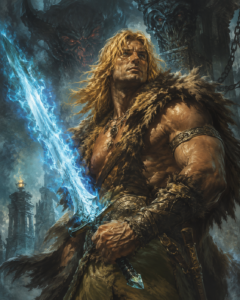 Gardner F. Fox’s gigantic wandering barbarian made his book debut in Kothar: Barbarian Swordsman in 1969, quickly followed by Kothar of the Magic Sword, Kothar and the Demon Queen, Kothar and the Conjurer’s Curse and Kothar and the Wizard Slayer. Five books appeared across 1969 and 1970 — an astonishingly concentrated burst of barbaric activity.
Kothar is not exactly subtle. He is enormous, fearless, hot-blooded and equipped with Frostfire, an enchanted sword possessing supernatural powers of its own. His adventures throw witches, sorcerers, monsters, forgotten kingdoms and supernatural artefacts directly into his path with the breathless efficiency expected of a paperback whose cover probably already contains somebody being attacked by a demon.
And that is precisely why Kothar belongs here.
He represents the moment when the Howardian barbarian became an entire publishing species.
Fox was not attempting to dismantle the archetype. He was revelling in it. Kothar is the wandering barbarian stripped down to the essentials: sword, muscles, sorcery, women, treasure and danger. The original book gathered adventures including The Sword of the Sorcerer, The Treasure in the Labyrinth and The Woman in the Witch-Wood.
There are greater literary characters further down this list. But there may be no better ambassador for the glorious paperback excess of second-generation Sword & Sorcery.
Sometimes you don’t need existential anguish.
Sometimes you need Frostfire.
-
Thongor of Lemuria
Created by Lin Carter — 1965
If Kothar embodies the Sword & Sorcery paperback boom, Thongor helped start it.
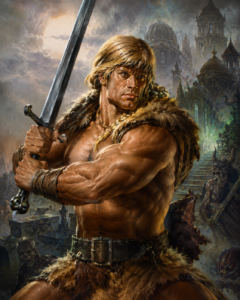 Lin Carter introduced the Valkarthan barbarian in The Wizard of Lemuria in 1965, his first published novel. Carter later expanded and retitled the book Thongor and the Wizard of Lemuria, and continued the saga through a sequence including Thongor of Lemuria, Thongor Against the Gods, Thongor in the City of Magicians and Thongor at the End of Time.
The debt to Conan is not exactly hidden. Thongor is a mighty northern barbarian wandering an ancient lost age filled with corrupt civilizations, sinister magic, monsters and tyrants. But Carter pushes the formula toward something stranger. His Lemuria mixes prehistoric fantasy with lost technology, flying machines, ancient races and quasi-scientific wonders.
The result feels like Conan colliding with Edgar Rice Burroughs while somebody pours another measure of pulp into the glass. Thongor himself possesses the familiar virtues: physical courage, impatience with civilization, loyalty to his companions and a healthy preference for immediate action over prolonged debate. He begins as a mercenary and adventurer, but — as so often happens to successful barbarians — eventually accumulates responsibilities considerably greater than the next purse of gold.
Carter was also an enormously important champion of Sword & Sorcery as a tradition. Through his criticism, editing and fiction, he helped preserve the connection between pulp writers and the paperback generation that followed them.
Thongor may never have escaped Conan’s enormous shadow. But perhaps that misses the point. He demonstrates just how powerful that shadow had become.
By the mid-1960s, you didn’t merely read about the barbarian.
You could build whole new prehistoric continents for him to conquer.
-
Jirel of Joiry
Created by C. L. Moore — 1934
Then things become considerably darker.
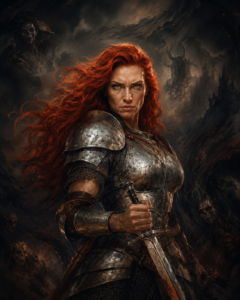 C. L. Moore introduced Jirel of Joiry in Black God’s Kiss, published in the October 1934 issue of Weird Tales. She was one of the earliest female protagonists in Sword & Sorcery and remains one of its strangest.
Jirel rules the medieval domain of Joiry. She is proud, furious, violent, red-haired and possessed of a temperament that would make most wandering barbarians reconsider starting an argument.
Yet Moore’s stories aren’t principally interested in proving that Jirel can swing a sword as well as a man.
They are interested in what happens inside her.
In Black God’s Kiss, humiliation and rage drive Jirel into an otherworldly realm in search of a supernatural weapon with which to avenge herself upon Guillaume, the conqueror who has taken Joiry. What follows is not a triumphant empowerment fantasy. It is something far stranger: vengeance, desire, horror and regret tangled together until Jirel herself can barely separate them.
Later stories — including Black God’s Shadow, Jirel Meets Magic, The Dark Land and Hellsgarde — repeatedly push her beyond the ordinary medieval world and into supernatural spaces operating according to their own disturbing logic.
That makes Jirel fundamentally different from many heroes on this list. Conan generally encounters the supernatural as something external: a monster to evade, understand or kill.
For Jirel, the supernatural often becomes psychological. It tempts her, reflects her, punishes her and forces her to confront parts of herself she’d rather solve with a sword. She is one of Sword & Sorcery’s earliest reminders that darkness doesn’t always live in the dungeon.
Sometimes the hero carries it inside.
-
Fafhrd and the Gray Mouser
Created by Fritz Leiber and Harry Otto Fischer — first published 1939
Yes, we’re counting them together. Separating Fafhrd and the Gray Mouser would feel vaguely criminal.
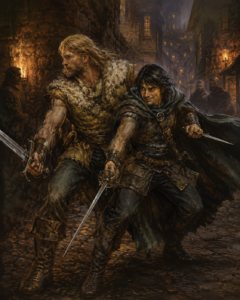 Fritz Leiber introduced the pair to readers in Two Sought Adventure, published in Unknown in August 1939, although their origins lay in correspondence between Leiber and his friend Harry Otto Fischer during the 1930s. Fafhrd was associated with Leiber himself; the Mouser with Fischer.
Together they changed Sword & Sorcery.
Fafhrd is the great northern barbarian: enormous, romantic and more sensitive than appearances suggest.
The Gray Mouser is small, quick, cynical, clever and perpetually convinced that he is approximately three steps ahead of everyone else. Usually he isn’t.
Their great territory is Lankhmar, perhaps the quintessential Sword & Sorcery city: smoky, corrupt, crowded with thieves, priests, merchants, assassins, magicians and countless opportunities to make catastrophic financial decisions.
Where Howard’s heroes often carry a tragic grandeur, Leiber discovered something equally important:
Sword & Sorcery could be funny.
Not parody. Not mockery.
Human comedy.
Fafhrd and the Mouser boast, drink, steal, quarrel, fall in love, lose money, acquire money and subsequently lose that as well. Their adventures can become genuinely horrific, but friendship anchors everything. The sequence stretched across roughly half a century, eventually collected into the famous Swords books. Among its finest stories is Ill Met in Lankhmar, the Hugo- and Nebula-winning account of how the pair first met.
Leiber also became the man who gave the genre its enduring name. But Fafhrd and the Gray Mouser may be the greater legacy. Conan proved the barbarian could carry S&S. Leiber proved two lovable idiots could carry it together.
-
Brak the Barbarian
Created by John Jakes — 1963
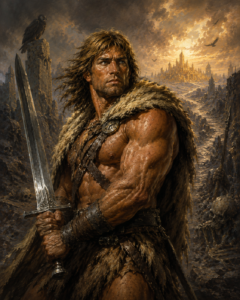 Before John Jakes became famous for enormous historical sagas such as North and South, he created one of the great second-wave Sword & Sorcery barbarians. Brak first appeared in the early 1960s, with Devils in the Walls dating from 1963.
More stories followed in magazines such as Fantastic, before they were gathered and expanded into paperbacks including Brak the Barbarian, Brak the Barbarian versus the Sorceress, Brak versus the Mark of the Demons and later collections.
Brak is instantly recognizable as a descendant of Conan: physically formidable, wandering through decadent kingdoms where sorcery usually indicates that something unpleasant is about to crawl from a crypt. But Jakes gives him an unusually clear objective: Brak wants to reach Khurdisan the Golden. That distant destination gives his adventures a wandering, almost odyssean quality. He isn’t simply drifting from one payday to another. Somewhere beyond the next haunted city, murderous priesthood or inconvenient demon lies the civilization he has decided to reach.
Naturally, Sword & Sorcery has other plans for him. Brak’s world is colourful, grotesque and frequently cruel. His enemies include witches, cultists, supernatural monsters and the sorts of people who build temples where one strongly suspects nobody has ever left through the front door.
The original Brak the Barbarian paperback appeared in 1968 with a Frank Frazetta cover, placing Brak squarely within that magnificent period when painted barbarians stared from the racks in pharmacies and bus stations across America.
Brak isn’t as psychologically complicated as the heroes approaching later in this countdown. But he doesn’t need to be. He is pure travelling Sword & Sorcery: a long road, a heavy sword and another cursed city appearing over the horizon.
-
Bran Mak Morn
Created by Robert E. Howard — 1920s; first published as king in 1930
Bran Mak Morn stands at the strange border between historical fantasy, weird fiction and Sword & Sorcery.
Which is exactly where he belongs.
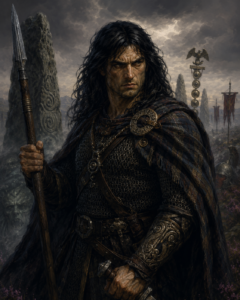 Bran is the last great king of Howard’s Picts, fighting a doomed resistance against the expanding Roman Empire. His first published appearance as king came in Kings of the Night in the November 1930 issue of Weird Tales, where Howard even brings Kull across the gulf of ages to fight beside him.
But Bran’s masterpiece is unquestionably Worms of the Earth, published in 1932. Here the heroic fantasy formula curdles into something far darker.
Bran cannot defeat Rome through conventional strength. So he seeks assistance from ancient subterranean beings — the degraded remnants of something older than humanity — despite understanding that making bargains with such creatures crosses a boundary even his own people fear.
This is what makes Bran so compelling. He is not the carefree adventurer riding toward another horizon.
He carries a civilization on his shoulders. Every victory is temporary. Every enemy soldier killed is replaced by another legionary. Rome is not a sorcerer Bran can behead. It is history itself advancing toward him. That desperation gives his stories an atmosphere unlike almost anything else in Howard.
Bran is ruthless because he believes ruthlessness is all that remains to him. Yet Worms of the Earth ultimately forces him to confront whether survival at any cost is actually victory. He is king, warrior, nationalist, schemer and doomed defender all at once.
Bran represents Sword & Sorcery looking backward — toward vanished peoples, ancestral memory and the terrible knowledge that courage does not guarantee survival. Some heroes fight because they expect to win. Bran Mak Morn fights because someone must still be standing when the darkness arrives.
-
Kull of Atlantis
Created by Robert E. Howard — 1929
Before Conan, there was Kull.
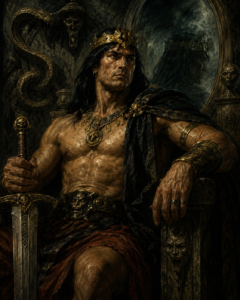 And before Sword & Sorcery even had a name, Robert E. Howard was already discovering what it could become. Kull first appeared in The Shadow Kingdom, published in Weird Tales in August 1929. The story is frequently identified as one of the foundational works — arguably the first fully recognizable example — of Sword & Sorcery.
Like Conan, Kull is a barbarian outsider who rises to kingship.
But the resemblance becomes less useful the closer you look.
Conan generally possesses an extraordinary certainty about himself. He may rage, brood or laugh, but he rarely wonders whether Conan exists. Kull absolutely does.
In The Mirrors of Tuzun Thune, published just one month after The Shadow Kingdom, the king of Valusia falls into a profound spiritual exhaustion. Power means nothing. Court life appears unreal. Gazing into the sorcerer Tuzun Thune’s mirrors, Kull begins questioning identity, reality and whether the reflection looking back at him might somehow be more authentic than the man standing before it.
This is Sword & Sorcery staring into an existential abyss before the genre has even been christened.
Kull is ferocious in battle, but violence is not his defining quality. He is introspective, melancholy and deeply suspicious of civilization’s rules. Where Conan adapts to kingdoms without ever completely belonging to them, Kull seems perpetually astonished that anyone takes their customs seriously. And his influence is impossible to overstate.
Howard’s unpublished Kull story By This Axe I Rule! was eventually transformed into The Phoenix on the Sword, the first published Conan story. In a very literal sense, Conan emerged from Kull’s discarded throne.
Kull may never have achieved his successor’s immortality. But without the Atlantean brooding on the throne of Valusia, the Cimmerian might never have walked into history.
-
Elric of Melniboné
Created by Michael Moorcock — 1961
And then Michael Moorcock created almost the exact opposite of Conan.
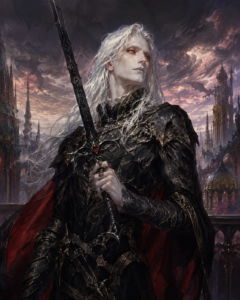 Elric of Melniboné first appeared in The Dreaming City, published in Science Fantasy in June 1961. He was albino, physically frail, intellectually sophisticated, aristocratic, introspective and dependent upon drugs and magic to sustain his strength.
Where the classic barbarian hero distrusts sorcery, Elric practices it. Where Conan comes from a vigorous young people outside civilization, Elric sits upon the throne of an ancient civilization so old, decadent and cruel that it seems to be dying beneath him.
And where Conan’s sword is a tool—
Elric’s sword is a problem.
Stormbringer, the black runeblade that becomes inseparable from Elric’s legend, grants its wielder supernatural strength by consuming souls. It is weapon, addiction, partner and curse simultaneously.
This transformed the Sword & Sorcery hero.
Elric is not simply confronted by evil forces. He is entangled with them. His adventures constantly ask whether he controls the powers he employs or merely provides them with somewhere convenient to stand.
Moorcock later positioned Elric within the larger mythology of the Eternal Champion, but the essential character remains profoundly intimate: a man trying to escape the civilization, destiny and supernatural forces that have defined him. There are great victories in the Elric saga. They rarely feel clean.
His influence spreads far beyond literature into role-playing games, music, comics and the wider visual vocabulary of dark fantasy. Yet beneath all that cultural weight remains a startlingly elegant inversion.
Howard had given fantasy its dark-haired barbarian giant. Moorcock answered with a sickly white-haired sorcerer carrying a sword that might be more dangerous to its owner than to his enemies.
Sword & Sorcery was never quite the same again.
-
Kane
Created by Karl Edward Wagner — 1970
If Elric turned the Sword & Sorcery hero inside out, Kane asked an even more troubling question.
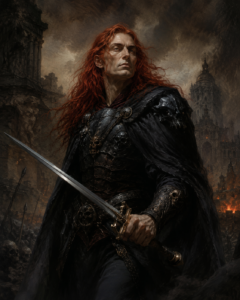 What if the hero was actually the monster?
Karl Edward Wagner introduced Kane in Darkness Weaves with Many Shades, published in 1970 and later restored and republished in fuller form as Darkness Weaves. It was Wagner’s first book.
Kane resembles the biblical Cain deliberately. In Wagner’s mythology, he is an ancient murderer cursed with immortality, condemned to wander through age after age unless violence finally destroys him.
Unfortunately for almost everyone who meets him, Kane is extremely difficult to destroy. He is immensely strong, a master swordsman, military commander, strategist, sorcerer and scholar.
Unlike the uncivilized barbarian wandering through decadent kingdoms, Kane understands civilization perfectly well. He has had thousands of years to study it. And occasionally conquer it.
Across novels such as Bloodstone and Dark Crusade, and collections including Death Angel’s Shadow and Night Winds, Wagner refuses to make Kane reliably heroic. Sometimes Kane is protagonist, sometimes villain, sometimes ally. Sometimes the most dangerous person in the story by an almost embarrassing margin. That moral instability is the source of his power as a character.
Conan may steal, kill and pursue his own interests, but Howard leaves us with a strong underlying sense of Conan’s natural code. Kane has had millennia to compromise his. He can be loyal. He can show compassion. He can also pursue power with terrifying coldness. Wagner surrounds him with horror rather than merely fantasy, giving the stories a bleak and frequently macabre atmosphere.
Kane is Sword & Sorcery after innocence has completely disappeared. He is intelligent enough to recognize every terrible thing he has become.
And immortal enough to keep becoming it.
-
Conan the Cimmerian
Created by Robert E. Howard — 1932
Who else?
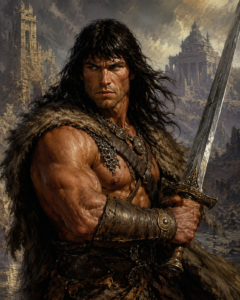 Conan first strode into print in Robert E. Howard’s The Phoenix on the Sword, published in the December 1932 issue of Weird Tales.
There were barbarian heroes before him.
There have been hundreds since.
None became Conan.
Part of the reason is that the popular caricature has never quite captured Howard’s character. Conan is immensely strong, yes. He is savage when violence is required. He can split skulls, climb impossible walls and survive circumstances that would kill almost anyone else.
Across the original stories he becomes thief, pirate, mercenary, outlaw, scout, commander and eventually king.
He does not remain frozen as a barbarian wandering eternally through the wilderness. He lives.
That movement may be the secret of him.
Conan possesses one of the strongest instincts for life in fantasy literature. Civilization intrigues him but never entirely owns him. Religion interests him without consuming him. Wealth attracts him without defining him. Kingdoms rise and fall around him, but Conan remains fundamentally Conan.
Howard surrounded that character with the Hyborian Age, a vanished pseudo-history where ancient civilizations sit upon older ruins and sorcery waits beneath the surface of apparently historical kingdoms.
Yet Conan himself remains beautifully immediate. There is usually a problem in front of him. He deals with it.
The original Howard sequence includes The Tower of the Elephant, Black Colossus, The Slithering Shadow, Rogues in the House, Iron Shadows in the Moon, Queen of the Black Coast, The People of the Black Circle, Beyond the Black River, Red Nails and many others now regarded as foundational texts of Sword & Sorcery.
His influence became so enormous that decades of imitation eventually obscured how unusual the original character actually was. But Conan is not merely a musclebound barbarian. Howard famously described him as possessing both enormous melancholy and enormous mirth, and that contradiction gets closer to Conan than any amount of bodybuilding imagery ever has.
He is curious, adaptable, melancholy, lusty, suspicious, witty, violent, restless and intelligent. In fact, Howard’s Conan speaks multiple languages, understands military strategy, reads people quickly, adapts to foreign cultures and learns from experience.
Kull questions existence.
Jirel descends into psychological darkness.
Fafhrd and the Mouser turn danger into friendship.
Bran fights against the march of history.
Elric is consumed by destiny.
Kane carries eternity like a curse.
Conan simply keeps moving. Across deserts, oceans, jungles, kingdoms and years, the Cimmerian survives not because prophecy requires it but because his vitality seems almost impossible to extinguish.
Every generation of Sword & Sorcery heroes that followed has had to contend with Conan’s enormous shadow. Some rebelled against it. Some inverted it. Some copied it shamelessly. The greatest created something new from it.
But after almost a century, when someone says Sword & Sorcery, there is still one figure who appears before all the others:
Black-haired.
Sullen-eyed.
Sword in hand.
Conan the Cimmerian.