Conan rarely has the luxury of knowing what waits beyond the next door.
He hears of a jewel and decides to steal it. He enters a ruin because shelter is preferable to exposure. He trusts a stranger, challenges an enemy, or takes the only escape that appears to offer a chance of survival.
We follow because Robert E. Howard makes those decisions feel immediate. The danger is close. The reasons for acting are clear. Whatever Conan does next will have consequences. That quality lies at the heart of my FirePath interactive sword and sorcery adaptations.
Over the past two articles, we have explored sword & sorcery through video games and tabletop RPGs. Both invite us to participate in the worlds we once encountered through reading. FirePath brings that invitation back to the page: a written adventure whose course opens at decisive moments, allowing the reader to choose the path ahead.
For Conan, those moments often feel remarkably close to the surface of Howard’s original stories.
Howard’s Relentless Forward Movement
Howard’s action has a particular force. Even when he pauses to describe a city, a landscape or something ancient and terrible, the story retains the pressure of what might happen next.
His characters have reasons to keep moving. Someone is pursuing them. Something valuable lies within reach. A companion is in danger. An enemy has left an opening that will not remain open for long. This does not mean every page contains a fight. Suspense, discovery and the anticipation of violence all contribute to the momentum. The silence inside a deserted building can carry as much pressure as a drawn sword.
For an interactive adaptation, that movement provides a useful discipline. A choice should arrive because the situation demands a decision. It should carry the adventure forward, rather than feel like a pause inserted to remind the reader that the book is interactive.
Conan might force an entrance, seek another approach, or abandon a tempting opportunity. Each possibility must arise from the danger he can perceive and the information available to him. The question is whether each course feels plausible for this character, in this place, under this pressure.
The Roads Howard Did Not Take
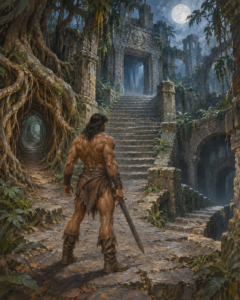 Every finished story contains decisions whose alternatives remain unwritten. The author chooses a route. The character survives—or does not—through a particular sequence of events. Other possibilities close behind him. Interactive adaptations can return to those thresholds.
In The Tower of the Elephant, the promise of an impossible theft draws Conan towards a place whose true nature he does not understand. In Iron Shadows in the Moon, escape across the Vilayet leads Conan and Olivia into another kind of confinement: an island whose apparent emptiness offers little assurance of safety.
Such situations invite questions without requiring the original story to be dismantled. Could another route offer shelter? Would a more direct confrontation succeed? What might a seemingly sensible escape expose?
The challenge is to make the alternatives belong to the tale. A new passage must respect the surrounding landscape, the characters’ knowledge and the dangers already established. Conan should remain recognisably Conan even when the reader sends him somewhere Howard did not.
The exercise begins with attention to what Howard wrote. The unwritten possibility has to grow from that foundation.
How Conan FirePath Adventures Work
The Hyborian Chronicles uses three major decision points across each adventure. At each, the reader can follow the course of Howard’s original story or select one of two newly written alternatives. Across the book, that creates six alternate paths around the original narrative.
Those alternatives have different consequences. Some lead through further danger, discovery or delay before returning to Howard’s tale. Others end fatally. The surviving routes reconverge with the original narrative, preserving Howard’s ending rather than replacing it with a menu of invented conclusions.
The prose remains in third person. Conan is still the character whose adventure we are following; the reader directs his course at particular moments. No dice, character sheets, numerical attributes or inventory tracking are required. This creates room for sustained passages of fiction between decisions. The reader can settle into the scene, follow the action and experience its consequences before another choice is required.
The structure is deliberately contained. Howard’s story remains the spine of the adaptation, while the alternate paths explore dangers and possibilities around it. Returning to that spine allows the adventure to retain its identity, even after the reader has taken a detour through unfamiliar ground. FirePath Books™
From Pulp Tale to Novella-Length Adventure
The short form is part of the attraction. Many of Howard’s Conan adventures reached readers through pulp magazines, where a story had to establish its world, seize attention and deliver within a finite space. Howard also wrote longer Conan works; brevity was one form available to him, rather than the limit of his imagination.
The shorter tales nevertheless offer an especially effective foundation for FirePath. Their concentration leaves room for additional encounters without requiring an entirely new central plot. An alternate route can let the reader spend longer in a threatening landscape, discover another face of a ruined place, or follow a dangerous possibility that the original narrative passes by. Its purpose is to give the chosen route substance while preserving the urgency that made the tale compelling.
That is how a compact pulp adventure can become a novella-length interactive volume without overwhelming its source. The added material occupies alternative courses through the adventure. It does not all have to be forced into one continuous journey. The distinction matters: the complete book contains more fiction than a reader will encounter on any single successful route. Exploring another path reveals another portion of that material.
Howard’s tale is already complete. The expansion offers further ways to experience its setting, peril and possibilities.
Conan’s Earlier Roads into Interactive Fiction
Conan’s relationship with branching books long predates FirePath.
In 1984, TSR published three Conan adventures within its Endless Quest paperback series: Conan the Undaunted by James M. Ward, followed by Conan and the Prophecy and Conan the Outlaw by Roger E. Moore. These brought the Cimmerian into a choice-driven format for younger readers, inviting them to take his role and direct the adventure through the pages.
Their simplicity provides a particularly relevant connection. Endless Quest required no dice or character statistics; participation came through choosing what happened next. FirePath shares that preference for accessible narrative choice, while approaching Conan through third-person adaptations of Howard’s original tales, retaining their darker atmosphere and preserving their narrative foundations.
Other books placed more emphasis on game systems. Steve Jackson Games’ GURPS Conan: Beyond Thunder River, based on Howard’s Beyond the Black River, offers a 560-entry solo adventure playable as Conan or a character of the player’s own. Character sheets and combat maps connect its branching passages to the wider GURPS roleplaying framework.
Gary Gygax and Flint Dille’s Sagard the Barbarian series offers another example. Across books including The Ice Dragon and The Green Hydra, readers guide a barbarian through adventures involving combat, equipment and developing abilities, with outcomes determined using a four-sided die or numbers printed in the books.
These traditions show how many different experiences can sit beneath the word “gamebook.” Some foreground narrative decisions; others combine those decisions with the management and development of a playable character. FirePath belongs within that broader history, with its own emphasis on sustained prose, mythic atmosphere and alternate paths woven around a coherent central tale.
Rhun Kin: Written for the Fork in the Road
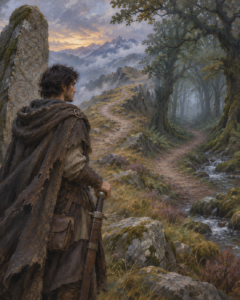 My original Rhun Kin adventures Tales from the Inferno approaches FirePath from the other direction: stories written from the ground up, with branching possibilities in mind. There was no existing story to preserve and no earlier author’s route to work around. Character, setting and choice could develop together.
Their mythic undertone is also more pronounced. Rhun moves through a world shaped by ancestral memory, sacred steel, old obligations and the weight of what has been inherited. His decisions can reveal how he understands those things when they make demands upon him.
Yet the pacing follows the same preference for concentrated adventure. A threatening situation takes shape. Rhun acts. His action changes what becomes possible. The alternate paths help make that world fuller. They can expose another danger, deepen an encounter, reveal a piece of lore or test a different aspect of the warrior’s judgment. Rather than interrupting the central adventure with every possible incident, the branching form lets some of those experiences belong to particular routes.
A reader may therefore discover more about the world by returning to a choice, even when they already know how the main adventure ends. With Conan, I am opening possibilities around a finished tale. With Rhun, those possibilities were part of the tale’s construction from the beginning.
Why I Chose Mythic Branching Fiction
For FirePath, I wanted the reader’s attention to remain on atmosphere, character and consequence.
A solo RPG can make the management of a character part of the pleasure: equipment, abilities, resources and the uncertainty of a combat roll. FirePath concentrates its participation in the decision itself, then carries the result through prose. A fight unfolds as a written scene. A fatal route reaches its end through the circumstances of the adventure. A surviving detour has to earn its place through what happens along the way.
That is what I mean by mythic branching narrative. The reader stands at a threshold in a hero’s story and chooses how he crosses it. The interest lies in discovering what that action reveals, what it costs, and where it leads. The consequences need not amount to a simple moral lesson. Courage can become recklessness. Caution can leave someone exposed. An apparently promising route may conceal a danger the character could not have understood from outside it.
The writing must make those outcomes convincing. A reader should be able to look back and recognise how the situation unfolded, even when the choice proved disastrous. This approach lets me preserve the experience I value most in these adventures: remaining close to the warrior, the landscape and the threat, with enough room for the prose to carry their full weight.
Interactive Sword and Sorcery
Knowing a story’s ending does not remove our desire to return to it.
We reread for the journey: the atmosphere of the city, the dread inside the ruin, the sudden recognition of what the hero has encountered. FirePath adds another reason to revisit that journey. A familiar threshold can now open onto an unfamiliar experience.
For Conan, the original route remains available, and surviving detours return to Howard’s enduring tale. For Rhun Kin, the paths reveal different possibilities within a world conceived for them.
Both begin with the same pleasure in concentrated, forward-moving adventure. A warrior has reached a place where he must act. He has reasons to press on and reasons to hesitate. Beyond the next decision lies something he cannot yet see.
The story has brought him this far.
The path ahead is yours to choose.