This is where fantasy in heavy metal intersects most powerfully with sword and sorcery…
Before fantasy returned to the mainstream — before streaming epics, cinematic universes, and mass-market adaptations — Sword & Sorcery did not vanish.
It endured.
Not in bookstores.
Not on cinema screens.
But in sound.
In the distortion of electric guitars.
In the thunder of drums.
In the voice of men who sang not of modern life, but of steel, fire, gods, and war.
This is where fantasy in heavy metal took hold.
Heavy metal became one of the defining forces shaping Sword & Sorcery during its quiet years.
THE SHARED ORIGIN — Pulp, Paint & Power
Sword & Sorcery and heavy metal were not separate forces that later intersected.
They were born from the same primal soil.
The pulp magazines of the early 20th century — Weird Tales, the worlds of Robert E. Howard and Michael Moorcock — forged a vision of fantasy that was raw, immediate, and physical. This was not distant myth or courtly intrigue. It was blood on stone. Steel in hand. Survival against the dark.
Decades later, that same energy found new expression through sound, and fantasy in heavy metal emerged as its natural continuation.
Artists like Frank Frazetta gave Sword & Sorcery its visual identity — muscle, motion, heat, and danger captured in a single frame. And heavy metal bands took those images and asked a simple question:
What would this sound like?
The answer was not subtle.
It was loud.
It was aggressive.
It was myth made audible.
MANOWAR — Kings Of Metal
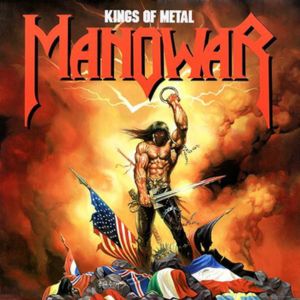 If Conan had taken up a warhorn instead of a blade, it would sound like Manowar.
There is no irony in their work. No distance. No reinterpretation. Only total commitment.
Manowar did not reference Sword & Sorcery — they embodied it.
Their music is built on the same pillars: honor, strength, brotherhood, death, and the unyielding will to stand against the world.
Where fantasy literature softened in the late 20th century — turning toward court politics, sprawling narratives, and moral ambiguity — Manowar held the line. They kept the barbarian archetype alive, making them one of the clearest expressions of fantasy in heavy metal.
Their albums were not collections of songs.
They were initiations into a worldview where the weak fall, the strong endure, and glory is taken.
CIRITH UNGOL — The Cult Keepers Of Steel
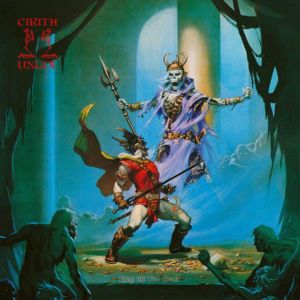 Long before “fantasy metal” became a label, Cirith Ungol was already there — quietly forging something stranger and more faithful to the spirit of the old tales.
Their sound is not triumphant.
It is haunted.
Paired with the artwork of Michael Whelan, their albums feel like relics pulled from a forgotten age — grim, heavy, and saturated with doom.
Where Manowar celebrates the warrior, Cirith Ungol lingers in the shadow of sorcery.
Cursed blades.
Fading worlds.
The slow collapse of order beneath something older and darker.
They did not chase audiences.
They preserved something, anchoring a darker strain of fantasy in heavy metal.
BATHORY — Fire & Ancestral Memory
If Sword & Sorcery is the myth, Bathory is the memory beneath it.
Their later work did not simply draw from fantasy — it reached back into the raw material from which fantasy itself was born.
Norse myth.
Pagan ritual.
The sense of a world governed not by morality, but by force, fate, and the will of gods who do not care.
The sound feels elemental.
Like wind over ice.
Like fire against bone.
This is not escapism.
It is recognition.
Bathory reminds us that the worlds of Sword & Sorcery are not inventions — they are echoes of something humanity once believed, feared, and lived within.
MOLLY HATCHET — The Frazetta Trilogy
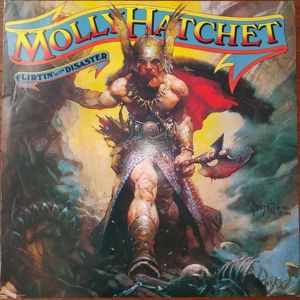 Few moments in music history are as visually decisive as the covers of Molly Hatchet.
Three albums.
Three paintings by Frank Frazetta.
Not as decoration — but as identity.
These images brought Sword & Sorcery directly into the mainstream. Into record stores. Into homes. Into the hands of listeners who may never have opened a pulp magazine.
For many, this was the gateway.
The first glimpse of armored riders, frozen wastelands, and battlefields soaked in myth.
Molly Hatchet proved something essential:
Sword & Sorcery does not need explanation.
It moves people instinctively.
And through this, sword and sorcery metal reached far beyond music.
BLIND GUARDIAN — The Return Of The Bard
Where others raised the sword, Blind Guardian raised the voice.
Their music revives something older than the warrior — the bard.
Through layered harmonies, choral structures, and narrative composition, they return metal to its storytelling roots. Not fragments or references, but full mythic retellings.
They draw from J. R. R. Tolkien, Moorcock, and wider legend—but the method is ancient.
Song as memory.
Song as history.
Song as the preservation of heroic deeds.
In Blind Guardian, fantasy in heavy metal becomes something communal again — shared, spoken, and carried forward through voice.
THE ETERNAL CHAMPION — Cosmic Myth
The influence of Michael Moorcock runs like a fault line through heavy metal.
His vision — of an Eternal Champion bound to endless cycles of war, of Chaos and Law locked in cosmic tension, of cursed blades like Stormbringer — reshaped fantasy itself.
And metal absorbed it completely.
From Hawkwind to later bands drawing on Elric and the wider mythos, his work introduced something Sword & Sorcery had only hinted at before:
Scale beyond the human.
Not just survival.
Not just glory.
But fate.
Endless recurrence.
A universe that grinds heroes down even as it elevates them.
Moorcock did not just influence metal.
He gave it a cosmology that continues to define fantasy in heavy metal.
IRON MAIDEN — The Immortal Icon
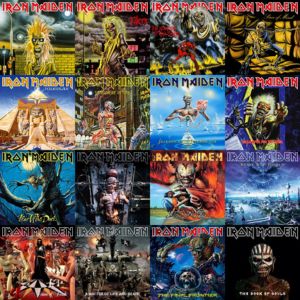 Iron Maiden may not sit cleanly within Sword & Sorcery — but their impact is undeniable.
Eddie is one of the most enduring mythic figures in modern culture.
Across decades, he has taken many forms:
A war-demon.
A pharaoh.
A corpse-king.
A cosmic entity.
He is not a character in a single story.
He is a symbol — mutable, eternal, and instantly recognizable.
Eddie carries the aesthetic forward.
Even when the music ranges across history, war, science fiction, and horror, the imagery remains rooted in the same soil: death, transformation, power, and myth.
He is the modern mask of ancient ideas — and a lasting pillar of fantasy in heavy metal.
FANTASY IN HEAVY METAL — The Swords Of Sound
Heavy metal did more than borrow from Sword & Sorcery.
It shaped it during the years when the genre faded from cultural prominence.
It transformed it into something immediate and visceral.
It kept its symbols alive — its warriors, its gods, its fire.
And crucially—
It passed them on.
To listeners who became readers.
To artists who became writers.
To creators who would carry the genre forward in new forms.
While often leaning into darker or more theatrical territory, modern bands are again embracing fantasy as a central identity.
A new wave of artists is not just referencing mythic imagery but actively building worlds around their music — drawing on the same well of symbols, archetypes, and visual language that defined Sword and Sorcery in its earlier forms.
This resurgence doesn’t always return to the raw barbarian roots directly, but it signals something just as important: the mythic imagination is alive again within heavy metal, evolving while still echoing the same ancient fire that first gave the genre its power.
Today, as Sword & Sorcery rises again, it does not return alone.
It returns with an echo.
A rhythm already known.
A pulse already felt.
Steel meets storm.
Fire meets sky.
Myth meets sound.
The swords were never silent.
They were only waiting to be heard.