When Conan the Barbarian thundered into theatres in 1982, nothing like it had ever existed.
Not in fantasy cinema.
Not in heroic storytelling.
Not in the cultural imagination.
There had been fantasy before — swashbucklers, mythological epics, scattered attempts at swordplay and spectacle. But this was different. This was not fairy tale, not escapism dressed in velvet and stage light. It was dust, muscle, ritual, silence, and steel.
It did not feel imagined.
It felt excavated.
And in doing so, it forged the cinematic language of modern Sword & Sorcery.
Carving Myth from Fire and Bone
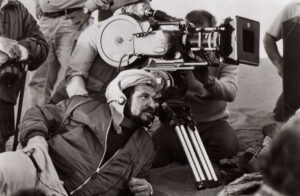 Director John Milius did not approach Conan as pulp adaptation or commercial trend. He approached it as myth-making.
The film opens not with banter or exposition, but with the forge — hammer striking steel beneath a black sky. A father shapes a blade. A child watches. The Wheel of Pain turns beneath winter’s frost.
This is not dialogue-driven storytelling.
It is elemental cinema.
The screenplay, initially developed by John Milius and Oliver Stone, evolved significantly during production. Stone’s early draft reportedly leaned toward grand, almost apocalyptic spectacle, while Milius reshaped the material into something leaner and more mythic — stripping excess and sharpening the ritual spine that defines the finished film.
Milius understood something essential about Sword & Sorcery: it is not about plot mechanics. It is about ordeal. Strength earned. Loss endured. Belief tested.
The massacre that follows — the slaughter of Conan’s village — is staged with operatic brutality. No quips. No sentimental framing. Just inevitability. Fire consumes wood. Steel consumes flesh. The boy survives.
In those opening minutes, the film establishes its governing principle:
Civilization is fragile.
Strength is forged.
The world does not care.
That tone would define every Sword & Sorcery film that followed — even those that misunderstood it.
The Barbarian Made Flesh
Before 1982, fantasy heroes were often refined, princely, or theatrical. After 1982, they were measured against one image.
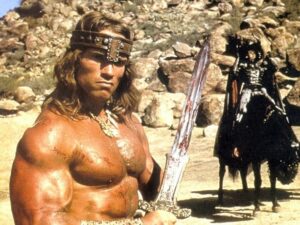 Arnold Schwarzenegger did not merely play Conan — he embodied a physical ideal that felt torn from a Frank Frazetta canvas and brought into three-dimensional space. This mattered.
The physique was not decorative. It was narrative. Schwarzenegger’s discipline, training, and presence conveyed something beyond costume: this was a man shaped by ordeal.
He speaks little. He does not charm. He does not wink at the audience. His power is not rhetorical — it is physical and internal.
The camera lingers not on spectacle but on stillness. On the weight of the sword. On the silence before action. On a man contemplating the Riddle of Steel.
Fantasy cinema had never looked this serious.
After Conan, the body became part of the genre’s vocabulary. Physicality was no longer optional. Strength was not metaphor alone — it was visible, undeniable.
The Sound of Iron and Fate
If the forge gave the film its imagery, the music gave it its heartbeat.
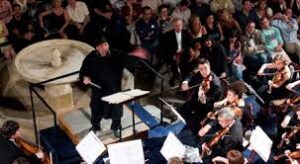 Composer Basil Poledouris delivered a score that transcended accompaniment. “Anvil of Crom” does not underscore the opening sequence — it ignites it. The brass surges like marching legions. The percussion strikes like hammer on metal. The choir does not soothe; it invokes.
Poledouris understood mythic scale. He did not write background music. He wrote a symphony of will.
In many ways, the score carries the film’s interior philosophy. Where dialogue remains sparse, music speaks. It communicates fatalism, fury, reverence, and triumph without explanation.
Later fantasy films would borrow this model — swelling orchestration, heroic motifs — but rarely with the same restraint. In Conan, silence and thunder are balanced carefully. The music erupts only when it must.
It is not decorative.
It is elemental.
To this day, the score remains one of the genre’s defining achievements — a blueprint for how Sword & Sorcery should sound.
Building a Believable Hyborian World
Fantasy lives or dies on credibility.
Production designer Ron Cobb constructed a Hyborian world that felt inhabited rather than staged. Stone temples erode beneath desert wind. Armor looks worn, not polished. Tribes feel tribal.
The film does not drown the viewer in exposition about the world. It shows architecture, ritual, weaponry, and lets implication do the rest.
This grounded texture is critical.
Too often, fantasy cinema drifts toward theatrical artifice — shining sets, ornamental costuming, ornamental lighting. Conan’s world feels dusty, weathered, heavy. When swords strike, they clang with weight. When bodies fall, they collapse like matter.
That physical grounding anchors the myth.
We believe the world because it resists beautification.
The Serpent and the Voice
Every myth requires a counterforce.
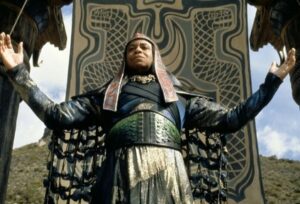 As Thulsa Doom, James Earl Jones offered something rare: a villain whose menace was not frenzy, but calm conviction.
His power lay not merely in steel, but in belief. In voice. In persuasion.
Where Conan represents endurance and personal strength, Doom represents the seduction of submission — the surrender of will to ideology. His cult is not chaotic; it is organized. Serene. Devoted.
Jones’ performance is almost spiritual. Soft-spoken. Measured. Unnerving.
This dynamic elevates the film beyond simple revenge narrative. It becomes philosophical.
Strength versus faith.
Self versus surrender.
Steel versus word.
The confrontation at the Temple of Set is not just physical — it is metaphysical. And when Doom falls, it is not spectacle alone. It is ideological rupture.
The Producer’s Risk
It would be incomplete not to recognize the scale of ambition that brought the film into existence.
Producers Raffaella De Laurentiis and Buzz Feitshans shepherded the project at a time when fantasy cinema was still considered commercially uncertain.
De Laurentiis, in particular, pushed for scope, grit, and operatic seriousness — bold choices in an industry not yet convinced of the genre’s viability. The film’s budget, practical scale, and refusal to soften its edges were risks.
That willingness to aim high — rather than retreat into camp — shaped the film’s enduring authority.
Conan the Barbarian did not wink at the audience, nor apologize for its intensity.
It aimed high — and hit.
Themes Etched in Ritual
Wheel. Forge. Sword. Riddle.
The film’s imagery is not decorative — it is symbolic repetition.
The Wheel of Pain becomes endurance incarnate. The forge becomes transformation. The sword becomes inheritance and identity. The Riddle of Steel becomes philosophical inquiry.
These themes are not explained in academic dialogue. They are lived.
When Conan stands atop the mound of his enemies, sword raised against the horizon, the image resonates because it has been earned. Suffering preceded it. Silence preceded it. Failure preceded it.
That structure — ordeal, transformation, confrontation — became the backbone of later Sword & Sorcery narratives, whether in film, comics, or games.
Conan the Barbarian did not invent these motifs.
But it carved them into cinema with unforgettable clarity.
The Rise, the Fall, and the Enduring Flame
Upon its release in 1982, Conan the Barbarian entered the cinematic record not merely as genre fare, but as a defining moment in fantasy filmmaking — a status reflected in its inclusion within the American Film Institute’s catalog of notable motion pictures.
In the years that followed, the genre saw imitators. Some earnest. Some opportunistic. Few captured the same gravity.
Sword & Sorcery would ebb through the 1990s and early 2000s, often overshadowed by high fantasy epics or dark urban reinterpretations. Yet the 1982 Conan remained a benchmark — a standard by which attempts were measured.
Its flame did not dim because it was never built on trend. It was built on fundamentals: myth, ritual, physicality, music, belief.
More than four decades later, its imagery remains instantly recognizable. Its score still stirs. Its opening still commands silence.
The Film That Forged an Age
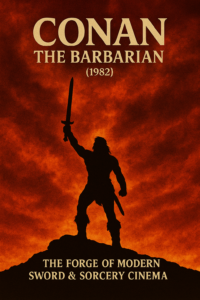 Conan the Barbarian did not simply launch a cinematic hero. It defined the grammar of Sword & Sorcery on screen.
It proved that fantasy could be austere. That it could be brutal without being cynical. That myth could be grounded in sweat and dust rather than shimmer.
It showed that the barbarian archetype was not primitive caricature, but a vessel for examining will, endurance, and identity. And it reminded audiences that sometimes the most powerful stories are told not through exposition — but through image, music, and ordeal.
The forge still burns.
The anvil still rings.
And for more than forty years, the flame lit in 1982 has never gone out.