Long after its heyday, the visual grammar of Sword & Sorcery still bends toward a painterly convention forged in fire, muscle, and myth.
In 1967, a single image did something rare.
It didn’t merely decorate a book — it changed how a character was perceived before a word was read.
When Frank Frazetta was commissioned to paint the cover for the Lancer/Ace paperback editions of Conan the Barbarian, he wasn’t illustrating a scene. He was answering a question that had hovered around Robert E. Howard’s creation since the pulp years:
What does Conan feel like when he enters a room?
Frazetta answered with muscle under tension, eyes alert, weight shifted forward — a man coiled like a drawn bow. This was not a knight. Not a prince. Not a romantic hero posing for legend. This was a predator who had survived long enough to understand violence intimately.
For millions of readers, this image became their first encounter with the Cimmerian. Before a sentence was absorbed, the tone was set. This was not high fantasy. This was steel, blood, and will.
Defining Presence, Not Pose
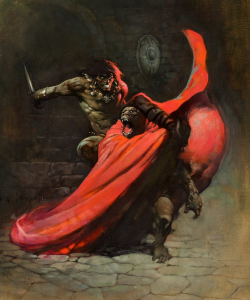 What makes the 1967 Conan painting enduring isn’t technical polish alone — though Frazetta had that in abundance — but psychological authority.
The figure doesn’t perform heroism. He occupies it.
There is no theatrical flourish, no symbolic framing, no attempt to soften the edges. The anatomy is exaggerated but purposeful; the posture suggests readiness, not display. The environment exists only insofar as it presses against the figure. Everything bends toward the man at the center.
This was a radical departure from much of fantasy illustration at the time, which often leaned toward romanticism or mythic distance. Frazetta collapsed that distance. He dragged the hero forward into the reader’s space.
You didn’t admire Conan from afar.
You felt him breathing.
A Visual Language Is Born
The impact of this painting rippled outward fast — and far.
Paperback covers shifted. Artists recalibrated. Publishers took note. A generation of illustrators learned, consciously or not, that fantasy could be physical, dangerous, and unapologetically human.
This single image became a kind of visual Rosetta Stone for Sword & Sorcery. It translated Howard’s prose — its velocity, its brutality, its refusal to moralize — into a language that could be understood instantly.
And once that language existed, it propagated.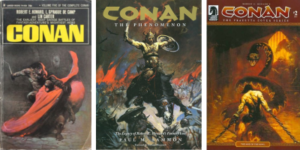
Film followed.
Comics followed.
Games followed.
Even decades later, when audiences think they are reacting to Conan as a character, they are often reacting to Frazetta’s Conan — the posture, the gaze, the implicit threat.
Beyond Illustration: A Cultural Artifact
On September 12, 2025, the original 1967 oil painting passed into new hands through a successful auction conducted by Heritage Auctions. The sale price — reported at $13.5 million — drew headlines, but the figure itself is almost beside the point.
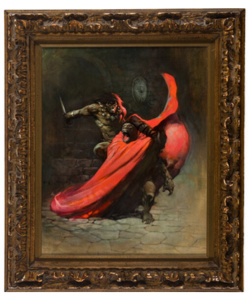 What mattered was the confirmation.
The market wasn’t paying for nostalgia.
It was recognizing a cornerstone artifact of modern fantasy culture.
Very few images can credibly claim to have reshaped an entire genre’s visual identity. This one can — and does.
Why Frazetta Still Defines Sword & Sorcery
Sword & Sorcery, at its core, is not about quests or prophecies. It is about presence under pressure — individuals measured by action, not destiny.
Frank Frazetta understood that instinctively.
His warriors do not look chosen. They look earned. Scarred. Alert. Capable of violence but not enslaved to it. Civilization has not refined them; survival has. That distinction matters.
It is why Frazetta’s work continues to influence the genre, even as fantasy splinters into countless subcategories. When creators want to signal danger, grit, or primal resolve, they reach — knowingly or not — for the visual language he established.
His paintings endure because they are honest.
For those who want to explore Frazetta’s work firsthand, the Frazetta Art Museum in Pennsylvania houses the largest collection of his original paintings and sketches, offering unparalleled insight into the visual language that reshaped fantasy art.
Inferno Books and the Flame That Endures
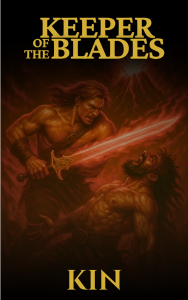
Inferno Books exists in the shadow — and the light — of works like this. Our aim is not imitation, nor preservation for its own sake, but continuation.
Sword & Sorcery is not a relic to be archived. It is a living tradition, forged at the intersection of literature, art, music, and myth, sustained by creators who refuse to blunt its edge.
Frazetta’s paintings endure because they show the genre in its truest form — unguarded, unpolished, and uncompromising. It reminds us what Sword & Sorcery looks like when it does not apologise for its own intensity – Fire. Steel. Consequence.
A Gateway Image
This is not just a painting.
It is a gateway image — the moment literature, art, and myth fused into something permanent. A visual threshold millions crossed before they even knew they were stepping into Sword & Sorcery.
And once crossed, there was no mistaking where they stood.
—
Image courtesy of HA.com (Heritage Auctions).