How Robert E. Howard imagined the forgotten ages before history
“Know, O prince, that between the years when the oceans drank Atlantis and the gleaming cities…”
With those words, Robert E. Howard did not merely open the chronicles of Conan the Cimmerian.
He opened a gulf in history.
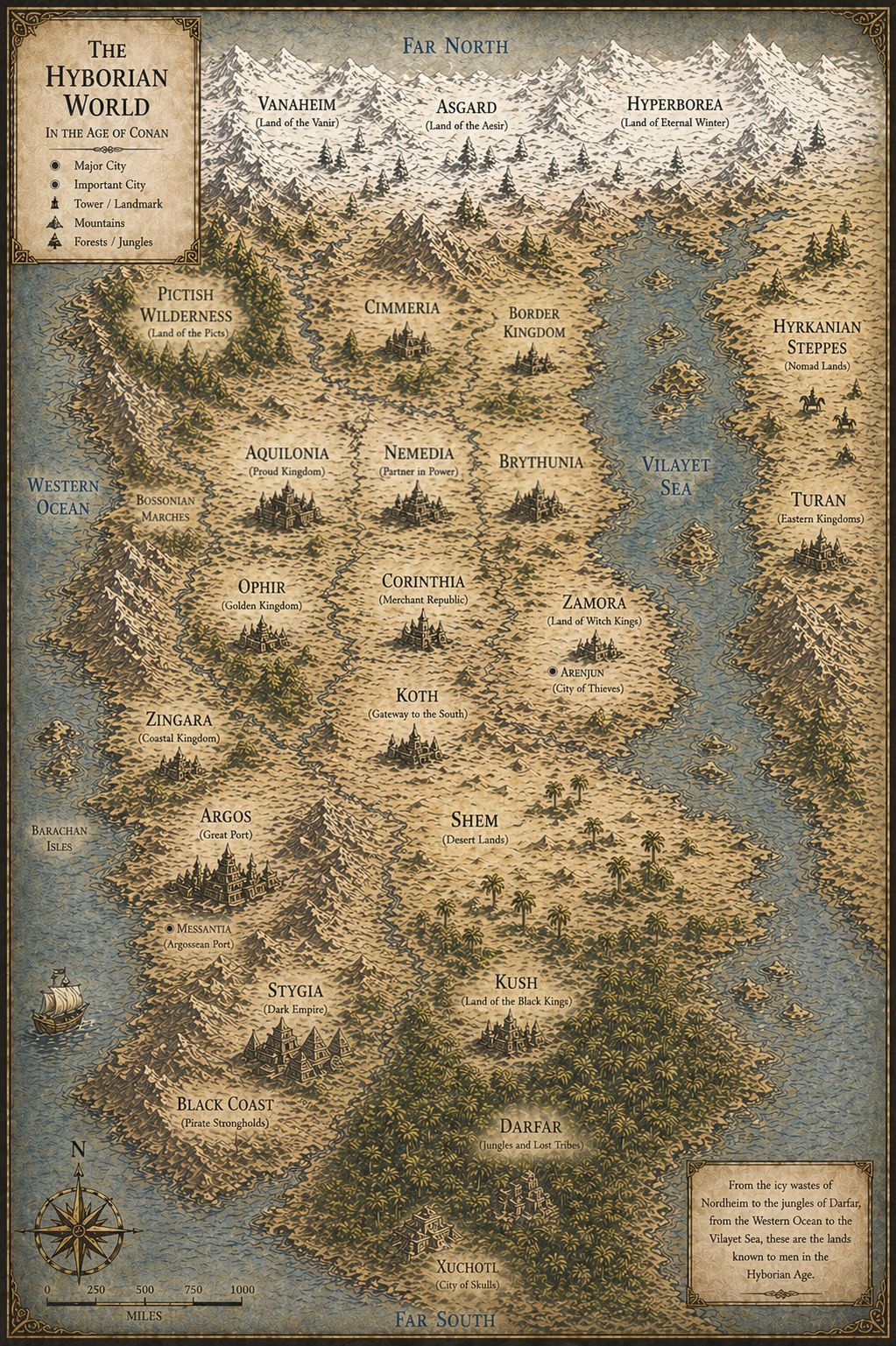
Beyond it lay kingdoms no surviving map remembers: Aquilonia and Nemedia, Stygia and Zamora, Argos, Zingara and the frozen lands of Nordheim. Their armies marched, their cities flourished, their dynasties rose and perished — and yet no ruin remains that modern hands might uncover. They belonged to an “Age undreamed of,” after the destruction of Atlantis but before the beginnings of recorded history.
This was The Hyborian Age.
It is often called the world of Conan, and understandably so. Howard gave it continents, frontiers, rivers, kingdoms, religions and peoples. He drew maps of it and composed an extensive history tracing the migrations and conquests of its nations. Yet the Hyborian Age was never simply another world in the modern fantasy sense.
Howard did not place Conan upon a distant planet or within an entirely separate creation. He placed him in the forgotten past of our own Earth. The Hyborian kingdoms were not intended to stand outside history, but beneath it: a vanished stratum of human experience buried by cataclysm, migration and the long erosion of memory.
Howard was not only building a world. He was excavating an age.
Before the Hyborian Kingdoms
Conan’s was not the first forgotten age imagined by Howard.
Long before the rise of Aquilonia and Stygia, the world belonged to the Thurian civilizations of Kull. It was an age of Valusia, Grondar, Commoria, Verulia and the other kingdoms collectively remembered as the Seven Empires. Beyond their borders lived older and wilder peoples: the Picts upon their islands, the Lemurians across the eastern seas and the fierce tribes of Atlantis.
Kull was born among those Atlantean tribes.
Like Conan after him, he entered civilization as an outsider. He rose from barbarian exile and galley slave to become king of Valusia, the most powerful of the Thurian kingdoms. Yet the crown could never entirely separate him from the wilderness that formed him. Within the marble halls of Valusia, Kull remained suspicious of ceremony, inherited custom and the strange machinery of civilized rule.
The Thurian Age already felt ancient even to those who lived within it. Valusia was burdened by immemorial traditions, forgotten dynasties and mysteries that reached back beyond the origins of humankind. Beneath its palaces moved remnants of races that had ruled before men.
Its civilization was not young and ascending, but old, magnificent and haunted.
Then came the Cataclysm.
Continents sank. Islands rose. Coastlines were broken and remade. Atlantis and Lemuria disappeared beneath the sea, while the proud kingdoms of the Thurian continent were shattered. Their survivors were reduced to scattered tribes, struggling through generations of savagery in a transformed world.
From those survivors — and from the peoples who emerged after them — the nations of the Hyborian Age would eventually arise. Conan therefore inhabits no pristine fantasy world awaiting discovery. He walks upon the wreckage of another age. Its ruins lie beneath later ruins; its peoples carry half-remembered inheritances from nations whose names have already been lost.
The Hyborian Age has a past because Kull came before Conan. That past, in turn, points forward towards our own.
A Lost Chapter of Our History
Howard’s great freedom was to make The Hyborian Age recognizable without making it historical.
Its kingdoms resemble civilizations known to us, but none corresponds perfectly to a single place or period. Aquilonia suggests medieval France and the feudal kingdoms of western Europe. Stygia evokes ancient Egypt. Zingara carries the heat and pride of Spain, while the horsemen of Hyrkania recall the nomadic peoples of the Eurasian steppe.
These similarities gave Howard an immediate language of atmosphere. A name, a weapon, a costume or a fragment of architecture could summon an entire cultural impression without pages of explanation. Yet because the Hyborian Age preceded recorded history, he was free to combine those impressions as the story demanded.
Conan could be a thief among the towers of Zamora, a mercenary in the armies of the eastern kingdoms, a pirate upon the Black Coast, a scout along the Pictish frontier and a king upon the throne of Aquilonia. Ancient temples, medieval fortresses, frontier stockades and pirate galleys could all exist within the same age without requiring Howard to reconcile thousands of years of real chronology.
This was not historical fiction, but neither was it entirely detached from history. It was a kind of mythic prehistory: one in which the familiar cultures of the ancient and medieval worlds appeared in younger, fiercer and less stable forms.
Howard could take whatever stirred his imagination — Celtic legend, Roman imperialism, Egyptian antiquity, Viking ferocity, Mongol cavalry, Mediterranean piracy or violence upon the American frontier — and cast it backward into an age where history had not yet hardened into fact.
The result was not an orderly reconstruction of the past. It was history remembered through a fever dream.
The Shape of the Hyborian World
Howard’s nations are frequently described through their real-world counterparts, but those comparisons should be treated as guides rather than equations. The Hyborian kingdoms are composites, altered by Howard’s imagination and shaped to serve the demands of adventure.
Nevertheless, their historical echoes are essential to the way the setting works.
Cimmeria
Cimmeria is Conan’s northern homeland: a mountainous country of dark skies, wooded slopes and warring clans. Its strongest associations are Celtic, particularly with the Gaelic peoples whose history and traditions fascinated Howard throughout his life.
Yet Cimmeria is never exhaustively described. We know it chiefly through Conan himself and through the few moments when he remembers its hills. It remains distant, severe and half-shrouded — a country that formed him but could never contain him.
Conan carries Cimmeria wherever he goes. Its hard climate survives in his endurance, its tribal life in his independence and its gods in his refusal to bow before the more elaborate faiths of civilized nations.
Aquilonia and Nemedia
Aquilonia is the greatest of the western Hyborian kingdoms, a feudal power suggestive of medieval France. Its provinces, knights, barons and contested frontiers give it the character of a high medieval realm approaching the height of its power.
Nemedia, its great rival, similarly evokes central and western Europe. It is learned, wealthy and politically formidable, with chroniclers whose writings provide the imagined historical frame for Conan’s life.
These are not crude or primitive nations. They possess scholarship, architecture, law and military power. Yet their sophistication does not make them morally superior. Their courts are vulnerable to conspiracy; their nobles hunger for power; their institutions can be turned towards oppression as readily as order.
Conan eventually conquers Aquilonia and rules it as king, but he never becomes wholly Aquilonian. The barbarian remains within the monarch, watching the rituals of civilization with an outsider’s eye.
Zamora
To the east lie the ancient cities of Zamora, a land of thieves, priests, merchants and towers.
Arenjun, known for its Maul and its thieves, provides the setting for Conan’s youthful adventure in “The Tower of the Elephant.” Shadizar would become another name synonymous with Zamora’s decadence and danger.
Zamora does not correspond cleanly to one historical nation. Its atmosphere draws upon western imaginings of the Near East and Central Asia: crowded bazaars, secretive cults, jewel-filled chambers and ancient structures whose origins have been forgotten even by those living beneath their shadows.
It is the natural beginning for Conan’s life as a wanderer. Here the young Cimmerian encounters civilization not as an ideal, but as a glittering labyrinth of wealth, deception and cruelty.
Stygia
South of the Hyborian kingdoms lies Stygia, one of the oldest surviving civilizations of Conan’s age.
Its monuments, priesthoods, tombs and river-fed cities unmistakably recall ancient Egypt. Khemi and Luxur stand beneath the shadow of a civilization whose power is inseparable from religion, secrecy and death. Its ruling culture possesses knowledge lost to younger nations, but that knowledge is rarely benign.
In Stygia, antiquity itself becomes threatening. Age does not signify wisdom so much as accumulated power. Forgotten rites endure because there are still those willing to perform them, and the gods of the tomb have not necessarily died with their worshippers.
Howard’s Stygia is therefore more than an Egyptian analogue. It is Egypt transformed through the atmosphere of sword and sorcery: older than safety, darker than memory and still conscious beneath the weight of its own monuments.
Shem, Hyrkania and Turan
The lands of Shem recall the ancient Semitic cultures and city-states of the Near East. They are divided among pastoral peoples and wealthy urban kingdoms, producing archers, merchants, mercenaries and princes. Shem stands between worlds: between the Hyborian west, Stygia to the south and the great eastern territories beyond.
Farther east, the plains of Hyrkania evoke the vast Eurasian steppe and its mounted nomads. From this broader world arises Turan, an expanding imperial power built around cavalry, conquest and control of the inland sea.
These regions allowed Howard to bring the speed and violence of steppe warfare into Conan’s adventures. Kingdoms that appear mighty behind their walls remain vulnerable to peoples who live in the saddle and move across distances that settled civilizations struggle to comprehend.
Nordheim
North of Cimmeria lie Asgard and Vanaheim, together forming Nordheim. Here the historical echoes are plainly Scandinavian. The Æsir and Vanir are tall, fierce and divided by an enduring blood feud.
Their frozen lands are places of raiding, tribal warfare and supernatural terror, where the boundaries between human enemies and older beings grow thin.
Nordheim is not a carefully reconstructed Viking society. It is the mythic north stripped to snow, steel, blood and saga.
Argos, Zingara and the Black Coast
Argos and Zingara are maritime powers whose ships travel the western seas. Argos carries broadly Mediterranean associations, while Zingara resembles a fierce and romanticized Iberian kingdom. Their sailors, merchants and buccaneers open the Hyborian Age to another tradition beloved by Howard: the pirate adventure.
Beyond their familiar waters lies the Black Coast.
The Black Coast is not a kingdom but a vast southern region of independent peoples, coastal settlements, jungles, rivers and forgotten ruins. It is here that Conan joins Bêlit and becomes Amra, the Lion, raiding the coasts aboard the Tigress.
In “Queen of the Black Coast,” the sea does not merely connect nations. It offers escape from them. A ship becomes a wandering kingdom, piracy becomes a rejection of civilized law and the coastline promises both freedom and horrors left behind by vanished peoples.
The Pictish Wilderness
West of Aquilonia lies one of the most important landscapes in Howard’s imagination: the Pictish Wilderness.
The Picts had already appeared in the Thurian Age, when they occupied islands west of Atlantis. They survive the Cataclysm and endure across the millennia, changing while retaining an identity older than the kingdoms surrounding them. By Conan’s time, the Aquilonian frontier has pushed into their wilderness. Forts and settlements stand upon contested ground, while the Pictish clans resist the advancing colonists.
The resemblance to the American frontier is unmistakable. Howard grew up in Texas surrounded by stories of settlement, displacement, raids and violent cultural collision. In tales such as “Beyond the Black River,” he translated that frontier into sword & sorcery without stripping it of its danger or moral unease.
The wilderness is not empty. It belongs to peoples with their own alliances, enmities and traditions. Civilization advances by calling the land vacant and defending what it has taken. Beyond the forts waits a world that refuses to disappear.
Barbarism and Civilization
At the centre of both the Thurian and Hyborian ages stands the conflict between barbarism and civilization.
Kull enters Valusia from Atlantis. Conan descends from Cimmeria into the southern kingdoms. Both men become rulers, yet neither completely accepts the assumptions of the societies he rules.
Howard frequently presents civilization as cyclical. A vigorous people conquers an older nation, inherits its wealth, adopts its comforts and eventually becomes vulnerable to another people hardened beyond its borders. Kingdoms rise from barbarism, attain splendour, decay and fall.
But Howard’s treatment of barbarism is more complicated than a simple celebration of savagery.
Conan is not morally pure because he is a barbarian. He steals, kills, raids and pursues wealth with unapologetic appetite. He can be ruthless and is often guided more by personal loyalty than abstract justice. Barbarism gives him vitality, instinct and independence, but it does not make him gentle.
Civilization is equally contradictory. It produces poetry, craftsmanship, scholarship, law and magnificent cities. It also produces slavery, political treachery, inherited corruption and systems through which cruelty can be hidden behind ceremony. The barbarian may kill a man openly. The civilized noble may condemn thousands with a signature.
Howard’s sympathy generally rests with the individual who remains strong enough to resist the systems surrounding him. Conan survives because he can learn from civilization without surrendering himself to it. He becomes thief, soldier, pirate, commander and king, adapting to each role while remaining fundamentally free.
He understands civilization. He simply never worships it.
A World Made for Movement
Many fantasy worlds are revealed through inheritance. Their heroes begin within a homeland, discover its history and ultimately defend or restore its rightful order. Conan rarely remains anywhere long enough to belong.
He enters the Hyborian Age as a wanderer, and the setting reveals itself through his movement. He crosses borders, changes professions, learns languages and serves under banners he may later oppose. Kingdoms that dominate one story vanish from the next. Years of his life pass beyond the reader’s sight.
This mobility is one of the reasons the Hyborian Age feels so immense. Howard does not stop to catalogue every province or explain every dynasty. We encounter only what Conan sees — and Conan is usually moving too quickly to receive a lecture. A tavern conversation suggests a distant war. A ruined temple reveals that another people occupied the land before its present rulers. A soldier’s armour, a god’s name or a woman’s accent tells us that Conan has crossed into another cultural world. The unexplained spaces between these details remain open.
Howard’s map gives the age shape, but the stories give it life. Roads matter more than borders. Coastlines matter because ships follow them. Mountains matter because men must cross them. Cities matter because they contain treasure, danger and people desperate enough to betray one another for both.
The Hyborian Age was not made to be observed from above. It was made to be travelled with a sword at one’s side.
The History Beneath the Ruins
Ruins appear throughout sword & sorcery, but in Howard they rarely feel ornamental. They are evidence.
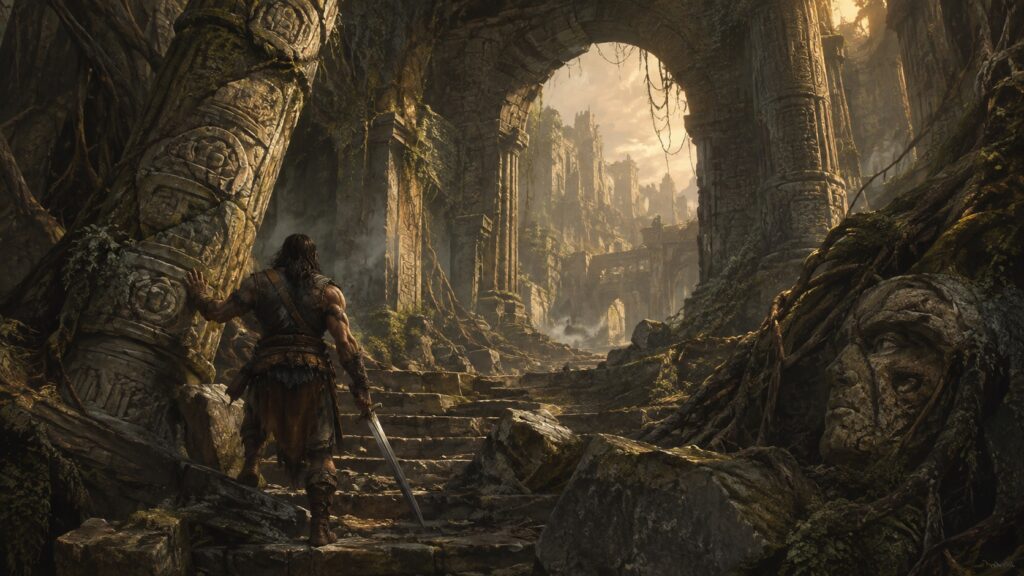
A deserted city, a buried chamber or an overgrown temple reminds us that the kingdoms of Conan are neither the first civilizations nor the last. Humanity occupies only the newest layer of an immeasurably older world. Beneath that layer lie forgotten peoples, inhuman survivals and powers that civilization has mistaken for myth.
This creates one of the defining tensions of Howard’s fiction. His characters often believe that history moves forward — that new kingdoms have replaced the old and that reason has banished the terrors of earlier ages. The ruins prove otherwise. The past has not vanished. It is waiting.
In “The Tower of the Elephant,” the glittering tower at the heart of Arenjun conceals a tragedy extending far beyond human history. In “Queen of the Black Coast,” the ruins beside the river hold the remnants of an extinguished civilization. Across Conan’s adventures, treasure and horror are frequently found together because both have survived from ages that should have remained buried.
The Hyborian Age itself occupies the same position in relation to us. It is the ultimate buried civilization: an entire epoch erased so completely that only Howard’s chronicles remain.
History as Myth, Not Textbook
Howard’s imagined history should not be mistaken for modern anthropology. “The Hyborian Age” was written within the racial and historical vocabulary of the 1930s.
Its account of peoples dividing, migrating, intermarrying and developing into later nations reflects ideas common to Howard’s time, some of which are now antiquated or deeply flawed. Nor should every Hyborian culture be reduced to a coded version of a real people. Howard’s nations are imaginative constructions assembled from history, legend, pulp convention and his own recurring concerns. They are most useful as echoes, not equivalences.
Cimmeria is not literally ancient Scotland. Stygia is not simply Egypt with sorcery added. Aquilonia is not France transported whole into prehistory. Each contains recognizable elements, but each belongs to Howard’s invented sequence of ages. That incompleteness is part of their power.
Howard gave the Hyborian Age enough historical familiarity to feel remembered and enough imaginative distance to feel lost. The reader recognizes the shape of a culture before discovering how it differs. We are always standing between memory and invention.
An Age Undreamed Of
Modern fantasy often prizes completeness. Maps must align with chronologies; magical systems must possess rules; every kingdom must have its dynasties, economies and institutions explained. Howard took another path.
The Hyborian Age feels vast because it is not entirely known. Its histories contradict, its borders shift and its deepest past survives only in fragments. Civilizations exist beyond the immediate story, but they do not wait patiently to be catalogued. They are alive, unstable and already passing away. This is why the distinction matters.
The Hyborian Age is a world in the ordinary sense, but it was imagined first as an age: a period shaped by migrations, conquest, catastrophe and decay. Its nations do not merely occupy space. They emerge from earlier peoples and will eventually become others. Behind Conan stands Kull and the drowned world of Thuria. Ahead of him lies another cataclysm, followed by the first faint outlines of recorded history.
Conan is not defending an eternal order. He is moving through a moment that cannot last.
Aquilonia will fall. Stygia will change. The seas will alter their shores. New peoples will inherit the ruins, forget the names carved upon them and build kingdoms destined for the same end. Even Conan, who wins a crown through strength and refuses to be mastered by those around him, cannot conquer time.
That knowledge lends Howard’s adventures their peculiar weight. Beneath the battles, monsters and glittering treasure lies the awareness that every triumph will one day become legend — and every legend will eventually be forgotten.
Robert E. Howard did not send Conan into another world.
He placed him in the darkness beneath our own.