Long before many of us knew the name Robert E. Howard, we knew the shape of his world.
We knew that ancient castles concealed forgotten powers. We knew that dark sorcerers commanded monstrous armies from towers of stone. We knew that a sword might be more than a weapon, that ruined temples guarded terrible secrets, and that somewhere beyond the borders of civilization waited a wilderness filled with danger and adventure.
We knew the barbarian hero too.
He stood broad-shouldered against a burning sky, sword raised above his head. He fought monsters, shattered chains, crossed strange kingdoms, and confronted evils that kings and armies were powerless to overcome. Sometimes he appeared on a television screen. Sometimes he waited in a toy box. Sometimes we guided him through a maze of flickering pixels.
We may never have heard the words sword & sorcery, but we recognized its language instinctively.
During the 1980s, the imagery of pulp fantasy escaped from paperback covers, passed through the era’s sword & sorcery cinema, and entered the lives of children. Its violence was softened, its darker passions removed, and its rough-edged wanderers transformed into champions of virtue.
Yet its essential spirit endured. Through cartoons, toys, games, and comics, a generation was introduced to barbarian heroes, enchanted weapons, monstrous villains, and worlds where magic stood alongside the ruins of forgotten ages.
We were raised by barbarians.
Before Eternia
The decade began with the end of the world.
Thundarr the Barbarian, first broadcast in 1980, was set upon a future Earth transformed by cosmic catastrophe. Civilization had fallen. Strange kingdoms had risen among its ruins. Sorcery, super-science, mutants, monsters, and fragments of the ancient world existed side by side.
Across this savage landscape rode Thundarr, Princess Ariel, and the leonine Ookla the Mok. Armed with his blazing Sunsword, Thundarr battled wizards, tyrants, and creatures born from the wreckage of the old world.
There was little subtlety about him. Thundarr was a barbarian in the boldest Saturday-morning sense: muscular, defiant, suspicious of sorcery, and always ready to bring down a fortress upon the head of an evil wizard. Yet beneath the bright animation and heroic declarations lay an imaginative mixture familiar to readers of fantastic adventure. Civilization had become fragile. The wilderness had reclaimed the world. Ancient knowledge had turned mysterious, while powerful men used magic and fear to dominate the weak.
A year later came Blackstar, another Filmation adventure built around a warrior in a strange and dangerous land. John Blackstar, an astronaut carried through a black hole to the planet Sagar, wielded one half of a mighty divided weapon while the tyrannical Overlord possessed the other. Accompanied by allies both magical and monstrous, Blackstar fought through a world of castles, demons, winged beasts, and sorcery.
Neither programme enjoyed the cultural reach of what followed, but together they helped establish a new kind of children’s hero. He was no caped guardian of a modern city. He belonged to a world beyond history: part barbarian, part knight, part cosmic wanderer. His adventures could move freely between lost technology and ancient magic, between alien landscapes and primeval fortresses.
The path to Eternia had been opened.
By the Power of Grayskull
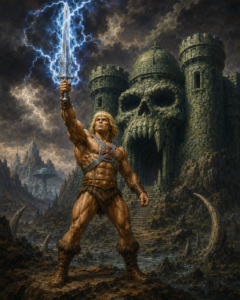 Then, in 1983, a voice rang out across television screens:
By the power of Grayskull!
With those words, Prince Adam raised his sword and became He-Man, the most powerful man in the universe. For millions of children, it was more than a transformation sequence. It was an invocation — a gateway into a complete mythology of heroic strength, ancient mystery, and magical adventure.
Masters of the Universe brought together almost every image that had made sword & sorcery so irresistible. Eternia was a world of trackless wilderness, sinister mountains, ruined temples, hostile wastelands, bottomless caverns, and castles shaped like skulls and serpents. Sorcerers plotted beside warlords. Warriors rode armoured beasts into battle. Strange machines stood among primeval rocks, their origins rarely explained and scarcely requiring explanation.
At the center of it all stood He-Man.
With his bare chest, furred boots, immense strength, and magical sword, his resemblance to the barbarian heroes of fantasy art was unmistakable. Yet He-Man was not simply Conan made suitable for children. The differences were as important as the similarities.
The traditional sword & sorcery hero is often a wanderer living beyond the protection of society. He may be honourable, but he is rarely appointed to defend the established order. He-Man, by contrast, was a prince in disguise: a champion entrusted with protecting his family, his kingdom, and the people of Eternia. His strength carried moral responsibility. The dangerous outsider had become a benevolent guardian.
Even his sword reflected this transformation. In pulp adventure, a blade is iron — a practical answer to the threats of a brutal world. The Power Sword was something more. It conferred identity, summoned strength, and connected its bearer to the mysteries of Castle Grayskull. To raise it was not merely to prepare for battle, but to step into the role of the hero.
If He-Man embodied heroic strength, his arch-nemesis Skeletor embodied everything waiting in the darkness beyond the castle walls.
With his skull-like face, hooded head, clawed hands, and Havoc Staff, Skeletor seemed to have emerged fully formed from some lurid fantasy paperback. He was warrior, necromancer, tyrant, and theatrical sorcerer at once. He commanded monsters and machines from Snake Mountain, an evil stronghold twisted into the shape of its master’s ambitions.
Skeletor could be comical, impatient, and frequently thwarted, but his appearance retained something genuinely macabre. A living body bearing a naked skull is an image of death itself. For children, he was frightening without becoming unbearable: a figure who allowed them to approach the gates of horror while remaining safely within the boundaries of adventure.
Between He-Man and Skeletor stood Castle Grayskull.
Perhaps no image better captures the strange power of Masters of the Universe. Grayskull was not a gleaming palace or a comfortable royal home. It was a green stone fortress whose entrance opened through the jaws of an enormous skull. It looked ancient before anything else in Eternia had been built. It suggested buried passages, ancestral powers, and secrets that even the heroes did not entirely understand.
Children did not need its mysteries explained. The mystery was the attraction.
Castle Grayskull represented one of fantasy’s most enduring promises: that the world is older, stranger, and deeper than it appears. Behind the visible gate lies another chamber; beneath the chamber, a forgotten stair; below the stair, some power left sleeping since the beginning of the world.
This sense of mystery extended across the entire toy line. Before characters acquired fixed histories through animation, many existed first as names, appearances, weapons, and fragments of suggestion. Beast Man, Mer-Man, Trap Jaw, Tri-Klops, Man-At-Arms — the names were simple enough for a child to grasp instantly, yet each figure invited stories beyond those provided on screen.
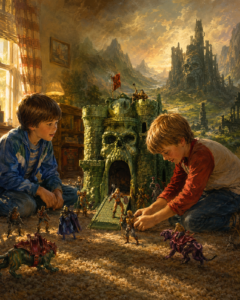 The toys did not merely reproduce the world of the cartoon. They allowed children to rebuild it.
Bedroom floors became wastelands and battlefields. Furniture became mountains. Heroes fell, returned, betrayed one another, discovered secret bloodlines, and joined forces against evils greater than anything seen on television. The story could continue indefinitely because no official boundary could contain it.
Not every child owned Castle Grayskull. For some — myself included — its gates opened only at a friend’s house, during a borrowed afternoon among toys their own families could never have afforded.
Yet imagination is not bound by ownership. Once the drawbridge fell and the figures were placed upon the floor, Eternia belonged equally to everyone gathered around it. Decades later, the stories invented there may be forgotten, but the wonder of entering that world remains.
In that sense, Masters of the Universe preserved something essential to sword & sorcery: the feeling that adventure waits just beyond the edge of the map.
The franchise emerged amid a broader transformation in children’s television and toy culture during the 1980s, but what began as a union of toys and animation soon became something far greater in the imaginations of its audience.
In adapting that fantasy for children, Masters of the Universe removed the bloodshed, sensuality, and much of the moral ambiguity of its pulp forebears. He-Man seldom used his sword as a sword. Enemies were thrown, trapped, outwitted, or driven away rather than cut down. Episodes often ended with clear lessons about courage, honesty, or responsibility.
Yet the primal dream survived its taming. There was still the warrior standing before the dark fortress. There was still the evil sorcerer hungry for forbidden power. There were still monsters in the wilderness, strange idols in the ruins, and weapons forged for purposes forgotten by ordinary men.
Sword & sorcery had entered the toy aisle.
Beyond the Heroic Male
The arrival of She-Ra: Princess of Power in 1985 expanded that imaginative world beyond He-Man and his largely male circle of warriors.
Adora’s transformation into She-Ra drew upon the same heroic ritual: an ordinary identity cast aside through the raising of a magical sword. Yet her struggle possessed its own character. Etheria was a world under occupation, dominated by Hordak and the Evil Horde. She-Ra was not merely defending a kingdom from conquest; she was helping to liberate one.
The imagery remained gloriously fantastic. Crystal castles stood against poisoned landscapes. Winged horses carried warriors into battle. Sorceresses, rebels, beast-like enemies, and enchanted weapons filled a world in which beauty and menace constantly overlapped.
She-Ra demonstrated that the appeal of this fantasy was never limited to boys or to male barbarian heroes. The fundamental promise was larger: transformation, courage, freedom, and the discovery of power within oneself.
The sword belonged to anyone bold enough to raise it.
Into the Realm
While He-Man and She-Ra invited children to imagine themselves as powerful champions, the Dungeons & Dragons animated series made that fantasy literal.
A group of ordinary children entered an amusement-park ride and emerged in another world. There, each received a role and a magical object: Ranger, Cavalier, Magician, Thief, Acrobat, and Barbarian. They were not merely spectators watching heroes from afar. They became the adventuring company.
This was one of the programme’s most powerful ideas. Its heroes were frightened, inexperienced, and frequently uncertain. Their weapons granted them abilities but did not provide wisdom. They survived because they learned to trust one another, combining courage and ingenuity against dangers none could face alone.
The world itself could be surprisingly oppressive. Venger pursued them relentlessly. Monsters waited in forests and ruins. The way home appeared repeatedly, only to be lost through sacrifice, misfortune, or the need to save someone else. Beneath the colourful surface lay a lingering sadness: adventure was wondrous, but it carried a price.
Here the solitary barbarian fantasy became communal. Children could imagine not only being the strongest warrior, but also the clever thief, the cautious magician, or the brave companion who held the group together.
The sword & sorcery fellowship had arrived.
The Sword in Our Hands
Television allowed children to watch these adventures. Video games allowed them to enter.
When The Legend of Zelda appeared in 1986, it placed a sword directly into the player’s hands. Hyrule was a land of forests, mountains, caves, graveyards, monsters, hidden chambers, and ruined places. Progress required exploration. The world did not surrender all its secrets willingly.
Its hero, Link, was small beside the dangers confronting him. That vulnerability mattered. Unlike the towering physiques of He-Man and Thundarr, Link began with little. Courage was expressed not through invincible strength, but through the willingness to venture farther into the unknown.
Other games offered a more muscular fantasy. Gauntlet sent warriors, valkyries, wizards, and elves through monster-filled dungeons in pursuit of treasure and survival. Golden Axe, arriving near the decade’s end, embraced the barbarian image openly: mighty warriors, scant Civilization, cruel tyrants, strange beasts, and steel flashing across a brutal landscape.
The visual language was familiar, but the relationship had changed. Children no longer waited for the hero to open the dungeon door.
They opened it themselves.
The Adventures Continued
The calendar turned, but the dream did not disappear.
In 1991, The Pirates of Dark Water carried the spirit of fantastic adventure into a new decade. Its world of Mer combined seafaring adventure with monstrous creatures, ancient treasures, exotic kingdoms, and an encroaching supernatural darkness. Its heroes journeyed through a realm that felt vast, dangerous, and only partly understood.
Then, in 1992, the barbarian returned. Conan the Adventurer brought Robert E. Howard’s most famous creation directly into children’s animation. Yet this was a Conan transformed by the fantasy culture that had grown partly from his own shadow.
The wandering thief, mercenary, pirate, and eventual king became a more conventional champion. Armed with a sword forged from fallen Star Metal, Conan travelled the Hyborian world seeking to free his family from a curse of living stone. His enemy was Wrath-Amon, a serpent sorcerer who sought to release the ancient god Set from the Abyss. Around Conan gathered a fellowship of warriors, thieves, magicians, and animal companions, each carrying weapons made from the same enchanted metal.
The violence of Howard’s world was carefully softened. When struck by Star Metal, Wrath-Amon’s Serpent Men were not slain but banished into another dimension. This Conan protected the innocent, spared defeated enemies, and possessed little of the dangerous moral ambiguity of his literary ancestor.
In many respects, he had become the kind of heroic barbarian that He-Man had taught children to recognize.
Yet something of the Hyborian Age remained. Cimmeria, Stygia, serpent cults, ancient cities, tribal kingdoms, monstrous gods, and treacherous sorcery survived the journey into Saturday-morning television. Beneath its brighter colours and gentler morality, the series still offered children a world older and more dangerous than their own.
The circle was complete. Conan had helped inspire the barbarian fantasy that filled the cartoons, toys, and games of the 1980s. Now those adventures had prepared a new generation to meet Conan himself.
A second series, Conan and the Young Warriors, followed briefly in 1994, but the greater significance lay in Conan’s return. The barbarian was no longer restricted to pulp readers, comic collectors, or cinema audiences. He had entered the same imaginative realm as He-Man, Thundarr, Link, and the young adventurers of Dungeons & Dragons.
For many children, these adventures became roads leading backwards.
He-Man led to Conan. Fantasy games led to tabletop role-playing. Animated monsters led to mythology. Painted toy packaging led to the work of fantasy artists. Simple tales of heroes and sorcerers opened the way to stranger, darker, and more morally complicated stories.
The bright gate of childhood adventure stood before an older wilderness.
Children of the Sword
It is easy to look back upon the fantasy of the 1980s and see only its excesses: impossible muscles, theatrical villains, recycled animation, plastic castles, and heroes forever raising enchanted swords into conveniently placed bolts of lightning.
But childhood does not measure stories by sophistication.
A child remembers the silhouette of Castle Grayskull against the sky. The glow of the Sunsword. The sound of a treasure chest opening in a darkened room. The terror of Venger appearing on the horizon. The first step into a dungeon whose farthest chamber remained hidden.
These stories taught us that the world could contain more than the visible and the ordinary. They gave us monsters that could be confronted, darkness that could be entered, and heroes who found their strength at the moment it was needed most.
They also preserved the oldest and most compelling promise of sword & sorcery: that Civilization is only a small fire burning against an immense darkness — and that beyond its light lie danger, freedom, mystery, and adventure.
We may not have known the names of Howard or Frazetta. We may never have heard the words sword & sorcery.
But we knew the shape of a heroic blade held against a burning sky. We knew that dark towers concealed ancient evil, that monsters guarded forgotten treasure, and that somewhere beyond the edge of the known world, adventure was waiting.
We had been raised by barbarians.