Picture Conan and you probably see a bare chest, a sword in hand, and little between him and the next charging enemy. It is a powerful image. It is also only one version of the man Robert E. Howard wrote.
Across Howard’s stories, Conan goes into danger with whatever the moment demands: a stolen knife, a battered sword, a shirt of mail, or enough steel to make him look like a king. His equipment changes with his fortunes. That is part of what makes him feel like a wanderer moving through a dangerous world, rather than a figure fixed forever on a book cover.
Weapons and armour do more than make a fantasy battle look good. They tell us who can afford protection, who has been forced to travel light, and what sort of fight a character expects to face.
In sword and sorcery, those details can make the difference between surviving the night and becoming another body in the dust.
A Thief Needs to Climb
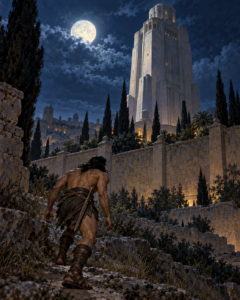 In The Tower of the Elephant, Conan first appears in a cheap tunic, with a sword hanging from a worn leather scabbard. Before approaching Yara’s tower, he discards the torn tunic and Conan’s weapons and armour continues in a loincloth and sandals.
He is entering a walled garden and climbing a tower in the dark. Mail would offer protection, but it would also add weight and make stealth harder. Howard’s account of the climb gives us a young thief equipped for the particular danger ahead.
There is no enchanted sword to save him when the tower’s monstrous spider comes at him. Conan has his strength, his reflexes, and whatever is within reach. The suspense comes from watching him use them.
Rogues in the House offers another glimpse of the lightly equipped Conan. Escaping prison, he throws off his ragged tunic and moves through the streets in a loincloth, carrying a captured poniard. He does not pause to collect the perfect heroic weapon. He takes what he has and heads into the Maze.
Both scenes explain something that illustrations alone cannot. Conan’s lack of armour is sometimes a practical choice; at other times, it reflects what he can lay his hands on. An exposed body makes every blade and claw more threatening. It does not make him invulnerable.
A Soldier Wears His Trade
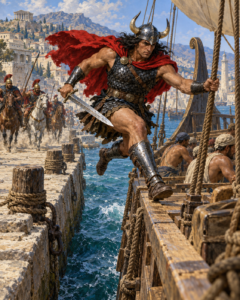 Now meet Conan at the opening of Queen of the Black Coast. He leaps aboard the Argus with armed riders behind him, a bloodied broadsword in his hand, and a scarlet cloak streaming from his shoulders.
Beneath it he wears a black scale-mail hauberk, greaves, and a horned helmet of blue steel. Howard makes him instantly recognizable as a man accustomed to fighting, even before he tells the shipmaster his name.
That is a very different image from the thief climbing the Elephant Tower. Conan has not become a different character. His circumstances have changed. A fighter facing swords and arrows has reason to welcome the protection that would hinder a stealthy climb.
In Black Colossus, Conan appears in the chain-mail hauberk of a mercenary. Later, Princess Yasmela has him dressed for command in full plate armour, replacing his mail with a cuirass, pauldrons, greaves, and a helmet. Those around him are startled by how naturally he wears it. The armour protects a commander on the battlefield, but it also changes how others see him. For a moment, the steel suggests the king he may one day become.
We should be careful about arranging every Conan story into a neat progression from loincloth to crown. Howard did not write them as a single, orderly record of Conan’s wardrobe. What the stories show clearly is his range: thief, mercenary, pirate, commander, and king. Each life brings its own tools and dangers.
Whatever Comes to Hand
The sword is Conan’s most familiar weapon, but Howard rarely allows it to solve every problem. In Rogues in the House, a beef bone helps Conan escape his cell. He takes the guard’s poniard and uses it through the dangers that follow. The knife has no grand history, and Conan has no reason to treasure it. What matters is that he has it when he needs it.
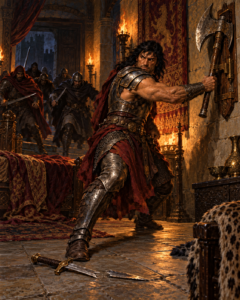 In The Phoenix on the Sword, Conan’s blade shatters against an attacker’s helmet. Surrounded in his own palace chamber, he tears an old battle-axe from the wall and fights on. Even that proves no answer to the monstrous creature that enters the room. His survival depends on reaching the broken sword again. The weapons change within a single fight, each meeting a different danger.
In Red Nails, Conan faces a huge reptilian creature from a position above it. Its scales make a sword a poor answer, so he binds his poniard to a bundle of branches, poisons the blade, and drives his makeshift spear into an unprotected part of the beast’s jaw. The shaft breaks as its jaws snap shut. The scene turns on distance, timing, and a weapon Conan has made for the opening he needs.
Such moments make Howard’s fights feel dangerous. Conan may be exceptionally strong, but he still has to judge his surroundings. A shorter blade belongs in a tight passage. A spear gives its wielder reach. A sword can fail against a foe that cannot be approached.
The weapon is part of the decision, and the wrong decision can be fatal.
Steel Has a Cost
Armour also tells us something about the world around a fighter. A mail shirt must be made, acquired, and kept in repair. A shield can turn a blow, but it occupies a hand. A helmet might save a life while narrowing its wearer’s view. Protection always changes how someone moves and fights.
Those choices are particularly vivid in sword and sorcery. Its heroes often travel beyond the reach of friendly armies, through alleys, wilderness, ruined cities, and hostile courts.
Equipment may be lost with a horse, stripped away in captivity, or exchanged for something better after a hard-won victory. A blade is valuable because the person carrying it may have nothing else to rely on.
This is why Conan’s shifting appearance feels right. The thief can strip down to cross a rooftop. The soldier can buckle on mail before battle. The commander can stand in polished plate beneath a banner. Howard lets Conan adapt without forgetting what a sword, a knife, or a suit of armour is for.
The steel matters. So does knowing when to wear it, when to leave it behind, and how to survive when it is gone.