Sword & Sorcery was born in the pages of Weird Tales.
Its founding authors wrote beside masters of horror, shared ideas through letters and filled their imagined worlds with sorcerers, forgotten gods, prehistoric races and things that should not exist.
It is hardly surprising, then, that Sword & Sorcery is often treated as a branch of Weird Fiction.
But the relationship is not so simple. The Weird runs through the blood of Sword & Sorcery, yet it does not define the genre. It is one end of a broad spectrum — an inheritance that some stories embrace completely, others use sparingly and still others can leave behind almost altogether. At the opposite end lies the muscular pulp adventure: immediate, human and driven by ambition, danger, steel and survival.
Both can belong to Sword & Sorcery. The difference is not merely academic. It determines what we expect when a warrior enters a ruined city, what sort of threat waits behind its sealed doors — and whether the story is ultimately about the terror of the unknown or the hero who dares to confront it.
When Weird Fiction and Sword & Sorcery Shared the Pulps
Robert E. Howard was not writing beneath a sign marked Sword & Sorcery. The term itself would not be coined until decades later, when Fritz Leiber proposed it in 1961 to describe the kind of fantasy adventure Howard had pioneered — an evolution traced more fully in this history of Sword & Sorcery.
Howard wrote for the pulp market, crossing freely among historical adventure, boxing stories, Westerns, horror and fantasy. His Kull, Solomon Kane and Conan tales emerged from that restless mixture. They carried the speed and physicality of adventure fiction into worlds haunted by ancient evils and supernatural remnants.
Howard’s friendship with H. P. Lovecraft is an important part of this history, but it is easy to simplify their relationship. Howard did not begin writing supernatural adventure because Lovecraft showed him how. Red Shadows, featuring Solomon Kane, appeared in 1928. The Shadow Kingdom, with its hidden serpent-men and atmosphere of ancient conspiracy, followed in 1929. Howard and Lovecraft began corresponding in 1930.
What followed was not a one-way transmission but a lively exchange between two very different imaginations. They shared invented names and fragments of mythology, discussed history and civilization, and participated in the wider creative cross-pollination now associated with the Lovecraft Circle. Yet their deepest instincts remained distinct.
Lovecraft looked into the cosmos and emphasized human insignificance. Howard looked into the same darkness and sent in a warrior with a sword.
The Weird End of the Blade
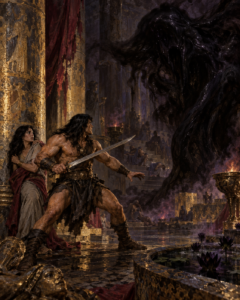 Some of Howard’s Conan stories lean heavily into the Weird Fiction elements. The Tower of the Elephant begins as a thieves’ adventure: Conan hears of an impossible jewel, scales a forbidden tower and enters its guarded chambers in search of treasure. Yet the adventure gradually opens into something stranger. Yag-kosha is not merely a monster or enchanted beast, but an alien being imprisoned far from his own world. The tower, the gem and the vengeance at the story’s heart carry Conan beyond common sorcery and into cosmic territory.
Even then, the story never becomes Lovecraftian in spirit. Conan does not lose his sanity upon discovering that humanity is not alone in the universe. He listens. He understands enough to act. Faced with the impossible, he does not surrender his agency.
The Slithering Shadow — also published as Xuthal of the Dusk — travels farther towards decadent Weird horror. Conan and Natala discover a lost city whose inhabitants exist in a dreamlike stupor, sustained by black lotus and preyed upon by a crawling horror. Xuthal is ancient, narcotic and corrupt: a place where civilization has withdrawn from struggle and surrendered itself to appetite, sleep and decay. The creature Thog is less an opponent in the ordinary sense than an intrusion from some older and darker order. Yet when it emerges, Conan does what Conan always does. The unknowable is forced into physical conflict. Horror becomes combat.
The same current appears throughout Howard’s work. In The Devil in Iron, an ancient supernatural power awakens upon an abandoned island. The Vale of Lost Women culminates in a grotesque winged horror and an unearthly ritual. Iron Shadows in the Moon moves from pursuit and piracy into a haunted ruin inhabited by stone figures and a monstrous grey ape. The Pool of the Black One begins with buccaneering rivalry before leading Conan into an island of eerie transformations and inhuman guardians.
These are recognizably Weird elements: lost races, forbidden places, decadent survivors, prehistoric memories, alien entities and powers beyond ordinary understanding. They contribute mystery and menace. They make the world feel older than its kingdoms and less comprehensible than its maps suggest.
But they are not the entirety of Sword & Sorcery.
Sorcery Is Not the Same as Cosmic Horror
The presence of the supernatural does not automatically make a story Weird.
A witch, curse, ghost, enchanted weapon or hostile god may belong to any number of fantasy traditions. What marks the Weird is not simply that natural law has been broken, but the particular sensation created by that rupture: reality has become unstable; human knowledge is inadequate; something alien, grotesque or fundamentally inexplicable has pushed through the familiar world.
Sword & Sorcery can use that sensation brilliantly. The supernatural is often most effective when it remains dangerous and partially unknowable. Magic should not always feel like a reliable instrument whose rules might be printed in a handbook. In many of Howard’s finest stories, sorcery feels old, corruptive and hostile to ordinary life.
Yet Sword & Sorcery does not require cosmic dread.
Its essential conflict can remain entirely human: a thief against a tyrant, a mercenary trapped between rival armies, a pirate fighting for command, or a wanderer caught within the intrigues of a decadent court. Treachery, greed, lust, revenge, warfare and survival provide more than enough fuel. Sorcery may intensify that conflict without becoming its subject — and it may sometimes be absent almost completely.
The sword is not merely the weapon used against the Weird. It represents the material heart of the genre: action, courage, bodily danger and the determination to impose human will upon a hostile world.
Howard’s Conan Was Never Fixed at One Point
Even within a single character’s adventures, Howard moved freely across the spectrum.
Rogues in the House is fundamentally a tale of political intrigue, imprisonment, betrayal and revenge. Thak lends it a horrific edge, but the story is driven by recognizably human motives. Queen of the Black Coast begins as maritime adventure and becomes an account of piracy, conquest and doomed passion before its supernatural elements rise to the surface. Beyond the Black River draws much of its strength from frontier warfare and the clash between civilization and barbarism, though darkness gathers at its edges.
Elsewhere, the Weird takes command. Xuthal would lose much of its identity without its drugged dreamers and crawling god. The Tower of the Elephant would be a very different tale if its treasure were merely a jewel and its prisoner merely a man. This variation is not inconsistency. It is evidence of the genre’s range.
Howard could begin with a familiar pulp structure — a jailbreak, a treasure hunt, a frontier siege, a pirate mutiny—and decide how far beyond the natural world he wished to travel. Sometimes sorcery waits at the end of the road. Sometimes it watches from the margins. Sometimes human cruelty is monstrous enough.
That freedom remains one of Sword & Sorcery’s greatest strengths.
 A Spectrum of Personal Taste
Readers do not all come to Sword & Sorcery seeking the same experience.
Some are drawn to the Weird end of the spectrum: dreamlike cities, decadent sorcerers, forbidden knowledge and the suggestion of vast powers operating beyond human comprehension. For them, the supernatural strangeness is not an embellishment but the genre’s richest atmosphere.
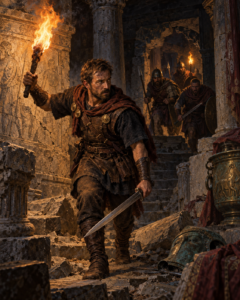
Others come for the pulp adventure: blades crossing in torchlit corridors, ships driven through black seas, ruined strongholds, desperate escapes and heroes whose fate depends on strength and cunning. They may enjoy a restrained supernatural presence while losing interest when the human struggle dissolves beneath cosmic mythology.
I belong firmly toward this second end. I have never been particularly drawn to Weird Fiction for its own sake, nor to Lovecraft’s cosmic pessimism or the decadent fatalism of Clark Ashton Smith. Even in Howard, the Weird elements are rarely what attract me most. I return for the momentum, the danger, the ancient world, the clash of character and civilization — and, above all, for heroes who act.
That preference does not require denying the genre’s history. The Weird is undeniably present at its birth, and many readers reasonably consider it indispensable to their ideal form of Sword & Sorcery. But a historical influence should not be mistaken for an eternal requirement.
Sword & Sorcery is not defined by tentacles, alien gods or the insignificance of humankind. It does not cease to be itself when the nameless horror retreats beyond the torchlight.
When the Hero Refuses to Be Insignificant
Perhaps the clearest dividing line lies not in the creature, ruin or spell, but in the story’s response to it.
Cosmic horror tells us that humanity is small, fragile and incapable of comprehending the forces surrounding it. Sword & Sorcery may accept the first two claims. Its heroes are mortal. Kingdoms collapse. Civilizations decay. The wilderness eventually reclaims every road and tower.
But the genre resists the final surrender. Its hero may not understand the horror, yet understanding is not always necessary. The thing can still be opposed. The prisoner can still be freed. The sorcerer can still bleed. The haunted city can still be escaped before dawn.
Conan cannot reorder the cosmos, but neither will he kneel before it. This is where Howard transforms the Weird material surrounding his heroes. The unknown remains dangerous, but it does not automatically erase human significance. Courage may be temporary and victory incomplete, yet the act of resistance matters. A single human life matters — especially to the person fighting to preserve it.
That defiance, rather than cosmic horror, stands nearer the heart of Sword & Sorcery.
The Weird is an Ingredient, Not a Commandment
Sword & Sorcery was forged in an era when the boundaries between adventure, fantasy and horror were porous. It carries traces of all three. To strip away every supernatural shadow would diminish much of its atmosphere, but to declare that the genre must be Weird is equally restrictive.
The Weird can deepen Sword & Sorcery. It can make magic dangerous again, fill the past with unanswered questions and place something more disturbing than another armed man behind the final door. At its best, it gives the hero an adversary that cannot be defeated by strength alone — even if strength remains necessary.
But Sword & Sorcery can also thrive closer to the firelight: among mercenaries, thieves, pirates, queens, border wars and blood feuds. Its scale can remain human. Its mysteries need not reach the stars.
Weird Fiction contributed profoundly to the genre’s atmosphere without establishing the limits of what Sword & Sorcery could become. The genre is broad enough to contain both the alien tragedy of Yag-kosha and the murderous politics of Rogues in the House; both the crawling horror beneath Xuthal and the salt-stung freedom of the Black Coast.
The Weird is in its ancestry. Adventure is in its bones.
Where any particular tale rests between them is not a test of legitimacy, but a matter of emphasis — and, ultimately, of taste.