There is a particular pleasure in browsing a secondhand bookshop with no guarantee of finding anything.
I like working along the shelves, pulling out old paperbacks and studying their covers, hoping that a vintage Conan will turn up — an original Lancer with one of Frank Frazetta’s extraordinary paintings, or a later edition bearing the work of Boris Vallejo. Or perhaps a Tarzan paperback will catch my eye: a battered spine, a faded price, and suddenly something worth taking home.
These artists, alongside many others, helped give adventure paperbacks their enduring visual appeal. Before we read the opening sentence, a painting can make us curious about the world inside.
Today, I wanted to honour another of those masters who recently left us: Sanjulián, whose legacy spans more than half a century of fantasy, horror and adventure illustration. The Spanish artist, born Manuel Pérez Clemente in Barcelona in 1941, died on 14 October 2026, aged eighty-five.
He leaves behind an immense body of work, including Conan paintings, paperback covers, film imagery and some of the most memorable covers in horror publishing. For readers of sword and sorcery, his work belongs to the visual landscape of the genre. His paintings invite us into places where physical courage matters, sorcery carries a threat, and the darkness beyond the fire might conceal something ancient.
A World Within the Cover
A good adventure cover gives the imagination somewhere to go. A warrior stands beneath an unfamiliar sky. Behind him, a ruined structure suggests a history we do not yet know. The light catches a blade, a face, the edge of something emerging from shadow.
We begin supplying the questions ourselves. Who built this place? What happened here? What is he facing?
Sanjulián understood that invitation. His figures possess weight and presence, while the surrounding atmosphere makes their situation compelling. Flesh, steel, darkness and colour contribute to the promise of an adventure.
There is considerable craft involved in making such an image work on a crowded shelf. A cover must catch the eye at a distance, survive the addition of a title and lettering, and reward closer inspection. The strongest examples remain satisfying long after their immediate commercial purpose has passed. We remember the painting, seek out other work by the artist, and sometimes buy a book largely because of the image on its cover.
That seems a perfectly respectable reason to add another paperback to the collection.
From Barcelona to the Paperback Shelf
Sanjulián trained at Barcelona’s Sant Jordi art school and worked through the influential agency Selecciones Ilustradas before reaching American clients around 1970. His career grew across international publishing markets, bringing his work to readers far beyond Spain.
His reputation became closely associated with Warren Publishing’s Creepy, Eerie and Vampirella. Those magazines offered ample opportunity for dramatic painted imagery, and his covers became an important part of their appeal. He also painted book covers for major American publishers, including sword-and-sorcery titles featuring Conan.
It is easy to concentrate on the famous characters and overlook the range behind them. Sanjulián’s career encompassed monsters, historical figures, cinematic subjects and imagined worlds. Across those subjects, his command of convincing human forms helped give fantastic situations a tangible presence.
That ability matters in fantasy. Readers may willingly accept an impossible creature or a supernatural landscape, but a convincing gesture or expression gives them something familiar within it. The extraordinary becomes easier to enter when the people confronting it feel alive.
Painting Conan
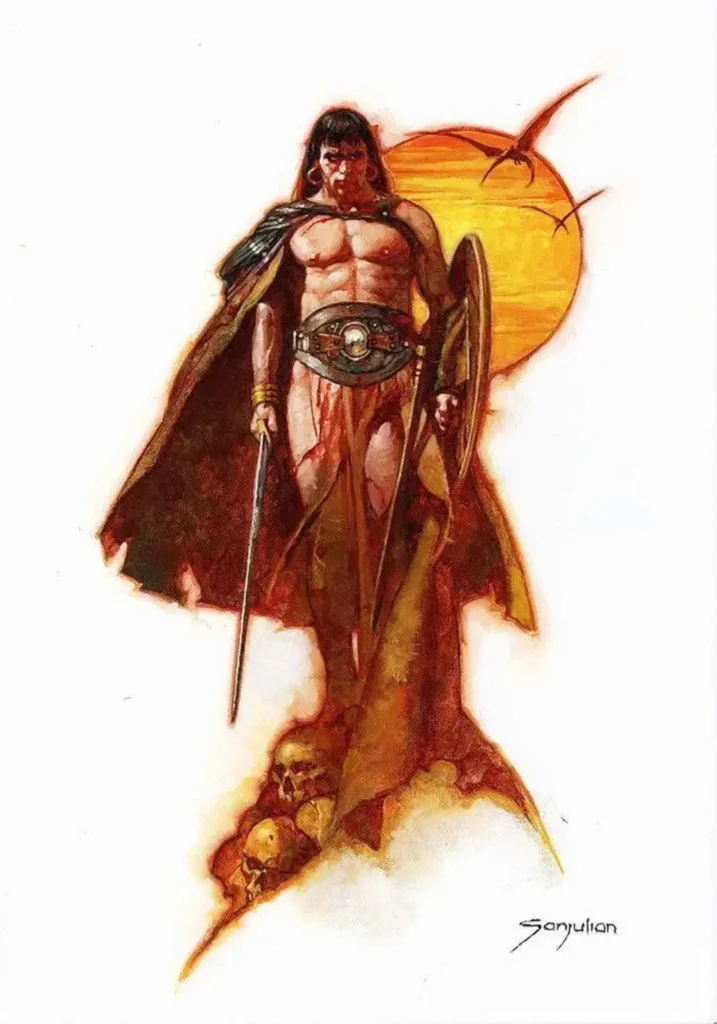 Conan is a revealing subject for any fantasy artist. His strength is immediately recognizable, but strength alone gives us only part of the character. Howard’s Cimmerian is also alert, dangerous, adaptable and intensely alive. A successful painting needs to suggest someone capable of acting decisively within the world around him.
Sanjulián’s Conan work belongs to that tradition of physical, atmospheric storytelling. The appeal lies in the relationship between the warrior and his surroundings: the sense of a human presence confronting an uncertain and often hostile world.
According to a recollection reproduced by RTVE, two early Conan cover commissions were so well received that they brought him many further assignments in sword-and-sorcery illustration. It is a fitting detail in the career of someone whose paintings would become so closely associated with heroic fantasy.
Frazetta naturally comes into any discussion of this tradition. His influence is enormous, and his Conan paintings remain a personal favourite. Looking beyond him, however, reveals how much individual artists contributed to the genre’s visual richness. Sanjulián deserves that attention on the strength of his own work.
Sanjulián: An Adventure in Every Painting
There is something moving about the reach of a cover artist’s work. A painting made in one studio travels through bookshops, newsstands, bedrooms and private collections. Someone encounters it without knowing the artist’s name, remembers it for decades, and eventually discovers who held the brush.
Sanjulián’s son shared a particularly fitting recollection in his tribute to his father:
“In every painting I paint, there is an adventure.”
For those of us who love these images, that adventure continues through the act of looking. A painted scene can suggest stories beyond the one printed beneath its cover. It can influence how we imagine a character, how we picture a distant kingdom, or what we hope to find in our next book.
I think of that when browsing those secondhand shelves. Among the creased covers and ageing pages are paintings that still have the power to stop someone’s hand.
Sanjulián gave readers many such moments. His work will keep finding us there: a face, a blade, a remarkable patch of colour — and the feeling that something extraordinary waits inside.
Explore more of Sanjulián’s paintings and original artwork at Corner4art.