A sword raised against the darkness. A prayer offered before battle. A god who answers when all seems lost.
Fantasy often brings mortals and divine powers together at the moment of greatest need. Faith earns protection. Devotion brings guidance. A warrior enters battle believing that something greater watches over him.
Robert E. Howard gives Conan a much harsher inheritance. His god is Crom, who dwells upon a mountain and cares little whether men live or die. Conan expects no rescue from him. Calling for his attention might make matters worse.
Yet this apparent absence of divine favour helps explain the enduring appeal of Conan himself. His courage requires no promise that the universe will reward it. When danger comes, he must act with the strength he possesses.
In Queen of the Black Coast, Howard gives that outlook its clearest expression. Conan and Bêlit are aboard the Tigress, travelling up the ominous river Zarkheba. Darkness surrounds them, and their conversation turns towards the gods. Bêlit observes that she has never heard Conan call upon his own.
His answer deserves to be read in full:
“Their chief is Crom. He dwells on a great mountain. What use to call on him? Little he cares if men live or die. Better to be silent than to call his attention to you; he will send you dooms, not fortune! He is grim and loveless, but at birth he breathes power to strive and slay into a man’s soul. What else shall men ask of the gods?”
—Robert E. Howard, Queen of the Black Coast
Strength Is the Gift
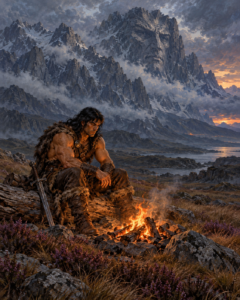 The final question carries the weight of the passage.
Crom has already given a person the capacity to struggle. In Conan’s understanding, that is the extent of the gift. There is no continuing arrangement through which sufficient devotion purchases safety. Strength has been given; using it falls to the mortal who received it.
This is a severe belief, but it suits the world Conan inhabits. Steel cuts flesh regardless of a warrior’s convictions. Hunger cannot be argued away. An enemy will exploit hesitation whether its cause is fear, pride, or misplaced confidence in supernatural protection. Conan therefore places his trust in things he can bring to bear: a ready weapon, trained instincts, physical endurance, and the will to move when others falter.
His famous exclamations of Crom’s name should be understood in that light. An oath is not necessarily a request. The name belongs to his language and his Cimmerian inheritance; invoking it does not mean he expects a hand to descend from the heavens.
There is also something sharper here than simple divine indifference. Conan believes Crom’s attention may bring disaster. Silence becomes practical wisdom. A man already facing enough trouble has little reason to invite the notice of a grim power who feels no affection for him.
That gives Crom a distinctive place among fantasy gods. His importance lies in how belief in him shapes the believer’s conduct. Conan carries that belief into danger as an expectation that he must meet it himself.
Belief Without Dependence
Howard also avoids making Conan’s self-reliance depend upon disbelief.
In the same conversation, Conan treats other gods cautiously. He acknowledges their possible power to harm or help, while adding a revealing qualification: such claims come from their priests. His response combines inherited belief, personal experience, and suspicion of what others profess to know.
This is a useful distinction. Conan does not need to dismiss the supernatural to resist surrendering his judgement to it. He lives in a world where sorcery and monstrous beings present tangible dangers. Underestimating them would be foolish. So would assuming that reverence makes them trustworthy.
For sword and sorcery, that uncertainty is fertile ground. A temple can hold wealth, political authority, forbidden knowledge, or something its worshippers barely understand. A priest’s claim to divine favour may conceal ambition. A sacred object may possess real power without offering any protection to the person who carries it.
The question becomes how a mortal should act amid forces whose existence may be undeniable but whose purposes remain obscure. Conan’s answer is characteristically practical: keep your senses, judge the danger, and retain the ability to act.
There is an ethical difficulty in admiring this outlook, and Howard’s language makes it impossible to ignore. Crom grants the power to “strive and slay.” Conan’s strength serves a violent life. He is capable of loyalty and generosity, but also plunder and ruthless killing. His independence does not turn every decision he makes into a righteous one.
That makes the passage more interesting. Self-reliance is a capacity, and its moral worth depends partly on what a person does with it. Courage can defend a friend or carry a raider aboard another man’s ship. Freedom from divine instruction leaves room for responsibility as well as appetite.
Nor does Conan’s attitude mean that he cannot accept help. He travels with companions, learns from experience, and recognizes useful knowledge in others. A person who refuses every offered hand would soon become a liability aboard a ship. There is a considerable difference between accepting assistance and believing that assistance is owed.
What Conan refuses to build his life around is the expectation that Crom will intervene.
Courage Without Guarantees
This gives his courage a particular force. He cannot reassure himself that devotion guarantees survival. He must commit himself while the outcome remains uncertain. Fear, injury, and death retain their power because no bargain has placed him beyond their reach.
Readers can recognize something human in that position, even without sharing his beliefs. Much of life must be faced without certainty that effort will succeed or fairness prevail. Preparation matters. Companionship matters. So does the decision to continue when neither can guarantee the result.
Crom offers no comforting answer to that uncertainty, which brings us back to the question what makes a hero: the decision to act when survival is far from assured.
Conan’s response is to live vigorously within the uncertainty.
That is why this brief exchange aboard the Tigress reaches beyond fictional theology. It reveals the foundation beneath the sword arm: a man who believes he has already received what his god will give him, and who expects the next act to be his own.
Crom remains upon his mountain.
Conan draws his sword.