A map lies between a handful of strangers. Someone has heard of a ruined temple beyond the hills. Someone else knows a merchant willing to pay for whatever remains inside. There are disagreements about the route, suspicions about the merchant, and very little enthusiasm for the temple’s reputed inhabitants.
Eventually, someone asks the question that matters. Who goes first?
It could be the beginning of a sword-and-sorcery story. It could also be an ordinary evening around a gaming table. In our recent exploration of sword & sorcery in video games, we considered what happens when readers become participants: when entering the ruin becomes a decision we make ourselves.
Tabletop gaming carries that invitation into a shared space. In tabletop roleplaying games (TTRPGs), friends gather, dangers are described, plans are proposed, and an adventure begins to take shape between them.
Few genres provide better material for such an evening than sword & sorcery. Its wandering adventurers, dangerous bargains, forbidden treasures and uncertain loyalties almost seem to arrive with the first scenario already prepared.
An Adventure Worth Getting Into
A good tabletop RPG adventure needs a reason to begin. Sword & Sorcery offers plenty. A caravan requires protection. A captive needs rescuing. A thief has discovered an entrance beneath a palace. An employer promises gold for an object he is strangely reluctant to describe.
These situations establish a motive without requiring everyone at the table to understand centuries of invented history. The characters need something. An obstacle stands between them and it. Beyond that obstacle lies the possibility of a much worse problem.
The apparent simplicity leaves room for discovery. Perhaps the captive does not want to leave. Perhaps the merchant has hired another company. Perhaps the treasure’s guardians are keeping something inside the tomb rather than protecting it from intruders. This is fertile ground for play because a decision can change the situation immediately. Bargaining, stealing, fighting and retreating all carry consequences. The adventure grows through what the characters do.
For me, that is where the connection becomes strongest. Sword & sorcery places tremendous weight on action under pressure. A gaming table lets several people share the responsibility for it.
Conan Comes to the Table
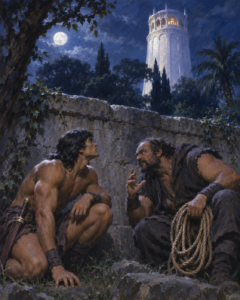 Conan’s tabletop history reaches back decades. TSR brought the Hyborian Age into Advanced Dungeons & Dragons through Conan Unchained! and Conan Against Darkness! in 1984. Later, Modiphius’s Conan: Adventures in an Age Undreamed Of offered a dedicated interpretation using its 2d20 roleplaying system. These earlier games approached Howard’s world through different rules, each exploring how its warriors, sorcerers and dangerous adventures might translate to the table.
Monolith’s Conan games offer two distinct ways into that experience. Its Conan board game builds adventures around scenario maps, miniatures and specific objectives. Heroes draw on pools of Energy Gems to move, attack, defend and perform other actions. Committing heavily to a decisive effort can leave a character exhausted when the enemy responds.
Depending on the mode, opposition is controlled by an Overlord player or by solo/cooperative scenario instructions. That gives physical form to a familiar adventure problem: how much strength can you afford to spend getting past the danger in front of you? A successful attack matters differently when it leaves too little in reserve. Bravery may demand commitment, but survival requires judgment. The figures on the board make position and danger visible; the decisions give those pieces a story.
Monolith’s separate TTRPG, Conan: The Hyborian Age, opens the setting to adventures created through conversation and character choices. Its premise places King Conan on Aquilonia’s throne while other adventurers make their own names. The free Quickstart includes five prepared characters and a complete introductory adventure, The Seal of Acheron. Here, the attraction is the space around Conan’s legend. His world contains more dangerous employment, sinister cults and forgotten places than one Cimmerian could ever visit. Players can enter that landscape with ambitions and loyalties of their own.
The board game and roleplaying game therefore offer different kinds of participation. One gives the group a defined tactical situation to overcome. The other allows the situation itself to expand as the players act and the Game Master responds.
Tower of the Elephant: One Story, Several Doors
Monolith’s recent Zamora expansion brings a particularly familiar destination to the board: the Tower of the Elephant. Announced through its Tales of Tortage and Zamora campaign, the expansion represents the tower across connected levels and provides scenarios for both Adventure Mode and solo/cooperative play.
That connection caught my attention for a personal reason. The Tower of the Elephant was also our first FirePath Conan adaptation. It is easy to understand why the story invites different forms of participation. A young thief hears of an extraordinary jewel hidden within a sorcerer’s tower and decides to attempt what other men consider impossible. The dangers are uncertain. Each success carries him deeper into a mystery he did not know he was entering.
Yet the story’s lasting power reaches beyond the burglary. Howard allows the adventure to change meaning as Conan discovers what the tower contains. Curiosity and greed bring him across the threshold; what he encounters there demands something more of him.
A board game, a roleplaying session and an interactive book approach such material through different tools. Position and resources matter on the board. Conversation can open unexpected possibilities in a roleplaying game. An interactive adaptation places choices within a written narrative.
The shared attraction is the chance to approach a familiar danger and wonder what we would do inside it.
Lankhmar: Trouble Beyond the Dungeon
Conan is only one road into the tradition. Goodman Games’ Dungeon Crawl Classics (DCC) RPG offers another route through its Lankhmar setting, adapting Fritz Leiber’s world of Nehwon, home to Fafhrd and the Gray Mouser. Its material brings the people, places and supernatural powers of those stories to the gaming table.
Lankhmar offers a useful reminder that adventure need not begin with a distant wilderness. A crowded city can provide more trouble than an expedition has time to find. Imagine a stolen purse that contains the wrong key. A debtor who disappears before paying. A tavern acquaintance offering work that sounds suspiciously respectable. Every street offers another witness, rival, employer or escape route.
The city also gives companionship room to become part of the adventure. Plans are improved — or ruined — by the person beside you. A companion’s appetite for easy money becomes everyone’s problem. Escaping together may matter more than keeping the treasure.
This suits the social nature of tabletop gaming. A group does not need to produce a company of solemn heroes united by perfect agreement. Friction, friendship, ambition and occasional foolishness can carry an evening wonderfully well, provided the players still give one another room to participate.
Where Dungeons & Dragons Fits
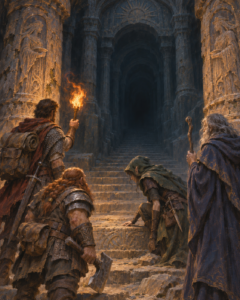 Dungeons & Dragons (D&D) belongs in this discussion because sword & sorcery forms part of its literary inheritance. Gary Gygax’s Appendix N, the inspirational reading list in the 1979 Advanced Dungeons & Dragons Dungeon Masters Guide, points readers towards authors including Robert E. Howard and Fritz Leiber. That connection does not mean every D&D adventure will feel like a Conan story. The game accommodates many approaches to fantasy, and the character of a campaign depends greatly on what its participants want to explore.
A campaign might follow champions confronting a threat to the world. Another might follow adventurers attempting to earn enough money to leave a city where they have become deeply unpopular. Both can contain monsters, magic and dangerous journeys, while offering quite different pleasures.
For a sword-and-sorcery approach, I would look first at the adventure’s focus. Give the characters a compelling immediate motive. Let the supernatural remain capable of surprising them. Make employers fallible, treasure troublesome, and retreat a meaningful possibility.
Magic need not disappear from the players’ hands for the unknown to remain threatening. A character may understand one spell perfectly and still have no idea what is moving beneath the temple floor. Nor must every adventure remain small. Kingdoms can fall and armies can march while the characters struggle with something personal inside those events.
What matters is whether we continue to feel their danger, choices and reasons for acting.
Tabletop Roleplaying Games: The Story Between the Players
Tabletop games possess a particular kind of uncertainty. The rules provide a framework, but the people gathered around them bring judgment, invention and habits that no adventure writer can fully anticipate.
Someone tries to negotiate with the supposed villain. Someone becomes attached to an incidental character. Someone spends half the evening devising a plan that fails at the first locked door. Out of these decisions comes a story the group remembers because they helped make it happen. The defeated monster may fade from memory before the disastrous bargain does. A failed escape can become a better tale than a victory achieved exactly as expected.
Sword & sorcery thrives in that space. Its adventurers are resourceful, imperfect people whose plans collide with a stranger and more dangerous world than they imagined. They survive through courage, cunning, loyalty and luck, often with good reason to wish they had stayed in the tavern.
Across Monolith’s Conan games, the streets of Lankhmar and a D&D campaign shaped by pulp adventure, the invitation remains remarkably familiar.
There is a rumour worth investigating. A reward worth considering. A place sensible people avoid.
Around the table, the argument over the route has finally ended.
Someone picks up the dice.