Once, a book offered only one road.
The hero entered the forest, descended into the dungeon or drew steel against the enemy, and the reader followed.
However fiercely we might have imagined ourselves in the hero’s place, the story had already been decided. Every door would open as the author commanded. Every choice had already been made.
Then a new kind of literature placed the decision in the reader’s hands.
Turn left or right. Trust the stranger or draw your sword. Drink from the fountain. Open the forbidden door. Fight, flee or bargain. Suddenly, reading was no longer merely an act of observation. It was an act of participation — and every decision carried the possibility of triumph, disaster or death.
Today, we call them gamebooks, interactive novels, solo adventures or role-playing RPG literature. The names describe slightly different traditions, but all belong to the same imaginative lineage: stories that invite the reader to enter the world, assume a role and help determine what happens next.
Their great age is often remembered as a distinctly 1980s phenomenon, preserved in battered paperbacks, pencilled character sheets and fingers wedged between pages. Yet the gamebook did not disappear when its original boom subsided. Its ideas spread into computer games, narrative adventures and interactive media—and now the books themselves are returning.
The paths are opening once again.
When Fantasy Left the Page
The origins of interactive literature reach further back than any single series. Writers experimented with branching structures long before the term gamebook became familiar, while puzzles, literary mazes and instructional stories had invited unusual forms of participation for generations.
The decisive change, however, came when fantasy ceased to be something an audience only witnessed and became somewhere a player could enter.
Published in 1974, Gary Gygax and Dave Arneson’s Dungeons & Dragons transformed the emerging ideas of fantasy role-playing into a game that could be shared around a table. Its earliest rules still bore the iron framework of miniature wargaming, but its imaginative power lay elsewhere. A player did not simply command an army. A player became someone: a fighter, a magic-user, a cleric, an adventurer with strengths, weaknesses, possessions and the uncertain promise of experience still to come.
The dungeon was not a story in the conventional sense. It was a place of possibilities. Behind one door might wait treasure; behind another, a trap; behind a third, something with too many teeth. The Dungeon Master prepared the world, but the players determined how they would meet it. Story emerged from the collision between design, decision and chance.
This changed the language of fantasy adventure. Character classes, statistics, equipment, exploration, combat and consequence became part of a new form of storytelling. The hero no longer survived because the next chapter required it. A poor decision or unlucky throw could bring the adventure to an abrupt end.
Around the table, fantasy had become participatory.
The next question was inevitable: could the same experience live inside a book?
The Reader Becomes the Hero
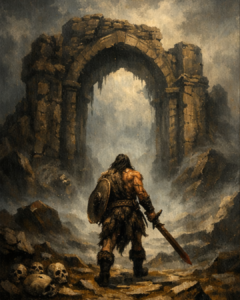 The late 1970s brought branching fiction to an enormous popular audience. Bantam’s Choose Your Own Adventure series, beginning with Edward Packard’s The Cave of Time in 1979, placed readers directly inside stories shaped by their decisions.
The invitation was irresistible. Instead of reading about an explorer entering the unknown, you entered it. At the foot of the page, the book presented a choice. Each answer sent the reader to another numbered passage, where the story continued along a different path. Some roads led to victory. Others ended in capture, calamity or wonderfully sudden death.
These books generally favoured choice over complex rules. There were no elaborate character sheets to maintain and few calculations to make. Their brilliance was immediate and accessible: they broke the fixed line of the conventional story and made curiosity dangerous.
Yet elsewhere, another tradition was forming — one that would bind the branching narrative more closely to the mechanics and atmosphere of the tabletop role-playing game.
Fighting Fantasy and the Birth of the Modern Gamebook
In 1982, Steve Jackson and Ian Livingstone published The Warlock of Firetop Mountain. The book announced its purpose with magnificent simplicity: part story, part game, with the reader as the hero.
Fighting Fantasy united the branching structure of interactive fiction with recognizable elements of role-playing. Readers generated scores, carried equipment, rolled dice and fought monsters. A pencil, an eraser and a pair of six-sided dice could transform a quiet room into a dungeon expedition.
The books were compact, dangerous and often merciless. Success depended upon judgment and luck, but also upon discovering the correct route through a carefully constructed web of encounters. A key overlooked fifty passages earlier might prove essential. A seemingly harmless choice could lead to poison, imprisonment or a dead end. Many readers quietly preserved a finger at the previous decision, though the purists among us may prefer not to admit it.
The worlds were rarely safe and never dull. Sorcerers, assassins, monsters and ancient evils waited across ruined cities, haunted houses, wildernesses and labyrinths. The covers promised danger before the first page was turned, while the internal illustrations gave grotesque form to whatever waited in the dark.
Fighting Fantasy became the defining gamebook series of its age because it offered more than a novelty. It created a complete ritual of adventure. The character sheet, the dice, the numbered sections and the repeated return after failure all made reading feel active. The book was not only telling a story. It was testing the person holding it.
Its success opened the gates.
A Thousand Roads Through Fantasy
The gamebook boom produced an extraordinary variety of worlds. Although many shared the basic language of numbered passages and reader choices, the strongest series developed identities of their own.
J. H. Brennan’s GrailQuest, launched with The Castle of Darkness in 1984, carried readers into an Arthurian world that was heroic, absurd and knowingly mischievous. The reader became Pip, a young adventurer despatched upon quests by Merlin and armed with the appropriately named Excalibur Junior. Failure did not always mean oblivion. Death might send poor Pip to the memorable afterlife of Section 14 before Merlin restored the adventure.
Where many gamebooks maintained a stern face, GrailQuest delighted in breaking the tension. Its humour, direct address and eccentricity made the relationship between book and reader feel unusually personal. The narrator seemed to know that the adventure was a game — and that disaster could be part of the fun.
Joe Dever’s Lone Wolf, also beginning in 1984 with Flight from the Dark, pursued a different ambition. Its hero was the last survivor of the Kai Lords, warrior-monks charged with defending the land of Sommerlund from the gathering darkness. Readers selected Kai disciplines, gathered equipment and carried their character’s development from one volume into the next.
That continuity changed the scale of the experience. Lone Wolf was not merely a shelf of separate adventures. It was a life measured across books. Skills improved. Old enemies returned. Earlier decisions lingered. Magnamund possessed history, nations, wars and a sense of distance that made the series feel like an epic fantasy saga joined to a continuing role-playing campaign.
The connection was no accident. Dever had first created Magnamund as the setting for his own Dungeons & Dragons campaign. The world moved from tabletop play into literature, carrying the accumulated depth of an already-lived setting with it.
Then came Way of the Tiger by Mark Smith and Jamie Thomson. Beginning with Avenger! in 1985, the series placed the reader in the role of a warrior-monk trained in stealth, martial arts and mystical disciplines. Its world of Orb had also grown from a role-playing campaign, but the series possessed a character all its own. Combat was more than the exchange of abstract blows. The reader selected techniques, tested disciplines and inhabited the role of a ninja whose choices could shape not only a mission, but the fate of cities.
Like Lone Wolf, Way of the Tiger built momentum across multiple books. The reader’s victories and failures belonged to an unfolding saga. The journey could widen from vengeance into leadership, war and rule, allowing interactive literature to pursue consequences on a scale normally associated with long-form fantasy.
These series proved there was no single gamebook voice. Interactive fantasy could be grim or playful, episodic or continuous, mechanically simple or filled with rules. What united it was the compact between writer and reader.
The writer built the roads. The reader chose which one to walk.
Dungeons & Dragons Returns to the Bookshelf
As gamebooks flourished, the worlds of tabletop role-playing began spreading across publishing in every direction.
Adventure modules already occupied a strange and fascinating borderland between manual and story. They described lost temples, ruined keeps, villains, treasures and possible encounters, but left the final sequence of events unwritten. Conventional novels set in role-playing worlds soon followed, allowing settings associated with Dungeons & Dragons to develop histories and heroes beyond any individual campaign. Dragonlance, the Forgotten Realms and other shared worlds helped turn role-playing settings into vast bodies of fantasy literature.
Yet TSR also brought the solitary reader directly into its worlds. Beginning in 1982, the Endless Quest series offered choice-based adventures connected principally to Dungeons & Dragons, along with settings and properties such as Star Frontiers, Gamma World, Tarzan — and Conan. These books generally set aside dice and detailed statistics in favour of a swift branching narrative. Their roots in role-playing remained clear, however. The reader was usually given a defined character, a history and a place within an established world.
Three Endless Quest books carried the reader into the Hyborian Age: James M. Ward’s Conan the Undaunted, followed by Roger E. Moore’s Conan and the Prophecy and Conan the Outlaw. All three appeared in 1984. Here, one of fantasy’s greatest heroes entered interactive literature. The reader could take Conan’s role, confront the perils of Hyboria and discover how different choices altered his fate.
These were original adventures written for the gamebook form rather than adaptations of Robert E. Howard’s stories. Even so, their existence revealed how naturally Conan belonged within interactive fiction. Howard’s world was built upon decisive action. His hero survived through instinct, strength, cunning and an immediate reading of danger.
Again and again, Conan stands at the threshold of the unknown and acts.
What better hero could there be for a story shaped by choice?
When the Golden Age Faded
By the end of the 1980s, gamebooks had crowded the shelves. Success had produced imitation, expansion and eventually saturation. Some series remained strong, but the market could not sustain every new line sent into it.
Publishing fashions shifted. Major gamebook series slowed, changed hands or disappeared. By the early 1990s, the form that had once seemed inseparable from childhood fantasy reading had retreated from the mainstream. At the same time, electronic games were learning to deliver many of the experiences gamebooks had promised.
Computer and console role-playing games could track equipment automatically, calculate combat instantly and conceal their branching structures behind moving images and explorable worlds. The player no longer needed to turn to Section 217 to enter the crypt. The door opened on the screen.
Yet not every digital path led away from the written word. As web browsers spread through the 1990s, hypertext gave interactive fiction a natural new home. A choice no longer required the reader to turn to a numbered section; a link could carry them there instantly.
Online communities preserved text adventures, writers experimented with branching narratives, and later tools such as Twine allowed independent creators to build and distribute nonlinear stories with fewer technical barriers. Browser-based interactive fiction became a bridge between the printed gamebook and the modern narrative game — using new technology while keeping prose, imagination and reader choice at its heart.
But retreat is not extinction. The books remained on private shelves and in second-hand shops. Readers preserved them, collected them and introduced them to their children. Dedicated communities catalogued lost editions, discussed impossible routes and kept beloved worlds alive.
Meanwhile, digital editions and creative tools carried the structure into new forms, and video games absorbed its central lessons so thoroughly that they became almost invisible.
Dialogue choices, moral decisions, multiple endings, character statistics, inventory systems and branching quests now belong to the ordinary grammar of digital games. Long before a glowing screen presented those possibilities, a numbered paragraph and a command to turn the page had achieved much the same magic.
The gamebook had not been forgotten. It had become an ancestor.
The Modern Resurgence of RPG Literature
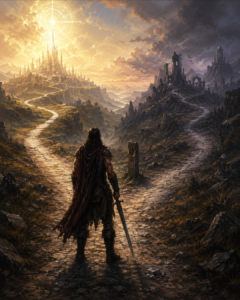 Now the ancestor is stirring.
The return has not taken the form of a single sudden craze. It is broader, slower and perhaps more enduring: a convergence of nostalgia, preservation, digital experimentation, collector culture and independent publishing.
Fighting Fantasy has returned through successive editions, new adventures and lavish anniversary releases. Its classic visual identity continues to inspire readers, while contemporary authors have added their own roads to the series. The warlock’s mountain is no longer a relic sealed in 1982. New readers are still climbing it.
Lone Wolf has received an ambitious Definitive Edition, bringing its volumes together in a consistent form. More remarkably, Light of the Kai completed Joe Dever’s 32-book saga in 2024 — forty years after Flight from the Dark first invited readers into Magnamund.
Way of the Tiger returned through crowdfunding and collector’s editions, with its unfinished journey extended beyond the point where the original publication had ceased. Other creators have used crowdfunding to prove that committed audiences still exist for interactive books, particularly when publishers treat them as objects worth keeping rather than disposable curiosities.
New series have also emerged. Projects such as Choose Cthulhu have transformed classic stories into branching adventures, while digital adaptations have carried gamebook design onto phones, tablets and computers. Print and screen no longer need to compete. Each can lead readers towards the other.
The modern resurgence is not an exact recreation of the 1980s. Nor should it be. The audience has changed, publishing has changed, and our understanding of interactive narrative has deepened. Many of the children who first entered Firetop Mountain, Camelot or Magnamund were also part of a broader generation raised on heroic fantasy across books, games, films, toys and Saturday-morning cartoons. They are now adult readers with decades of fantasy behind them. They remember the excitement of choosing a path, but they may now seek richer prose, stronger characterisation and decisions with greater narrative weight.
That creates room for a new kind of interactive literature: one that honours the immediacy of the classic gamebook while drawing upon everything fantasy fiction has learned since its golden age.
FirePath and the Return to Heroic Fantasy
FirePath Books was created within that opening. Its purpose is not to reproduce the gamebook exactly as it existed forty years ago. The classics already exist, and their finest qualities do not need to be imitated into lifelessness. FirePath asks a different question:
What can interactive fantasy literature become when the story comes first?
FirePath interactive adventures are built as works of heroic fantasy. They favour atmosphere, character and consequence over layers of calculation. There are no dice to roll and no statistics to maintain. The reader makes decisions at decisive moments, follows the path those decisions open and lives — or dies — with the result.
These paths can reveal dangers, confrontations and hidden corners of the story that a single fixed narrative could never contain. Yet they remain part of a coherent tale. Choice expands the adventure without reducing it to a collection of disconnected outcomes.
The result stands between the traditional novella and the classic gamebook: a substantial fantasy story whose road changes beneath the reader’s feet.
Tales from the Inferno
The first FirePath cycle, Tales from the Inferno, established this approach through the adventures of Rhun Kin.
These are original works of grounded heroic fantasy: stories of iron, endurance, loyalty and blood. Their branching paths do more than ask whether Rhun turns left or right. They test judgment. They expose different aspects of the world and the warrior moving through it. Some choices offer victory. Some bring delay or loss. Others end beneath a blade, beneath the earth or in the jaws of something waiting beyond the firelight.
Death matters because the story matters. A fatal path is not merely a mechanical instruction to begin again. It is a glimpse of what might happen when courage becomes recklessness, when caution comes too late or when the world proves stronger than the hero.
Through Rhun Kin, FirePath returned interactive literature to the hard roads of heroic fantasy. The reader does not stand outside the tale, directing a distant piece upon a board. The reader enters the danger beside him.
The Hyborian Chronicles
With The Hyborian Chronicles, FirePath returns to the character who had already proved, four decades earlier, how naturally Sword & Sorcery could inhabit the gamebook. This time, however, the foundation is Robert E. Howard’s original fiction.
Beginning with The Tower of the Elephant, the series transforms five classic Conan tales into interactive FirePath adventures. Howard’s stories remain the spine of each book: the atmosphere, the momentum, the danger and the fierce vitality of Conan himself. Around that foundation, new paths allow readers to confront choices that the original narrative passed in a single direction.
What if Conan chose another means of entering the tower? What if instinct led him towards a different danger? What waits beyond the door Howard never needed to open?
The purpose is not to correct the original stories or replace their outcomes. It is to enter them more deeply — to explore the possibilities already sleeping within their shadows.
That distinction separates The Hyborian Chronicles from the TSR Conan gamebooks of 1984. Those earlier books created new interactive adventures within the Hyborian Age. FirePath instead invites the reader into Howard’s tales themselves, preserving the original road while opening others beside it. The approach is especially suited to Conan. He is not a hero who waits for destiny to carry him. He climbs, strikes, escapes, risks and endures. His intelligence is physical and immediate, expressed through action under pressure.
To choose as Conan is to confront the world as he does: without certainty, without safety and without time to consult the rules. Four decades after Conan first entered the gamebook, the Cimmerian walks its branching roads again.
The Road Opens Again
Interactive fiction and RPG literature has always occupied a strange frontier. It is fiction, but it asks something more of the reader. It is a game, but its greatest victories are imaginative. Its worlds exist in words, yet they cannot move until someone makes a choice.
That may be why the format endures. Technology can calculate every statistic and render every monster, but there remains a particular power in facing a decision alone on the page. Nothing moves except the mind. No animation shows the sword rising. No voice announces that the door has opened. The reader supplies the motion, the sound and the fear — and then accepts responsibility for what follows.
The great gamebooks understood this. Fighting Fantasy, GrailQuest, Lone Wolf, Way of the Tiger, Endless Quest and their companions did not merely imitate role-playing games in print. They discovered a form of literature with its own rituals, dangers and possibilities.
That tradition is no longer confined to memory. Classic series are returning. Lost sagas are being completed. New writers are entering the labyrinth, and independent publishers are once again placing meaningful choices inside fantasy stories.
The gamebook never truly died. It waited — between numbered pages, upon old bookshelves and in the imaginations of readers who remembered what it felt like to become the hero.
Now the dice are rolling again.
The paths are opening.
And the next choice belongs to us.