Civilization has a high opinion of itself in Robert E. Howard’s fiction.
A kingdom trusts the borders on its maps. A court trusts a law because it’s old. A roomful of thieves laughs when a stranger from the hills asks a simple question.
Then Conan or Kull comes along, and some certainty that everyone else has lived with for years suddenly looks a good deal less certain. That is where the old contest between barbarian and civilization gets interesting.
Barbarian vs. Civilization
At the end of Beyond the Black River, Aquilonia has lost a province. Fort Tuscelan has fallen, cabins lie in ashes, and wounded men drink quietly in the taverns along Thunder River. A borderer looks across at Conan and says, “Barbarism is the natural state of mankind.” He follows it with a verdict as hard as anything Howard wrote. “Civilization is unnatural. It is a whim of circumstance. And barbarism must always ultimately triumph.
The line is often remembered as Conan’s. It matters that Howard gives it to a man who has just watched the frontier move backwards. Earlier, Conan reminds the young settler Balthus how Aquilonia acquired the land in the first place. Its men crossed the marches, burned villages and wiped out clans. Now the Picts have driven them back. The borderer has seen enough to know how little of that country ever belonged to the people who drew the maps.
Howard and Lovecraft on the Good Life
Howard and H. P. Lovecraft began corresponding in 1930. Their letters, collected in A Means to Freedom, grew into a long argument about what makes a life worth living. Lovecraft looked to the Athens of Pericles for an example of the intellectual and artistic life a settled society could sustain. Howard answered from experience.
One of his most exhilarating memories, he told Lovecraft, was a midnight fight with an Oklahoma drifter in an abandoned ice vault. The air stank of sweat, tobacco and cheap whisky. Oilfield men shouted them on. Years later, the memory could still get his blood moving.
In his letter of 6 March 1933, Howard pointed Lovecraft to the Norse sagas. The men who took to the sea had known hardship and bloodshed, and still they sang about the life they’d chosen. “They were alive; they stung, they burned, they tingled with Life.” In the same correspondence, Howard readily granted that civilization was better for people generally.
He understood what hunger, clan obligations and superstition could cost a man. Given the choice of being born into such a life and knowing it from childhood, he said he would still take it. That is the force of his argument. A life could be hard by any reasonable measure and still be fiercely worth living.
Conan in the Tower and on the Throne
Howard can make the point with a joke. In The Tower of the Elephant, a tavern full of thieves laughs at the young Cimmerian for asking why a man couldn’t climb the tower and come at the jewel from above. The narrator observes that “Civilized men are more discourteous than savages”. Conan, who has yet to learn what everyone in the room knows to be impossible, goes and climbs it.
The greater surprise comes inside. Conan finds Yag-kosha, a creature whose appearance repels him until he recognises the marks of torture. He lets his sword hang forgotten in his hand and comes close enough for the blinded prisoner to touch his face. The young man who couldn’t read a room full of thieves reads this one perfectly. For me, that moment of compassion gets to the heart of what makes a hero in Howard’s fiction.
Put a crown on him and that same judgement takes a different form. In The Phoenix on the Sword, Prospero urges Conan to hang Rinaldo, a poet whose songs have turned people against him. Conan refuses. “A great poet is greater than any king.” Rinaldo once sang for him, and Conan knows what those songs can do. He expects to be forgotten while the verses live on. It’s a fine answer to anyone who takes the barbarian’s impatience with court life for a dullness of mind.
Conan knows the reach of a sword and the reach of a song.
Kull and the Weight of the Law
 Howard first worked out the plot of The Phoenix on the Sword in a Kull story written before the Lovecraft correspondence began.
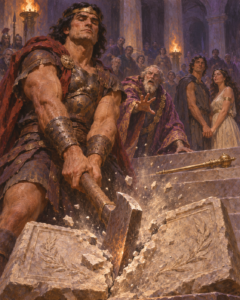
The earlier tale, By This Axe I Rule!, gives its barbarian king a problem no victory in battle can settle. Valusian law forbids Seno from marrying Ala, an enslaved woman. When the two help save Kull’s life, he declares them free to marry. His councillor protests, and Kull brings his axe down on the stone tablet. “Laws that are just shall stand,” he tells the court. The rest will have to earn their place
There’s a harsher scene in Exile of Atlantis. Kull’s own people bind a young woman to a stake for marrying a Lemurian. Her mother stands among the onlookers and disowns her. Kull sees the wood piled at the woman’s feet and understands what she’s asking of him.
With the crowd between them and the priest ready to light the fire, the only mercy he can give her is a quick death. The tribe turns on him. In Valusia, years later, Kull has the authority to give a couple the freedom his own people denied that woman. This time he can break the law itself.
That is what I find most enduring in Howard’s barbarians. Conan goes looking for a jewel and stops for a stranger in pain. Kull takes an axe to a law his own court is afraid to question. In both stories, it takes a barbarian to see what everyone else has learned to live with.