A warrior stands against impossible odds.
A sword flashes in the darkness.
Somewhere beyond the firelight, a monster waits.
These are familiar images of heroism, especially in fantasy. We recognize the figure who confronts danger, defeats an enemy, and emerges bloodied but victorious. There is good reason these stories endure: physical courage matters, and facing something that could kill you is no small thing.
But is that enough to make someone heroic?
A tyrant can be brave. A murderer can be formidable. The strongest person in the room may also be the cruelest. If heroism means anything beyond the ability to win a fight, we must look at what someone does with their strength — and what they are prepared to risk when victory is uncertain.
Conan: The Choice Behind the Sword
Robert E. Howard’s Conan is an obvious place to begin. Few fantasy characters embody physical courage so completely. He meets danger with instinct, ferocity, and an extraordinary refusal to surrender.
Yet Conan is also a thief, a mercenary, and an opportunist. He wants gold, freedom, pleasure, and survival. He does not wander the world looking for worthy causes, and Howard rarely makes him deliver speeches about virtue. That makes his heroic choices more interesting.
In The Tower of the Elephant, Conan enters the tower seeking treasure. What he discovers is suffering: Yag-kosha, a captive being whose terrible condition awakens his compassion. The adventure changes because Conan responds to what stands before him. His original purpose gives way to an act of mercy and the fulfillment of the captive’s final request.
The thief becomes heroic through a choice. Conan’s strength gives him the means to act, but cannot make that decision for him. The revealing moment comes when another creature’s suffering matters more than the jewel he came to steal.
Heracles: Strength Under a Burden
Heracles offers a more troubled picture. He possesses strength beyond ordinary human measure, yet his life is marked by suffering, terrible mistakes, and consequences that strength cannot simply sweep aside.
His labours demand endurance as well as violence. Again and again, he must face another ordeal.
There is something recognizable beneath the monsters and divine interference: the experience of carrying a burden that does not disappear after one great effort. We often imagine heroism as a single decisive moment. Heracles invites us to consider its duration. What happens after the first victory, when exhaustion sets in and another task remains?
His story also resists the comfortable idea that a hero must be admirable in every respect. Great deeds and grievous failings can exist in the same life. We can recognize courage without pretending that courage excuses the things that have come before. Sometimes the heroic struggle is the effort to continue while bearing the weight of what is.
Bilbo Baggins: Courage Against the Odds
Then there is Bilbo. Placed beside Conan and Heracles, a hobbit with a comfortable home and a fondness for regular meals might seem an unlikely addition. That is precisely why he belongs.
Bilbo has none of their physical advantages. He leaves a sheltered life for a journey through wilderness, captivity, giant spiders, and the shadow of a dragon. Almost everything he encounters is stronger, larger, or more experienced than he is.
His courage grows through the journey. Fear remains, but he learns to act despite it. When his companions need help, he finds resources in himself that neither they nor he expected.
There is no single victory that makes the road easy. Each ordeal carries him towards another, farther from the safety of home. Bilbo reminds us that courage must be understood in relation to the person showing it. For someone small and inexperienced, continuing into danger may demand as much resolve as a warrior’s charge.
History: Courage Through the Long Ordeal
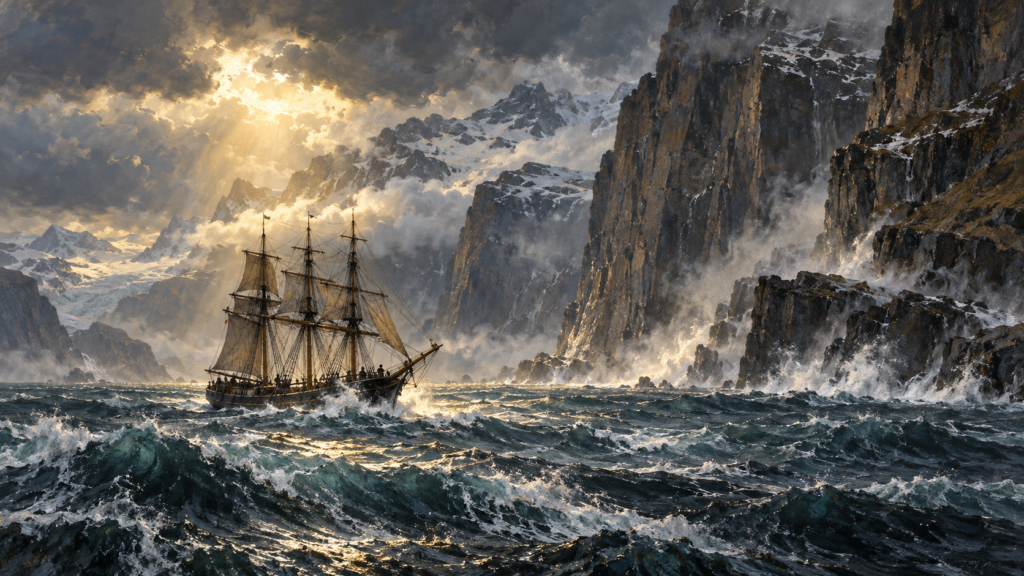
History offers equally powerful examples beyond the battlefield. After Ernest Shackleton’s Endurance was crushed by Antarctic ice, survival demanded months of resolve in freezing conditions. Shackleton and five companions crossed treacherous seas in a small boat to seek help. All twenty-eight men of the Endurance party eventually survived.
The courage here was sustained: enduring cold, exhaustion, uncertainty, and the responsibility of securing rescue while others waited. Likewise, Phillip Parker King spent years surveying the coasts of Australia and South America for the Royal Navy. His expeditions faced damaged vessels, dangerous leaks, narrow escapes from shipwreck, and the immense strain of prolonged command.
Preparing new editions of my ancestor’s expedition narratives has brought this quieter form of heroism into focus. Behind the surveying records stood people repeatedly facing danger, with a commander responsible for decisions on which others’ lives depended. Such work can appear merely technical from the comfort of a modern armchair. At sea, a calculation, a repair, or the decision to seek shelter could carry enormous consequences.
We readily recognize courage in a charge into battle. We should also recognize it in those who faced hazardous conditions day after day, fulfilling their duty while carrying responsibility for their companions.
What Are You Willing to Face?
Perhaps heroism begins when someone accepts a danger or burden that they could leave to another.
It may involve a sword, a small boat on a freezing sea, or a long journey far beyond familiar comforts. It may mean helping a stranger or carrying responsibility long after the excitement has gone.
The cause matters. So does the choice to continue.
The question is not simply how many enemies a hero defeats.
It is what they are willing to face — and for whose sake.