There is a quiet assumption that has taken hold in modern fantasy — that the world is the story.
In contrast, sword and sorcery heroes have always stood at the center of the narrative.
Maps stretch wider. Histories deepen. Systems grow more intricate. Languages are invented. Continents charted. Timelines expanded — until they resemble archives more than myths. The world becomes the spectacle, and the characters move within it like guided observers.
Sword & Sorcery was never built that way.
At its core, the genre begins somewhere far simpler — and far sharper:
The world is not the story.
The man walking through it is.
The Weight of the Individual Hero
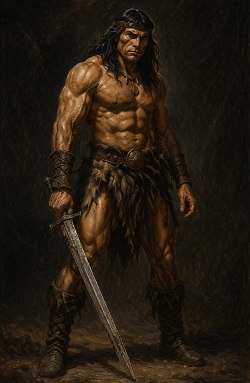 In Sword & Sorcery, the world exists as pressure.
It is not a puzzle to be explored or a system to be understood. It is a force that pushes back — harsh terrain, hostile cities, ancient ruins, and shifting allegiances — these are not there to be catalogued.
They are there to test. The sword and sorcery hero stands at the center of that pressure.
Not as a chosen savior.
Not as the fulfillment of prophecy.
But as a man measured by action.
You are not waiting for the world to reveal itself.
You are watching a person respond to it — in real time, with limited knowledge, under real consequence.
Before the Map, There Was the Man
The earliest Sword & Sorcery stories rarely opened with extended lore. They began in motion.
A thief scaling a tower.
A warrior entering a city.
A wanderer crossing a desert with no promise of arrival.
The world was implied, not explained.
A temple’s crumbling stone hinted at forgotten gods.
A coin purse spoke of trade routes and power.
A scar told its own history.
The reader did not need a map.
They needed a man worth following.
This is not an absence of worldbuilding.
It is a different philosophy of it.
The world is revealed through encounter — not exposition.
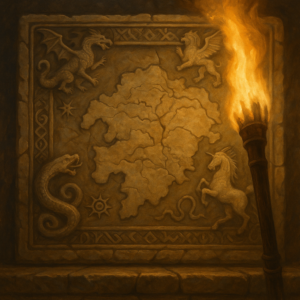 Worldbuilding, Weight, and the Illusion of Scale
Worldbuilding is not the enemy of Sword & Sorcery. On the contrary — it is essential.
Some of the most enduring fantasy worlds are built on deep foundations, with histories, cultures, and geographies that extend far beyond the page.
The world is known by the creator and may be vast beneath the surface — as Robert E. Howard himself demonstrated in his outlining of The Hyborian Age.
It exists beneath the story, informing it and giving it weight — but that depth is not displayed in full. It is only ever partially revealed to the reader.
In Sword & Sorcery, that depth functions as bedrock rather than spectacle.
What the reader encounters instead are fragments — a ruined tower, a passing reference, a whispered name — enough to suggest depth without overwhelming the moment.
A city is defined by how it feels to walk through its streets.
A culture is understood through its rituals and conflicts.
A ruin carries meaning through its silence.
The world breathes, but it does not dominate.
It exists in service of the encounter.
There is a common belief that a story becomes more meaningful as its world becomes larger.
More kingdoms.
More factions.
More history.
But scale does not create weight.
Weight comes from consequence.
A single decision made under pressure — with no guarantee of survival — carries more narrative force than a thousand years of invented history.
And this is the crucial distinction: Sword & Sorcery does not reject worldbuilding — it avoids displaying it at the expense of momentum.
Modern fantasy often reverses that.
The world does not need to be important.
The moment does.
The Presence of Sword and Sorcery Heroes
One of the defining qualities of Sword & Sorcery heroes is presence.
They do not need to explain themselves.
They do not justify their place in the world.
They exist within it — fully, physically, and without apology.
This is why the genre resists over-explanation.
The more a world is explained, the less space there is for presence.
Mystery contracts. Edges soften.
Danger becomes theoretical.
By contrast, when the world is only partially known, every step carries risk.
Every encounter matters.
And the hero’s response becomes the focal point.
Nowhere is this clearer than in the barbarian archetype.
Often described as an outsider, the barbarian stands not simply beyond civilization — but outside its assumptions. He does not rely on systems, defer to institutions, or expect the world to make sense.
He acts.
That action may be brutal. It may be flawed. It may even be wrong.
But it is decisive.
In a world that offers no guarantees, decisiveness becomes a form of truth.
This is why the barbarian endures at the heart of Sword & Sorcery — not because he is primitive, but because he is unmediated.
He meets the world directly.
Strength Without Certainty
Modern fantasy often builds toward resolution.
The world is in danger.
The stakes are global.
The outcome must be decisive.
Sword & Sorcery operates on a different axis.
The stakes are immediate. Personal. Local.
A duel.
A betrayal.
A stolen artifact.
A choice made in the dark with incomplete information.
Even when the consequences reach far beyond the moment — when the fate of kingdoms or entire realms hangs in the balance — Sword & Sorcery remains grounded in the immediate experience of the individual.
Victory is rarely clean. Loss is rarely final.
And the world does not change simply because the hero passes through it.
This creates something rare: uncertainty that cannot be solved by knowledge alone.
The hero cannot rely on prophecy or destiny to guide them.
They must act.
And in acting, they define themselves.
The Fire at the Center
In an age of expansive fantasy universes and ever-growing narrative scope, the principles of Sword & Sorcery can feel almost restrained.
But that restraint is its strength.
By narrowing its focus to the individual, the genre achieves something broader forms often struggle to maintain:
Intensity.
Every decision matters.
Every action carries weight.
Every moment is lived rather than observed.
This is not a rejection of vast worlds — but a reminder that scale without substance is hollow. A map, no matter how detailed, means little if no one walks it with purpose.
At its heart, Sword & Sorcery is about confrontation.
Not between armies or empires — but between a person and the world that presses against them.
The terrain may shift.
The cultures may differ.
The dangers may change.
But the core remains the same:
A figure stands alone, faced with a choice.
No prophecy ensures success.
No system guarantees survival.
No world bends to accommodate them.
What happens next defines everything.
A Different Kind of Legacy
Stories built this way do not rely on encyclopedic depth to endure.
They endure because they capture something elemental.
The experience of being tested.
The necessity of action.
The cost of failure.
The weight of survival.
Worlds fade.
Maps are redrawn.
Lore is forgotten.
But the image of a lone figure standing against the dark — that remains.
And it remains because it is not about the world at all.
It is about the one who walks through it.
This is why sword and sorcery heroes endure — not because of the worlds they inhabit, but because of the trials they survive.