Fantasy is often remembered for worlds. Sword & sorcery is remembered for symbols. Long after the names of kingdoms have faded, certain images endure.
Fire. Steel. Blood. Fate. These are the core symbols of sword & sorcery — images which endure long after kingdoms fade: A lone warrior standing before a blaze, a bloodied sword buried in the dust; a storm gathering over distant mountains — a shadow of destiny stretching across the horizon.
These are not mere props. They are the elemental forces that define the genre, shaping heroes, testing courage, and revealing the cost of legend. These symbols appear again and again throughout the genre because they speak to something deeper than plot.
Sword & sorcery is a genre of action and adventure, but beneath its battles and quests lies a symbolic language forged from some of humanity’s oldest stories. They touch ideas that are older than civilization itself.
Fire: The Symbol of Transformation
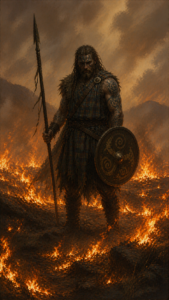 No symbol appears more frequently in myth than fire.
Fire destroys, but it also creates. It burns away weakness while illuminating what remains. In ancient traditions, fire is often associated with purification, revelation, and rebirth.
It is the force that transforms raw ore into metal, darkness into light, and ordinary people into legends.
This symbolism runs deep within sword & sorcery.
Heroes rarely begin as heroes. They are forged through hardship. The mercenary becomes a king. The wanderer becomes a champion. The exile becomes a leader.
The journey itself resembles a furnace in which character is tested under unbearable pressure.
Fire therefore represents more than danger. It represents change.
The heroes of sword & sorcery emerge from these trials altered. Every hardship becomes another stroke of the hammer. Every failure burns away illusion. Every victory leaves its mark.
The journey is not merely a path toward a goal, but a process of transformation. By the story’s end, the hero is rarely the same person who first stepped into the flames.
The forge is perhaps the most perfect image of sword & sorcery because it embodies the genre’s central belief: greatness is earned through tribulation. Nothing emerges from the flames unchanged.
Steel: The Symbol of Will
If fire transforms, steel endures. The sword is arguably the defining symbol of the entire genre. Yet its significance extends far beyond combat.
A sword represents human agency. Magic may alter reality. Kings may command armies. Gods may shape destiny. But a sword remains a profoundly personal weapon. It relies on the strength, skill, courage, and judgment of the individual who carries it.
This is why sword & sorcery heroes often trust steel more than prophecy. The sword symbolizes action over theory. Deeds over promises. Reality over illusion.
In many fantasy traditions, magical artifacts grant power to those deemed worthy. Sword & sorcery takes a different approach. The blade itself is often secondary. What matters is the hand that wields it.
A common sword in the hands of a determined warrior can be more meaningful than an enchanted weapon bestowed by fate.
Steel therefore becomes a symbol of responsibility.
Every choice has consequences. Every battle carries risk. Every victory demands a price. The sword reminds us that action shapes destiny, not merely intention.
Its edge cuts both ways.
Blood: The Symbol of Cost
Modern storytelling often treats violence as spectacle.
Sword & sorcery, at its best, treats violence as consequence.
Blood is one of the genre’s most important symbols because it reminds us that every conflict carries a cost. Victory is rarely clean. Glory is rarely free.
Heroes bleed.
Their enemies bleed.
Sometimes entire kingdoms bleed.
Blood grounds fantasy in physical reality. No matter how ancient the ruins, how powerful the sorcerer, or how grand the prophecy, blood reminds us that flesh remains vulnerable.
Yet blood also symbolizes sacrifice.
Throughout myth and history, blood has been associated with kinship, loyalty, inheritance, and obligation. To shed blood for something is to prove its value.
This is why the most memorable battles in sword & sorcery are rarely about conquest alone. They are about defending a people, honoring an oath, protecting a friend, or confronting a personal failure.
The blood spilled becomes evidence that something mattered.
Without sacrifice, heroism loses its meaning.
Fate: The Shadow on the Horizon
Few genres wrestle with fate as intensely as sword & sorcery. Yet in this tradition, heroes are rarely born for greatness — they earn it.
Prophecies may exist. Omens may appear. Ancient powers may whisper from forgotten ruins. But these forces do not define the hero. They merely create conditions in which character is revealed.
The wandering mercenary becomes a king. The exile becomes a leader. The outcast becomes a legend — not because destiny demanded it, but because they earned it through courage and choice.
In sword & sorcery, fate is less a script than a horizon. It represents possibility rather than certainty. The future remains unwritten until the hero acts. This is the core principle behind the genre: heroes are forged, not chosen.
The question is not whether destiny exists.
The question is whether a person possesses the courage to claim it.
Why These Symbols of Sword & Sorcery Endure
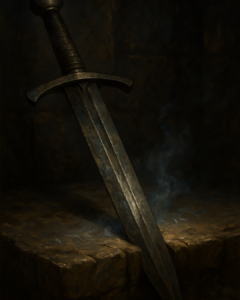 Fire, steel, blood, and fate. These symbols of sword & sorcery endure because they are older than fantasy itself, appearing throughout the heroic myths and legends that inspired the genre.
They appear in ancient myths, heroic epics, religious traditions, and historical legends from every corner of the world. Sword & sorcery inherits these symbols because it inherits the questions they represent.
Can hardship transform us?
Can courage overcome fear?
What price are we willing to pay for what we believe?
Do we control our destiny, or does destiny control us?
The genre does not offer easy answers. Instead, it places a sword in a hero’s hand, sets a fire on the horizon, and asks them to choose.
That choice is where sword & sorcery lives.
Not in kingdoms.
Not in magic.
But in the eternal struggle between what a person is and what they might become.
The flames burn.
The steel waits.
And fate watches from the shadows.
Further Reading: Joseph Campbell’s The Hero with a Thousand Faces