Among the many archetypes that have come to dominate modern fantasy, few are as recognizable as the “Chosen One.”
From hidden heirs marked by fate to prophesied saviors long before they understand their significance, fantasy literature has spent decades exploring heroes whose destinies have already been written.
Entire kingdoms rise and fall around these figures, and the central tension often revolves around whether they will ultimately fulfill the role that fate has prepared for them.
There is a reason these stories remain popular. They tap into ancient myths and timeless human questions about purpose, identity, and destiny. Yet for all the influence of the chosen one archetype, it has never been the defining model of heroism within Sword & Sorcery.
In fact, some of the genre’s most enduring heroes stand in direct contrast to it.
A Different Kind of Hero Than the Chosen One
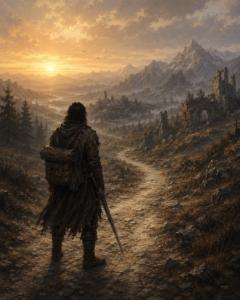 The chosen one archetype has become one of the most recognizable patterns in modern fantasy, appearing so frequently that many readers now think of the chosen one trope as a defining feature of the genre itself.
Sword & Sorcery rarely begins with a prophecy.
Instead, it begins with a man or woman standing alone before a difficult choice, uncertain of the outcome and possessing no guarantee that fate will intervene on their behalf.
Its heroes are not chosen.
They are forged.
One of the defining characteristics of Sword & Sorcery is its focus on the individual rather than the grand design. While epic fantasy often concerns itself with kingdoms, bloodlines, and world-shaping destinies, Sword & Sorcery tends to narrow its gaze toward the personal and immediate.
The hero is not tasked with fulfilling an ancient prophecy or restoring cosmic balance. More often, they are simply trying to survive, protect something they value, or navigate a dangerous world with their principles intact. This distinction has a profound effect on how these stories unfold.
When a hero is chosen, there is often an underlying sense that they were always meant for greatness. Even when they struggle or fail, the reader understands that destiny has already marked them as significant. The heroes of Sword & Sorcery possess no such safety net.
Conan does not rise because a prophecy foretold his future kingship. Kull does not sit upon a throne because the gods selected him for greatness. Their importance emerges through action, determination, and endurance.
They become legendary not because fate chose them, but because they repeatedly proved themselves capable of surviving circumstances that would have broken lesser individuals.
Their stories are not about discovering hidden greatness.
They are about earning it.
The Forge and the Blade
Perhaps the best metaphor for the Sword & Sorcery hero is the forge itself.
A sword is not born complete. Before it becomes a weapon worthy of carrying into battle, it must pass through fire. It must be hammered, shaped, folded, and tempered. Every stage of the process removes weakness and reveals strength.
The same principle applies to many of the genre’s greatest protagonists.
While the chosen one archetype has become increasingly prominent in modern fantasy, many older heroic traditions more closely resemble what Joseph Campbell later described as the Hero’s Journey, in which transformation is achieved through trials, hardship, and personal growth rather than predetermined destiny.
They begin as wanderers, mercenaries, sailors, thieves, outcasts, or exiles. Their hardships are not obstacles standing between them and destiny. Rather, those hardships are the very process through which destiny is created.
This is one reason Sword & Sorcery places such emphasis on struggle. The hostile wilderness, the corrupt city, the tyrannical ruler, the treacherous sorcerer — these are not merely background elements. They are the fires through which the hero must pass.
Every scar becomes part of the story.
Every failure becomes a lesson.
Every victory must be earned.
By the time the hero stands triumphant, they have been transformed by the journey itself.
Destiny as a Consequence
This does not mean that Sword & Sorcery rejects destiny altogether.
If anything, the genre simply approaches destiny from a different direction.
In many chosen one narratives, destiny exists before the hero takes action. The prophecy comes first, and the character spends the story growing into a role that has already been prepared for them.
Sword & Sorcery often reverses this relationship.
The hero acts first.
Only later does destiny emerge.
The legends surrounding Conan were not written before his birth. They were created by the choices he made throughout his life. The same can be said for countless heroes across the genre. Their significance is not inherited from the past but built through experience.
In this sense, destiny becomes less like an inheritance and more like a consequence.
It is the cumulative result of courage, sacrifice, resilience, and conviction exercised over time. The hero becomes important because of what they do, not because of what they were told they would become.
Why This Still Resonates
Perhaps this is one reason Sword & Sorcery continues to resonate with readers nearly a century after its emergence.
Most people do not see themselves in ancient prophecies.
Most people are not secret heirs to forgotten kingdoms.
The challenges of everyday life rarely come with guarantees of success, nor do they arrive with assurances that everything will ultimately work out according to a predetermined plan.
Instead, life demands adaptation, perseverance, and the willingness to continue despite uncertainty.
The forged hero reflects this reality.
Their victories feel meaningful because failure was always a genuine possibility. Their achievements carry weight because nothing was handed to them. They earn the reader’s respect through action rather than destiny, through character rather than lineage.
This creates a form of heroism that feels remarkably grounded, even when surrounded by sorcery, monsters, and ancient ruins.
Beneath the fantasy lies something profoundly human.
The Enduring Appeal of the Forged Hero
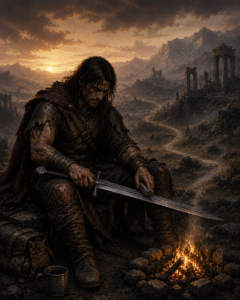 At its heart, Sword & Sorcery is a genre built upon agency.
Its heroes are not defined by what fate expects of them but by how they respond when confronted with hardship. They are shaped by difficult choices, tested by adversity, and transformed through struggle. Whatever destiny eventually awaits them is something earned rather than inherited.
That idea remains just as compelling today as it was when the earliest Sword & Sorcery stories first appeared in the pulp magazines of the twentieth century.
Readers may enjoy tales of chosen kings and prophesied saviors, but there is something uniquely satisfying about watching a hero carve their own path through a hostile world. There is something timeless about the individual who begins with nothing but determination and emerges as something greater because they refused to surrender.
In the end, Sword & Sorcery offers a different vision of destiny.
Not destiny as a gift.
Not destiny as an obligation.
But destiny as something forged in the fire of experience, shaped by choice, and earned through action.
The hero is not chosen because they are destined.
They become destined because of what they choose to do.