This week I was talking with my daughter, who had just returned from Melbourne Comic-Con with a stack of comics spread out on her carpet.
It reminded me that Sword & Sorcery comics played a crucial role in preserving the genre through decades of cultural change. The history of Sword & Sorcery is often told through magazines, novels, and later films. Yet comics occupy a crucial place in that lineage.
Sword & Sorcery comics introduced new generations to barbarian heroes, lost civilizations, ancient gods, and the spirit of adventure that first emerged from the pulp magazines of the early twentieth century.
They preserved heroic adventure through changing cultural tides, introduced new generations to legendary characters, and helped transform Sword & Sorcery from a pulp literary movement into a lasting part of popular culture.
Without them, many of the genre’s most iconic heroes might never have reached the audiences that kept them alive.
From Pulp to Panel
Sword & Sorcery emerged from the pages of pulp magazines during the early twentieth century. Writers such as Robert E. Howard created worlds filled with ancient ruins, savage frontiers, forgotten gods, and larger-than-life adventurers.
Yet by the middle of the century, the pulp era had largely faded.
The magazines that once carried these stories disappeared, readership habits changed, and the literary landscape shifted. The genre survived, but its most influential works risked becoming relics of another age.
Comics arrived at precisely the right moment.
Unlike prose fiction, comics could present fantasy with immediate visual power. Towering warriors, haunted temples, serpent cults, and crumbling kingdoms could all be brought to life in a single image. The energy that once existed in pulp cover paintings now flowed directly into sequential storytelling.
The result was something more than adaptation.
Comics became a continuation of the tradition.
Marvel and the Rise of Conan
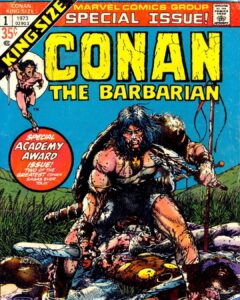 The turning point came in 1970 when Marvel launched Conan the Barbarian.
At the time, few could have predicted the impact it would have. Conan was not a mainstream character. Robert E. Howard’s stories were admired by devoted readers, but he was far from a household name.
Marvel changed that.
The early issues, illustrated by Barry Windsor-Smith, brought a unique visual style to the Hyborian Age. His work felt strange, dreamlike, and almost mythological. As the series evolved, artists such as John Buscema helped define what many readers still imagine when they think of Conan: powerful, relentless, and larger than life without becoming a superhero.
The comic did more than retell Howard’s stories.
It introduced Conan to an entirely new generation.
For countless readers, the comic came first and the original stories came later.
More importantly, it proved that Sword & Sorcery comics could thrive beyond the fading world of the pulps.
Savage Sword of Conan
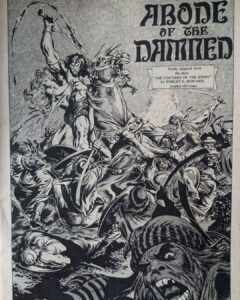 If Conan the Barbarian opened the gate, Savage Sword of Conan became the sacred text.
First published in 1974, the magazine-format series allowed creators greater freedom than traditional comic books of the era. Printed in black and white and aimed at a more mature audience, it embraced the grit, danger, and atmosphere that defined Robert E. Howard’s original stories.
For decades, writers and artists including Roy Thomas, John Buscema, Alfredo Alcala, Ernie Chan, and Gary Kwapisz poured their talents into its pages. The result was something unique. Not merely a comic, but a visual chronicle of the Hyborian Age.
Across windswept ruins, forgotten kingdoms, pirate coasts, haunted jungles, and ancient tombs, Savage Sword of Conan captured the loneliness, mystery, and hard-won heroism that lie at the heart of Sword & Sorcery.
Its influence reached far beyond comics. Fantasy artists, role-playing games, filmmakers, and generations of readers drew inspiration from its imagery. For many fans, it remains the definitive visual expression of Sword & Sorcery ever produced.
More than fifty years after its debut, the series still stands as one of the great monuments of heroic fantasy — a black-and-white saga forged from ink, steel, and imagination.
The Artists Who Forged an Age
One of the great strengths of comics is their ability to create enduring iconography. Readers may forget individual stories, but they remember images.
A warrior standing alone against impossible odds.
A ruined city beneath a blood-red sky.
A sword raised before an ancient throne.
Artists such as Barry Windsor-Smith, John Buscema, Alfredo Alcala, Ernie Chan, Gary Kwapisz, Cary Nord, and Liam Sharp helped establish and continually reinvent the visual language of modern Sword & Sorcery.
From Windsor-Smith’s dreamlike linework to Buscema’s heroic grandeur, Nord’s painterly realism, and Liam Sharp’s richly detailed mythic compositions, each generation brought its own vision to the genre while preserving its essential spirit. Their influence extends far beyond comics.
Elements of fantasy illustration, film design, role-playing games, video games, and even modern fantasy book covers all carry traces of their work.
These artists did not merely draw heroes. They forged myths in ink, and they helped to forge the core symbols that continue to define the genre’s enduring themes.
The Modern Revival of Sword & Sorcery Comics
The story of Sword & Sorcery comics did not end with Marvel.
In 2003, Dark Horse Comics launched a remarkable revival that returned Conan to his roots. Writers and artists such as Kurt Busiek, Cary Nord, Timothy Truman, and Tomás Giorello approached the material with a deep respect for Howard’s original work and a clear understanding of what made it endure.
Rather than reinventing Conan, they sought to rediscover him.
Their stories embraced the grit, danger, mystery, and humanity that defined classic Sword & Sorcery. The result was a critically acclaimed run that introduced a new generation of readers to the Hyborian Age while remaining faithful to the spirit of the source material.
Dark Horse proved that Sword & Sorcery was not merely a relic of the twentieth century.
It remained relevant.
It still had stories worth telling.
The Modern Era: Titan Comics
 Today, Sword & Sorcery comics continue to thrive.
The Conan license now resides with Titan Comics, whose current line has earned widespread praise from fans of heroic fantasy and Howard’s work alike.
At the forefront of this modern era is Jim Zub, whose writing combines a deep appreciation for classic Sword & Sorcery with an understanding of what makes the genre resonate with contemporary readers. His work demonstrates an important truth.
The appeal of Sword & Sorcery has never vanished. The heroes may change. The artists may change. The publishers may change. But the hunger for tales of courage, danger, mystery, and adventure remains.
Beyond Conan: A Global Movement
The story of Sword & Sorcery comics is not confined to the English-speaking world.
In recent years, a growing revival has emerged throughout Spain and Latin America, where creators and fans continue to celebrate the traditions of heroic fantasy through independent publications, anthologies, communities, and crowdfunded projects.
Initiatives such as Hyborian Tales through Verkami, along with communities like Crónicas Hiborianas, demonstrate that enthusiasm for Sword & Sorcery remains strong far beyond the major publishers. These projects are driven not by corporate trends, but by a genuine love of the genre and its history.
The language may change.
The country may change.
Yet the appeal of wandering heroes, ancient ruins, dark sorcery, and perilous adventure continues to endure.
A Medium of Ink and Iron
Today, many readers discover fantasy through novels, films, and video games. Yet for Sword & Sorcery, comics have become one of the most important gateways into the genre.
For countless readers, Conan was first encountered not in the pages of Robert E. Howard, but through the artwork of Barry Windsor-Smith, John Buscema, Cary Nord, and the generations of artists who followed.
For generations, they stood as guardians of the flame.
A medium of ink and paper became a pillar of iron and myth.
And because of that, the road from the pulps to the present day remains unbroken.
Readers interested in exploring Conan’s journey from Robert E. Howard’s original stories to the modern era can find an excellent overview in the official Conan timeline.