Here is a deep dive into the history of Sword & Sorcery, and how the genre evolved from pulp roots without losing its teeth.
Sword & sorcery has never belonged to the throne — it lives closer to the fire, in the narrow space where steel meets flesh and survival matters more than destiny.
It is a genre built not on kingdoms or prophecies, but on individuals — solitary figures moving through hostile worlds that offer no guidance, no mercy, and no meaning beyond what is carved from them.
While often treated as a relic of the pulp era, its lineage has never truly disappeared. It endures through writers who understand its core and refuse to soften it.
Before the Blade: Proto-Sword & Sorcery
Though Robert E. Howard stands as the defining figure of the genre, the impulse behind sword & sorcery predates him. Edgar Rice Burroughs had already begun shaping proto-forms of the idea with tales like John Carter — stories of lone warriors navigating brutal, alien landscapes where strength, instinct, and will determined survival.
These works leaned toward romance and adventure, but the underlying structure was already there — personal stakes over grand design, action over abstraction.
Howard took that foundation and stripped it down — removing the romantic distance, sharpening the violence, and grounding everything in something more immediate, more physical, more real.
Pulp Foundations: Forging of Sword & Sorcery
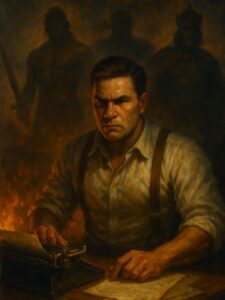 In the pages of Weird Tales, Howard forged what would become the defining blueprint of sword & sorcery through figures like Conan the Barbarian and Kull of Atlantis — who were not chosen by fate, but driven by necessity.
In these stories, the world is not wondrous but indifferent, magic is not helpful but dangerous, and civilisation is not a triumph but a fragile veneer over something older and darker.
The hero survives not because he is destined to—
but because he must.
Alongside Howard, voices like Clark Ashton Smith and C. L. Moore helped shape the tonal spectrum of the early pulp era. Smith’s decadent, dying worlds and richly poetic style pushed the genre toward the strange and the fatalistic — even as Howard carved out the harsher, more physical edge that would define sword & sorcery proper.
Moore, in turn, brought an interior intensity through Jirel of Joiry — stories that moved as much through psychological descent as physical danger.
Together, they did not just establish a genre — they defined its range.
Refinement Without Softening (1940s–1980s)
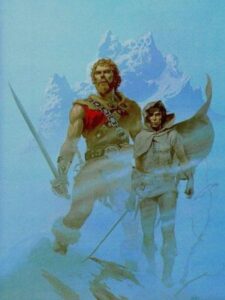 After Howard’s death, the lineage did not break — it evolved throughout the 1940s-1980s.
Fritz Leiber (1940s–1960s) expanded the form through Fafhrd and the Gray Mouser — introducing companionship, irony, and a living urban environment in Lankhmar without losing the immediacy of the stakes.
The stories proved that sword & sorcery could broaden its tone without sacrificing its core.
Michael Moorcock (1960s–1970s) turned the archetype inward — replacing brute strength with fragility and dependence, and introducing a deeper sense of fatalism through Elric of Melniboné. Yet even here, the focus remained personal — the struggle was not for the world, but within it.
Karl Edward Wagner (1970s–1980s) brought the genre back to its coldest edge. With Kane, Wagner stripped away lingering romanticism and presented something closer to its raw core — a world without moral comfort, and a protagonist who survives within it not as a hero, but as a force.
If Leiber expanded and Moorcock philosophised, Wagner distilled.
Parallel Paths and Adjacent Fires
Not every major voice sits cleanly within that frame. Poul Anderson, for example, explored similarly harsh and mythic terrain, but his approach leans toward heroic and mythic fantasy rather than the tight, immediate confrontation that defines sword & sorcery.
These adjacent writers matter not because they define the genre, but because they shape the ground around it — influencing tone, expanding possibilities, and occasionally crossing into its territory without fully inhabiting it.
The Forgotten and the Fierce
Beyond the central figures lies a broader field of contributors — voices that shaped, supported, or extended the genre across decades that deserve honorable mentions.
Writers such as Leigh Brackett, Henry Kuttner, Robert Bloch, L. Sprague de Camp, Andrew J. Offutt, Charles R. Saunders, David C. Smith, Richard L. Tierney, Tanith Lee, Jessica Amanda Salmonson, and Janrae Frank all played their part.
Some expanded the genre, some blurred its edges, and some simply kept it alive long enough for it to endure throughout the ages.
The Long Shadow of Epic Fantasy
Sword and sorcery is a subgenre of fantasy focused on personal stakes, physical conflict, and hostile worlds, rather than epic quests or grand destinies.
As the twentieth century progressed, sword & sorcery was increasingly overshadowed by the rise of epic fantasy, driven in large part by J. R. R. Tolkien. Where epic fantasy moved outward — toward scale, history, and complexity — sword & sorcery remained focused inward.
Its stories stayed close to the individual, to the immediate moment, to consequence rather than spectacle. In a literary landscape that rewarded size, that restraint was often mistaken for simplicity.
But the genre did not disappear — it sharpened.
The Paperback Wildlands: Survival Through Volume
Around these central figures, others carried the form forward — sometimes refining it, sometimes simply keeping it alive.
Writers like Lin Carter, John Jakes, and Gardner F. Fox contributed to a wider body of work that, while uneven at times, ensured the genre did not vanish during the decades when larger, more elaborate forms of fantasy began to dominate.
The history of sword & sorcery is not made only of its finest works, but of those who continued to write within its frame — preserving its structure through repetition, variation, and persistence.
The 1960s–1980s was the preservation era — the forge had cooled, but the fire had not gone out.
The Modern Edge: A Quiet Resurgence
 Today, sword & sorcery persists not as a dominant force, but as a deliberate one. A new generation of writers is returning to the form — not to reinvent it, but to recover its edge.
The emphasis remains on tighter narratives, harsher worlds, and characters defined by action rather than destiny.
That resurgence has not happened in a vacuum. It has been carried, in part, by modern torchbearers of the tradition — publications and presses that have treated sword & sorcery not as nostalgia, but as a living form.
Magazines like The Magician’s Skull and imprints such as DMR Books have provided a space for the genre to breathe again — echoing, in spirit, the role once played by Weird Tales.
But as ever, the lineage is carried by writers. Contemporary authors such as Howard Andrew Jones and Scott Oden have continued to explore grounded, physical storytelling rooted in the tradition, while others have pushed the form into darker or more experimental territory without abandoning its core.
Alongside them, newer voices are emerging with a deliberate return to stripped-back, iron-age sensibilities — writers focused on immediacy, consequence, and mythic weight without excess.
Independent presses have also played a role in revitalising interest in sword & sorcery over the past decade. Publishers such as D. M. Ritzlin at DMR Books have embraced the full spectrum of pulp tradition — from action-driven tales to the darker, more decadent strains of the genre.
Others have taken a more focused path — returning to grounded, physical storytelling rooted in survival, atmosphere, and mythic restraint. Among them, KIN and the Inferno Books imprint represent a conscious continuation of that sharper, more restrained approach.
This is not a mass-market revival.
It is a tightening of the form — driven by those who understand that sword & sorcery does not need to grow larger to remain alive. It needs only to remain sharp.
The History of Sword and Sorcery: The Unbroken Line
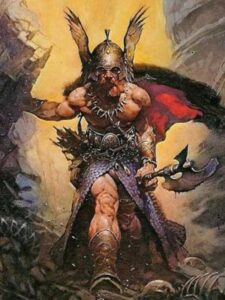 Sword & sorcery survives because it was never dependent on scale, and never sustained by institutions.
It is carried forward by writers (and publishers) willing to return to its core and keep within its constraints without weakening them.
From Howard to Wagner, from Moorcock to the present day, the line remains unbroken.
Not because the genre has grown larger — but because it has remained exactly what it was meant to be.
A lone figure. A drawn blade. And a world that does not care whether he lives or dies.