By 1985, the fires of Sword & Sorcery cinema were already beginning to cool.
Just three years earlier, Conan the Barbarian had burst onto cinema screens like a war cry from another age. Its success sparked a brief but memorable boom of fantasy films throughout the early 1980s.
Then came Conan the Destroyer in 1984. Lighter in tone and broader in appeal, it proved successful enough at the box office but lacked much of the raw intensity that had made its predecessor a classic.
One year later, Red Sonja arrived.
Though it was not intended as a farewell, history would remember it as something very close to one.
A Heroine Forged in Steel
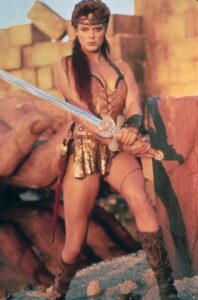 The character of Red Sonja had already established herself as one of fantasy’s most recognizable female warriors through comic books published by Marvel Comics.
Inspired loosely by Robert E. Howard’s creation Red Sonya of Rogatino and later adapted into the Hyborian Age by Roy Thomas and Barry Windsor-Smith, the comic version became an icon of Sword & Sorcery during the 1970s and early 1980s.
Bringing her to the screen seemed like a natural next step.
Produced by the legendary Dino De Laurentiis, the film cast Brigitte Nielsen in the title role. At the time, Nielsen was largely unknown, making Red Sonja one of the most ambitious fantasy debuts of the era.
Alongside her appeared Arnold Schwarzenegger as Kalidor — a character who was clearly designed to evoke Conan without officially being Conan due to rights complications.
The result was a film that felt closely connected to the Conan universe while never fully belonging to it.
A Production Caught Between Worlds
Part of what makes Red Sonja fascinating is how clearly it reflects a changing moment in fantasy cinema.
The original Conan the Barbarian, had embraced a darker and more mythic atmosphere. Driven by Arnold Schwarzenegger’s commanding presence, John Milius’ direction, and Basil Poledouris’ thunderous score, it helped define an entire generation’s vision of heroic fantasy.
It treated its world with seriousness and conviction, allowing ancient ruins, forgotten gods, and brutal struggles to feel tangible and real.
Red Sonja took a different approach.
Its world was brighter, stranger, and at times almost fairy-tale-like. Giant mechanical monsters, magical talismans, and exaggerated villains pushed the film toward a more family-friendly fantasy adventure.
While these elements gave the movie a distinctive identity, they also created a tonal distance from the harsher Sword & Sorcery roots audiences had come to expect.
The result was a film caught between two worlds.
It wanted the spectacle of mainstream fantasy while still carrying the DNA of barbarian adventure.
In some ways, it succeeded.
In others, it struggled to find its footing.
Ennio Morricone’s Forgotten Masterpiece
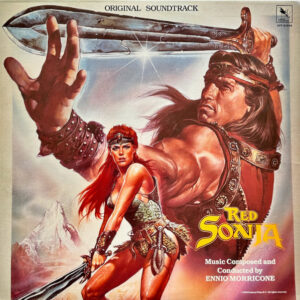 If there is one aspect of Red Sonja that deserves far greater recognition today, it is the score.
While Sword & Sorcery fans rightly celebrate Basil Poledouris’ work on Conan the Barbarian, Red Sonja boasts music composed by one of cinema’s true giants: Ennio Morricone.
Known worldwide for his unforgettable scores, Morricone brought an entirely different musical sensibility to fantasy.
Rather than emphasizing brute force and martial power, his compositions often feel mournful, romantic, and dreamlike. The score lends Red Sonja a sense of grandeur that elevates many scenes beyond what appears on screen.
The main theme in particular captures something timeless about fantasy itself. There is a feeling of longing within the music — a sense that we are glimpsing the final days of a fading age.
Whether intentional or not, that atmosphere perfectly suits the film’s place in history.
Why the Red Sonja Film Struggled
Upon release, Red Sonja received mixed reviews from critics and failed to match the success of the Conan films. Several factors contributed to this outcome.
Brigitte Nielsen’s lack of acting experience was frequently criticized, despite her obvious physical presence and commitment to the role. The screenplay often struggled to balance humour, adventure, and mythic drama.
Meanwhile, audiences were beginning to show signs of fatigue toward the wave of fantasy films that had followed in the wake of Conan and Star Wars.
Perhaps most importantly, Red Sonja arrived at a transitional moment.
The cultural appetite that had fueled the early 1980s fantasy boom was beginning to shift. Studios increasingly looked toward larger-scale blockbusters, family entertainment, and eventually the effects-driven spectacles that would dominate the decades to come.
Red Sonja found itself standing at the edge of that change.
More Important Than Its Reputation
Today, discussions about Red Sonja often focus on its flaws.
Yet doing so risks overlooking what the film accomplished.
It preserved many of the qualities that made Sword & Sorcery distinct from other branches of fantasy. The story remains personal rather than world-ending. The heroine seeks justice rather than destiny. The stakes revolve around courage, loyalty, vengeance, and survival rather than prophecy or the fate of entire kingdoms.
In many ways, Red Sonja still belongs to the same tradition that stretches back through Conan, Kull, Fafhrd and the Gray Mouser, and ultimately to the pages of Weird Tales itself.
It is a fantasy of individuals rather than empires.
Steel matters. Courage matters. Choice matters.
The world is not saved by a chosen one.
It is changed by the actions of flawed and determined people.
Red Sonja: The Last Ember
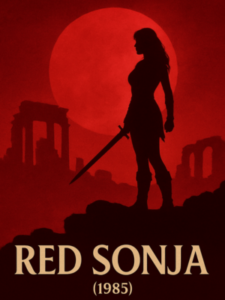 Fantasy would continue to thrive long after Red Sonja.
The following decades would bring unforgettable worlds, beloved heroes, and eventually the enormous success of epic fantasy adaptations such as The Lord of the Rings.
But the age of Sword & Sorcery on the big screen was drawing to a close.
For many years afterward, the genre would survive primarily in novels, comics, roleplaying games, and the imaginations of devoted readers.
That is why Red Sonja remains significant.
Not because it was the greatest fantasy film ever made.
Not because it matched the cultural impact of Conan the Barbarian.
But because it represented the final major spark of a particular kind of fantasy filmmaking — one rooted in wandering heroes, forgotten ruins, ancient sorcery, and personal struggle.
Like the last glowing ember in a dying fire, it carried the spirit of Sword & Sorcery into the darkness. And though the flames eventually faded from cinema screens, that ember never truly went out.
In recent years, Sword & Sorcery has shown signs of renewed life. New adaptations, independent publishers, comics, games, and fantasy creators have begun revisiting the raw adventure, personal stakes, and mythic atmosphere that once defined the genre.
Most notably, Red Sonja herself returned to the screen in 2025, introducing a new generation to one of fantasy’s most enduring warrior heroines. Whether this marks the beginning of a lasting resurgence remains to be seen, but it serves as a reminder that some legends never truly disappear.
The ember still glows.