Night settles differently over an old city.
The market stalls have closed, but commerce has not ended. Torchlight spills from the doorway of a crowded tavern, illuminating rain-darkened cobbles and figures who have no desire to be recognized.
Somewhere within, dice tumble across a scarred wooden table while sailors trade rumours of distant coasts. A merchant reaches instinctively for his purse and discovers it lighter than he remembers. Across the street, a shadow slips through an alleyway, and high above the rooftops, someone is climbing towards a window that was very deliberately locked.
Sword & Sorcery has always belonged to warriors, but it has belonged just as much to rogues and thieves.
The rogue is one of the genre’s oldest and most enduring figures: the cutpurse, burglar, pirate, smuggler, tomb robber, gambler, mercenary and wandering adventurer who lives somewhere beyond the comfortable boundaries of respectable society.
He may carry a sword, but steel is only one of the tools at his disposal. Cunning, nerve, charm, deception and an instinct for recognizing opportunity can prove every bit as valuable.
Perhaps that is because Sword & Sorcery has never required its heroes to be particularly heroic.
The Rogues in Sword & Sorcery
Epic fantasy often begins with obligation. A kingdom must be saved, an ancient evil defeated, a prophecy fulfilled or a rightful ruler restored. The protagonist may initially resist the burden placed upon them, but sooner or later something larger than themselves calls them towards adventure.
The rogue requires no such invitation.
A locked chest, a whispered rumour, a wealthy merchant or the promise of forgotten treasure may be reason enough to set events in motion. Where the knight is given a quest, the rogue sees an opportunity.
This distinction touches upon something fundamental within Sword & Sorcery. Its adventures are frequently personal rather than world-changing. Kingdoms may rise and fall in the background, but the immediate concerns of its protagonists are often much closer to hand: survival, wealth, revenge, freedom, companionship or simply discovering what lies beyond the next horizon.
Such characters naturally gravitate towards the edges of civilization. They become mercenaries when their purses are empty, thieves when something valuable appears insufficiently guarded, sailors when a ship promises passage elsewhere, and fugitives when local authorities fail to appreciate their entrepreneurial spirit. Their lives are unstable, dangerous and wonderfully suited to adventure.
They are not chosen by destiny.
More often than not, they choose trouble for themselves.
Conan the Thief
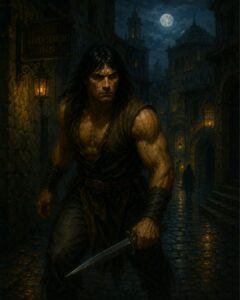 Popular culture remembers Conan primarily as the barbarian warrior: a towering figure with sword in hand, standing amid ruined temples, monstrous serpents and fallen enemies.
Yet Robert E. Howard’s Conan was never confined to a single role. Across his life he becomes a thief, pirate, mercenary, outlaw, soldier and eventually king.
Some of his most memorable adventures begin not with armies or crowns, but with theft.
In The Tower of the Elephant, the young Conan hears men discussing the fabulous jewel known as the Heart of the Elephant, supposedly hidden within the near-impenetrable tower of the sorcerer Yara. Where a sensible man might hear of deadly guards, sheer walls and supernatural protection and conclude that the treasure is best left alone, Conan hears a challenge.
He decides to steal it.
That simple premise contains much of what makes Sword & Sorcery so compelling. Conan does not enter the tower because prophecy demands it or because the fate of civilization rests upon his shoulders. He goes because something valuable lies inside a place everyone says cannot be entered. His own audacity opens the door to something far stranger and more terrible than the burglary he imagined.
This pattern appears repeatedly throughout the genre. A seemingly straightforward act of greed or curiosity carries the adventurer across a threshold into the unknown. The stolen jewel belongs to a forgotten cult. The tomb is not as abandoned as it appeared. The merchant’s treasure was acquired from somewhere best left undisturbed. The sealed door beneath the temple was sealed for a reason.
The rogue goes looking for gold and finds sorcery.
Fafhrd, the Gray Mouser and the Art of Roguery
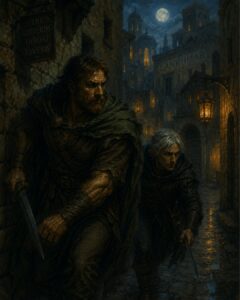 If Conan sometimes practices thievery, Fritz Leiber’s Fafhrd and the Gray Mouser embrace the profession with considerably greater enthusiasm.
The towering northern barbarian and his smaller, cunning companion became two of Sword & Sorcery’s defining adventurers, wandering through the world of Nehwon and repeatedly finding themselves entangled in schemes involving thieves, sorcerers, assassins, strange treasures and questionable employment.
At the center of much of their world stands Lankhmar, one of fantasy’s great cities. Lankhmar is not merely a backdrop against which adventures happen. Its crowded streets, taverns, temples, markets, guilds and criminal underworld actively create them. It represents a form of civilization very different from the shining capitals of heroic legend. Wealth and poverty exist almost on top of one another. Respectability shares walls with corruption. Behind an ordinary doorway may lie a gambling den, a thieves’ guild or something considerably stranger.
For rogues such as Fafhrd and the Mouser, such a city is an ecosystem.
There are pockets to pick, houses to burgle, employers to distrust, enemies to make and fortunes to lose almost as quickly as they are acquired. The city offers everything an adventurer could desire, including an endless supply of reasons to leave it in a hurry.
The City After Dark
The wilderness has always been important to Sword & Sorcery. Mountains, jungles, deserts and forgotten ruins provide places where civilization falls away and older things remain. Yet the city offers another kind of wilderness altogether.
Its predators simply walk on two legs.
The city is a labyrinth of narrow streets and crowded markets, docks and warehouses, temples and palaces, crumbling districts and wealthy quarters. The danger here does not always announce itself with a roar. It may approach with a smile, offer to buy you a drink and ask whether you are interested in earning some easy money.
This makes urban adventures particularly well suited to rogues. Survival depends upon understanding people as much as mastering a blade. A thief must recognize when he is being watched. A gambler must know when the game is crooked. A mercenary must decide whether the man offering gold intends to be alive when payment becomes due.
Civilization does not necessarily make the world safer.
Sometimes it simply gives danger more places to hide.
The Questionable Tavern
And nowhere are those dangers more likely to gather than beneath the roof of a questionable tavern.
The tavern has become such a familiar feature of fantasy that it is easy to dismiss it as little more than scenery: a convenient place for adventurers to drink before the real story begins. Yet within Sword & Sorcery, the tavern performs an important role. It is one of the few places where every layer of society can plausibly collide.
A sailor newly arrived from a distant port may drink beside a mercenary waiting for employment. A merchant can boast too loudly about his cargo while a thief listens from the next table. Travellers bring rumours from beyond the city walls. Gamblers exchange coins and accusations. Someone knows where an ancient ruin lies. Someone else knows who disappeared trying to reach it.
Information moves through taverns almost as readily as ale.
They are crossroads of adventure precisely because they bring together the ingredients from which adventures grow: strangers, rumours, money, ambition and alcohol. Add a dark corner and several concealed knives and very little additional encouragement is required.
For the rogue, the tavern is workplace, marketplace and hunting ground. It is somewhere to find an employer, mark, companion or enemy, sometimes all four before the night is over.
Gold, Jewels and Forbidden Treasure
There is also something refreshingly straightforward about the motivations of the classic rogue.
Sometimes he simply wants the gold.
Sword & Sorcery has always understood that an adventure does not require the fate of the world to justify it. A jewel glittering inside a forgotten temple can be enough. A treasure map can be enough. A rumour that an abandoned fortress contains the accumulated wealth of a dead king can certainly be enough.
The smaller scale makes the resulting danger no less compelling. In fact, it can make it more so because the protagonist often walks knowingly into peril for entirely human reasons.
Greed is one of them.
Yet treasure in Sword & Sorcery has an unfortunate habit of carrying history with it. Gold was buried because someone wanted to protect it. Tombs contain treasure because the dead were expected to need it. Ancient idols belonged to people who worshipped forgotten gods, and forgotten gods have an equally unfortunate habit of not being quite as forgotten as everyone assumes.
This is where thievery and the supernatural meet beautifully.
The rogue breaks into somewhere he should not be, takes something he does not understand and discovers that possession has consequences. Greed opens doors that wisdom would have left closed, and once the door is open, a quick hand may need to be followed by an even quicker sword.
Honour Among Thieves
Yet the appeal of the rogue goes deeper than criminality.
The finest rogues are rarely without principles. Their morality simply does not correspond neatly with the laws of the societies through which they travel. A thief may happily relieve a wealthy merchant of his purse while despising cruelty towards the helpless. A mercenary may fight for gold but refuse a task he considers dishonourable. A pirate may have greater loyalty to his companions than the king who publicly speaks of duty while privately arranging murder.
This moral ambiguity is particularly at home within Sword & Sorcery.
Its protagonists frequently distrust institutions because institutions have given them little reason to do otherwise. Kings can be tyrants. Priests can be corrupt. Merchants can cheat, judges can be bought and respectable citizens can conceal appetites far darker than those of the criminals they condemn.
Against such a world, personal loyalty becomes enormously important.
A rogue may lie to almost everyone he meets yet keep his word when it truly matters. He may break every law in the city and still be the most honourable person in the room.
The question is not always whether a character obeys the rules.
It is what he does when no rule compels him to do anything at all.
Why We Still Love the Rogue
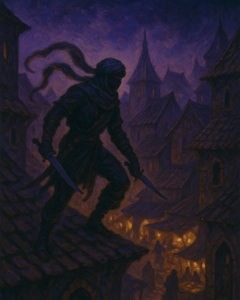 Perhaps this is why the rogue remains such an enduring figure in fantasy. At his heart, he represents freedom.
No kingdom owns him. No institution defines him. No prophecy has already written his future. He goes where opportunity leads and survives through whatever combination of courage, cunning and sheer luck he can summon. He can fight when fighting is necessary, deceive when deception is wiser, and run like hell when both alternatives have failed.
There is something deeply appealing about that independence.
Sword & Sorcery has always celebrated characters who exist beyond the walls of comfortable society. Barbarians, wanderers, mercenaries and thieves all possess an outsider’s view of civilization. They can enter its cities, drink in its taverns and steal its treasures without ever entirely belonging to it.
The rogues in Sword & Sorcery embody that spirit perhaps better than anyone.
Somewhere tonight, in some imaginary city of leaning rooftops and torchlit streets, the dice are still rolling. A merchant is telling a story he should probably keep to himself. A sailor has mentioned an abandoned temple beyond the city walls, and someone claims there is a ruby inside large enough to buy a kingdom.
Most sensible people at the table laugh.
In the darkest corner of the tavern, however, someone has stopped drinking and started listening.
A rogue is taking notes.