There is a strange contradiction at the heart of sword & sorcery.
It is a genre filled with blades, blood, sieges, monsters, and desperate combat — yet the best sword and sorcery stories rarely glorify violence itself.
That distinction matters.
We live in a time where violence has often become spectacle. Endless explosions. Endless body counts. Combat treated like fireworks.
Modern entertainment can sometimes reduce suffering into visual noise — something consumed quickly and forgotten just as fast. Whether in films, games, or increasingly hollow “grimdark” fiction, violence often exists simply to stimulate.
Sword & sorcery, at its best, does something very different. It treats combat as consequence. Not performance. Not choreography for its own sake. Not empty brutality.
Consequence.
That is why combat matters in grounded heroic fantasy — because the fights are rarely filler.
They are moral crucibles. Moments where character is revealed under pressure.
Violence as Reality, Not Celebration
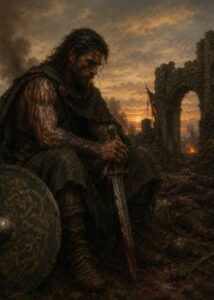 A sword fight in true sword & sorcery should never feel disconnected from the soul of the story.
It should cost something.
Physically. Emotionally. Spiritually.
The best combat scenes are not about who swings hardest.
They are about who remains standing after being tested.
None of this means violence is inherently noble.
War is horrific. Bloodshed destroys families, cultures, and generations. Most people who have experienced real violence firsthand do not romanticize it. They carry it.
Sword & sorcery works precisely because it understands this tension.
Much of the enduring power of great sword & sorcery can already be felt in Robert E. Howard’s foundational essay, The Hyborian Age, where history, brutality, migration, and survival are treated as inseparable forces.
His Conan stories are remembered for savage battles and larger-than-life action, but beneath the surface they are deeply aware of mortality, corruption, greed, and human weakness.
Combat is rarely clean or glamorous. Men die tired, wounded, frightened, or betrayed. Victory often comes at cost. That grounded realism is part of what separates sword & sorcery from more sanitized fantasy traditions.
The hero is not protected by destiny.
Steel cuts everyone equally.
In many modern blockbusters, violence becomes abstract because consequence disappears. Entire armies fall without emotional weight. Cities collapse without grief. Characters recover instantly from trauma. The audience is conditioned to consume destruction passively.
Grounded sword & sorcery resists that.
A single duel can matter more than the destruction of kingdoms because the conflict is personal.
The stakes are immediate.
The wound is real.
Combat Reveals Character
This is where sword & sorcery becomes more than “people fighting with swords.”
Combat strips away illusion.
In ordinary life, people can hide behind status, ideology, titles, wealth, or performance. In moments of survival, much of that disappears. Fear enters the equation. Pain enters the equation.
Choice enters the equation.
And choice is everything.
Who do you protect?
What do you sacrifice?
When do you stand your ground?
When do you walk away?
A meaningful combat scene forces characters to answer these questions without speeches. Conan fighting for survival in a haunted tower tells us more about him than pages of exposition ever could.
Solomon Kane’s violence is terrifying precisely because it emerges from conviction rather than cruelty. Even modern works like The Northman or Berserk resonate because combat reflects inner transformation rather than existing as empty spectacle.
The battle is never just physical.
It is moral.
That is why the best sword & sorcery fights linger in memory. Not because of gore, but because they force characters to confront themselves.
The Weight of Steel
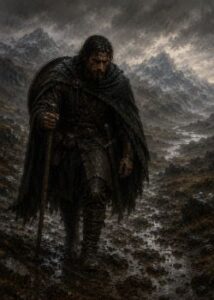 Grounded combat also restores something modern fantasy often loses: physicality.
A sword is heavy.
Armor exhausts the body.
Cold presses. Hunger haunts. Fatigue cripples.
One of the reasons classic sword & sorcery still feels visceral today is because the violence usually emerges from harsh environments and desperate conditions. Characters are not superheroes exchanging infinite blows. They are flesh and blood people surviving brutal worlds.
This gives combat narrative gravity.
When a warrior enters battle, there is uncertainty. Injury is possible. Death is possible.
That uncertainty creates tension.
Without consequence, action becomes noise.
This is also why restrained violence often feels more powerful than excessive violence. A single grounded strike described honestly can carry more emotional force than pages of gore.
The imagination fills in what restraint leaves behind.
Classic pulp writers understood this well. Howard, Fritz Leiber, and Karl Edward Wagner knew that atmosphere and implication could make violence feel mythic without descending into exploitation.
Sometimes victory itself feels tragic.
The point was never blood for blood’s sake.
The point was ordeal.
Why Modern Audiences Still Crave It
Despite cultural shifts, audiences continue returning to grounded heroic stories.
Why?
Because people instinctively recognize struggle.
Not necessarily literal combat — most readers are not seeking war in their own lives — but struggle against chaos, corruption, fear, weakness, and despair.
Combat in sword & sorcery externalizes those struggles.
The monster becomes greed.
The warlord becomes tyranny.
The haunted ruin becomes the burden of the past.
The battle becomes a test of will.
This is why the genre still resonates in uncertain times. Beneath the swords and ruins lies something ancient and human: the desire to confront darkness rather than submit to it.
Importantly, this does not require flawless heroes.
In fact, sword & sorcery protagonists are often deeply flawed. They are wanderers, thieves, mercenaries, outcasts, or reluctant warriors.
But when tested, they act. Not because violence solves everything — it does not — but because courage still matters when danger arrives.
Violence Without Spectacle
There is a meaningful difference between depicting violence and worshipping it.
Great sword & sorcery understands that difference.
The goal is not to encourage brutality. Nor is it to numb audiences through endless excess. The goal is to explore what happens to human beings when they are pushed to their limits.
Combat becomes the furnace where character is forged.
Sometimes the hero survives.
Sometimes they fail.
Sometimes they become something worse.
But the violence means something.
And perhaps that is why grounded sword and sorcery combat continues to endure while so much disposable action media fades almost instantly. Spectacle alone rarely lasts. Emotional truth does.
A meaningful duel at a ruined gate can carry more mythic weight than an army generated by computer effects. Because when combat is treated seriously — as sacrifice, ordeal, and consequence — it stops being noise.
It becomes story.