For many of us, our earliest adventures were spent watching the same hero battle the same villain. Whether through comic books, television serials, or Saturday morning cartoons, the pattern rarely changed.
A sinister plot threatened the world, the hero intervened just in time, and although the villain’s latest scheme was inevitably foiled, he almost always escaped to plot his revenge another day. The story reset, the world returned to normal, and by next week the rivalry began all over again.
As children, we rarely questioned this formula because it simply felt like the natural shape of adventure.
Looking back, however, it becomes clear that these stories were serving a particular purpose. They were designed to continue indefinitely, allowing familiar heroes and familiar villains to return again and again without fundamentally changing the world they inhabited.
The conflict itself became the product, while the enduring rivalry was the thread that kept readers and viewers coming back for another episode.
The Hero Without An Arch-Nemesis
Yet if we turn to the roots of classic literary Sword & Sorcery, we find a very different storytelling tradition.
Its greatest literary heroes rarely possessed an enduring arch-nemesis at all.
Conan did not spend his life pursuing one immortal enemy, nor did Fafhrd and the Gray Mouser find themselves locked in an endless contest with a recurring mastermind. Kull crossed swords with conspirators, monsters, and sorcerers throughout his adventures, but once those stories ended, so too did most of their antagonists.
In the classic literary tradition of Sword & Sorcery, each tale introduced a new danger, resolved it decisively, and then allowed both hero and reader to continue their journey into an entirely different corner of the world.
This was not a limitation of the genre.
It was one of its defining strengths.
A World of Endless Peril
Rather than revolving around a single rivalry, classic Sword & Sorcery follows a hero moving through a world that possesses a history, mystery, and momentum of its own.
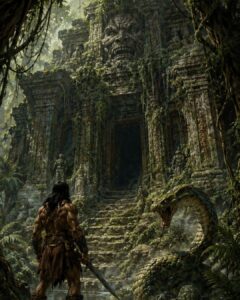
Kingdoms rise and fall without his involvement, forgotten temples wait patiently beneath tangled vines, decadent cities conceal cults in their shadows, and distant mountain passes harbour creatures that have never heard his name.
The reader follows the hero above all else, yet every adventure carries the reassuring sense that the world extends far beyond the edges of the page.
 The Unknown as the True Antagonist
Perhaps this is one reason why classic literary Sword & Sorcery continues to possess such a powerful sense of discovery. The true antagonist is rarely a single person; it is the unknown itself.
One adventure may pit the hero against a serpent lurking beneath ancient ruins, another against a corrupt king who has sacrificed his people for power, and the next against a forgotten civilization whose greatest threat lies not in its armies but in the ancient horrors sleeping beneath its stones.
The faces change, the landscapes change, and the dangers change, yet the world remains every bit as mysterious as it was when the journey began.
Ancient Roots of the Wandering Hero
This wandering quality reaches back far beyond the pulp magazines of the twentieth century. Long before the term Sword & Sorcery was ever coined, myths and heroic legends were already telling stories in much the same way.
Odysseus did not spend his long voyage pursuing a single enemy, but encountered a succession of trials, monsters, kings, and temptations, each revealing something different about both the world and the man himself.
Celtic heroes wandered from one strange encounter to another, while figures from Norse saga and medieval romance often found their journeys shaped less by one overarching conflict than by the unpredictable turns of fate.
The structure feels ancient because, in many ways, it is.
Conan and the Freedom of the Form
When Robert E. Howard began writing Conan, he inherited something of that older tradition. Conan is not driven by destiny to overthrow one supreme evil, nor does he wander the Hyborian Age searching for a lifelong nemesis.
Instead, he simply lives. He serves as a mercenary, becomes a pirate, climbs as a thief, commands armies, survives betrayals, topples tyrants, and occasionally finds himself standing before horrors older than civilization itself.
Each story captures one chapter of an extraordinary life rather than one step toward a predetermined final confrontation.
This freedom allows the world to breathe.
Uncertainty and Consequence
Because the hero is not bound to one adversary, every new story carries genuine uncertainty. Readers cannot predict whether the next danger will emerge from a haunted forest, a forgotten crypt, a decadent court, or the ambitions of an ordinary man.
The world feels limitless because it is never reduced to a single conflict, and every distant horizon promises not another round in a familiar rivalry, but an entirely new adventure.
It also gives the stories a welcome sense of consequence. When a tyrant falls, he is usually gone. When a monster is slain, it rarely returns. When a temple burns, its secrets are often lost forever.
The victories may not change the course of history, but they matter because they are permanent, and permanence lends weight to both triumph and sacrifice.
Two Traditions, One Genre
It is worth noting that this distinction applies primarily to classic literary Sword & Sorcery, rather than every adaptation or franchise that has inherited its imagery.
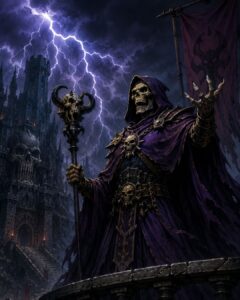
Television series such as He-Man and the Masters of the Universe, along with many long-running comic books, embraced the visual language of Sword & Sorcery — muscular heroes, ancient fortresses, dark sorcery, monstrous creatures, and enchanted blades — yet they were built upon a very different storytelling model.
Designed as ongoing serial entertainment, they relied upon recurring casts, familiar villains, and enduring rivalries between hero and nemesis because those media rewarded continuity and recognizable characters from one episode or issue to the next.
The literary tradition developed under different circumstances. Robert E. Howard, Fritz Leiber, and their contemporaries were not writing stories built around enduring rivalries, but adventures that were satisfying in themselves while leaving the road open for countless others. They chronicled the lives of wandering heroes whose greatest adventures always lay beyond the next horizon.
The hero endured, but each adventure usually left its principal antagonist behind. New kingdoms, new monsters, and new mysteries replaced old ones, allowing the world to remain unpredictable and the next horizon forever inviting.
Both traditions have produced memorable stories, they’re just from different storytelling conventions.
For readers interested in exploring the wider history and evolution of fantasy literature, The Encyclopedia of Fantasy remains one of the most comprehensive reference works ever assembled.
 The Role of Recurring Villains
None of this is intended as a criticism of recurring villains.
Some of fiction’s most enduring rivalries have become cultural touchstones precisely because they allow writers to explore familiar relationships from new perspectives.
That approach serves serial storytelling remarkably well, particularly when the hero is meant to remain the guardian of one city, one kingdom, or one enduring cause.
Sword & Sorcery simply asks a different question.
What lies beyond the next hill?
That question, simple though it may seem, changes everything. It shifts the reader’s attention away from a single opponent and back toward the world itself, encouraging curiosity rather than expectation.
In the classic literary tradition, we turn the page not because we are waiting for the inevitable return of yesterday’s villain, but because we genuinely do not know what awaits beyond the next ruined tower or forgotten pass.
The Enduring Spirit of the Genre
 Perhaps that is the genre’s quiet magic.
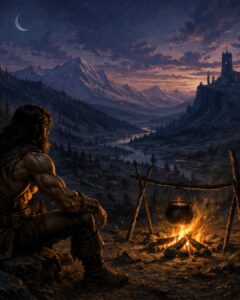
Readers return to spend another evening beside the campfire with a familiar hero, not because they’re hopeful they’ll be able to settle an endless score, but because they know another road waits to be travelled.
Somewhere beyond the mountains another kingdom is falling into darkness, another ancient tomb has been disturbed, another lonely village whispers of things that walk after sunset, and somewhere, quite unknowingly, another would-be conqueror has only just begun believing himself invincible.
The hero does not wander because one enemy still lives.
He wanders because every horizon hides another mystery, another kingdom, another monster, another tyrant convinced his reign will last forever.
The world remains inexhaustible, and so the road never truly ends.
And that, perhaps more than anything else, is the enduring spirit of classic Sword & Sorcery.