One swordsman meets danger with a flashing rapier, a defiant smile and a feather sweeping from his hat. He vaults a balustrade, trades insults with a corrupt nobleman and crosses blades beneath the windows of a moonlit palace. Even when surrounded, he appears to be enjoying himself.
Another stands upon a blood-darkened deck beneath an alien sky. He is half-naked, scarred and gripping a notched broadsword while something ancient moves beyond the jungle. There is no court to applaud him, no law coming to his aid and no certainty that courage will be enough.
Both are adventurers. Both reject the safety and restrictions of ordinary society. Both trust their courage, their instincts and their ability with a blade. Yet they belong to very different imaginative worlds.
The first is the classical swashbuckler: romantic, flamboyant and apparently invincible. The second belongs to Sword & Sorcery, where heroism is harder, the world is older and every freedom carries a price.
Somewhere between them lies the pirate ship.
What Does Swashbuckling Actually Mean?
Today, the word swashbuckling evokes flashing blades, daring escapes and heroes who answer mortal danger with a grin. Its beginnings were considerably less flattering.
The word joins swash — associated with the noise or blow of clashing weapons — to buckler, the small shield carried in one hand. A swashbuckler was originally a noisy, swaggering fighting man: the sort who struck sword against shield, boasted of his prowess and made certain that everyone nearby knew he was armed. The name suggested bluster and ostentation rather than genuine heroism.
Literature and cinema eventually transformed the insult. The swaggering bravo became the romantic adventurer: courageous, resourceful, charming and magnificently skilled with a sword. His bravado ceased to be evidence of insecurity and became proof that danger could not master him.
This transformation reveals what swashbuckling has come to mean. The sword remains central, but the defining quality lies in the manner with which the hero confronts danger. A warrior may fight with grim economy, terrified determination or cold professional discipline.
The swashbuckler makes courage conspicuous. He leaps where another man would climb, laughs when another would retreat and treats the duel not merely as a struggle for survival, but as an opportunity to assert his character.
Swashbuckling combines physical daring with a certain emotional buoyancy. Its heroes possess wit under pressure, disdain for cowardly authority and an almost theatrical confidence in their ability to escape the consequences of their own recklessness. Danger is real, but it is also exhilarating.
This spirit gives swashbuckling a natural affinity with pirate adventure and Sword & Sorcery. All three celebrate movement, individualism and defiance. They follow dangerous people beyond the protection of respectable society and into places where personal ability matters more than law or noble birth.
Yet shared qualities do not make them interchangeable. Pirates do not automatically belong to Sword & Sorcery, every heroic outlaw is not merely the same figure in a different costume, and a warrior’s skill with a blade tells us little about the imaginative world surrounding him.
The more interesting question is how the bright, romantic adventure of the swashbuckler found its way into the darker waters of Sword & Sorcery — and how Conan carried its freedom and audacity into something harsher, stranger and more enduring.
The Romantic Adventurer
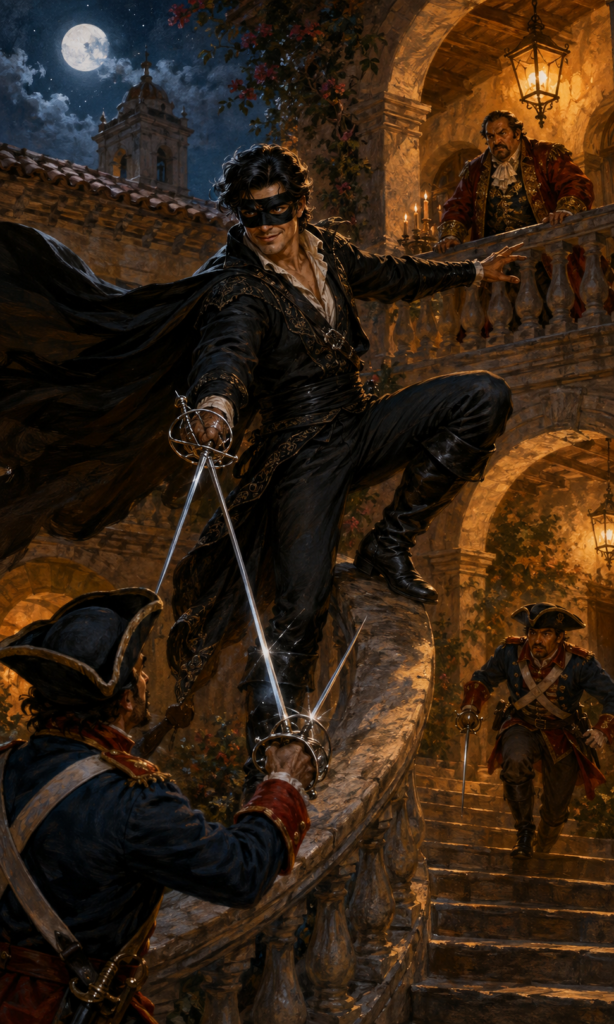 The classical swashbuckler belongs to the broad tradition of romantic historical adventure. Alexandre Dumas gave the world d’Artagnan and the Three Musketeers. Rafael Sabatini sent Captain Blood from wrongful imprisonment to piracy upon the Caribbean.
Zorro carved his mark beneath the noses of tyrants, while Robin Hood became the laughing outlaw of Sherwood Forest. On the screen, Douglas Fairbanks and Errol Flynn made acrobatic swordplay and irrepressible charm inseparable from the form.
These heroes frequently stand outside the law, but they are seldom enemies of justice.
The distinction is crucial. The law has been corrupted by a usurper, a governor, a minister or a scheming nobleman; the outlaw therefore serves a higher moral order than authorities pursuing him. He may be a rogue, but he is a rogue with loyalties.
He protects the helpless, avenges betrayal, defends personal honour and opposes power when power becomes illegitimate. The swashbuckler is often a gentleman-adventurer even when birth or circumstance denies him the title. He moves through a world of courts, estates, fortresses and occupied cities. He understands civilization’s manners well enough to mock them and its codes well enough to expose those who abuse them. Romance, disguise, intrigue and divided allegiance matter nearly as much as skill with a blade.
His victories also tend to restore a recognizable order. The tyrant is overthrown, the rightful ruler returned, the innocent vindicated or the lovers reunited. However wild the adventure becomes, justice remains imaginable.
This does not make swashbuckling shallow. At its best, it is a celebration of personal courage against institutional cowardice. It insists that wit, loyalty and nerve can matter more than rank. Yet it usually retains a romantic confidence that the bold individual can cut through corruption and emerge into sunlight.
Sword & Sorcery inherited that defiance. It was much less certain about the sunlight.
From Silk to Iron
The swashbuckler and the Sword & Sorcery hero are close relations. Both stand apart from the crowd. Both distrust corrupt authority and act according to personal loyalties rather than abstract institutions. They survive by strength, cunning and speed of decision. Their stories favour immediate dangers and personal stakes over the slow machinery of nations. Neither waits patiently for history to happen.
Yet Sword & Sorcery transforms nearly everything it inherits. The elegant duel becomes a desperate struggle in an alley, dungeon or ruined shrine. The theatrical villain becomes a tyrant, sorcerer, monster or inhuman remnant of an elder age. The romantic past becomes a violent world built upon the bones of forgotten civilizations. The hero may overthrow a despot, but there is no promise that the next ruler will be better — or that civilization itself deserves to be restored.
The classical swashbuckler is frequently at odds with a corrupt part of society. The Sword & Sorcery hero is more fundamentally estranged from society. He is the barbarian in the city, the mercenary between employers, the thief beyond the law or the wanderer who knows that every kingdom is temporary.
Violence carries a different meaning in Sword & Sorcery. For the swashbuckler, the sword can be an expression of style, honour and mastery. Here, it is more often the final certainty in a world of lies. Steel cannot make the world just, but it may keep the hero alive until morning.
Robert E. Howard stands at the crucial point of transformation. His imagination was steeped in history, frontier conflict, outlawry and the violent movement of peoples. Conan did not emerge from the stately courts and ordered cosmologies of later epic fantasy. He came from the older bloodline of adventurers, raiders, mercenaries and men who lived by their own capacity at the unstable edges of civilization.
Sword & Sorcery did not discard the swashbuckler’s blade. It hammered away the ornament and left the iron beneath.
Why Pirates Belong in Sword & Sorcery
Pirate adventure is the natural meeting place between these traditions because the sea represents both liberation and terror. To leave the harbour is to pass beyond the immediate reach of courts, prisons, taxes and kings. The land-bound hierarchy weakens with every mile of open water. Aboard ship, rank survives only for as long as the crew accepts it and the captain proves worthy of command. Authority becomes personal. Loyalty must be continually earned. A poor decision can kill everyone before dawn.
A pirate vessel therefore contains the essential machinery of Sword & Sorcery in miniature: a small company, a dangerous leader, uncertain loyalties, immediate stakes and violence without legal protection. There are no vast armies arriving to settle the conflict. Survival depends upon nerve, judgement and the strength of those standing on the deck.
Piracy also represents freedom in its most uncompromising form. The pirate refuses not merely a corrupt official but the entire system that named him subject. He takes what he can seize, sails where he chooses and measures his life by appetite rather than obedience. That freedom is romantic precisely because it is precarious. Mutiny, starvation, storm, battle and execution remain close at hand.
Most importantly, the sea is wilderness. It surrounds the ship with an immensity indifferent to human laws. Its horizons conceal countries absent from any chart, and unexplored islands. A voyage can begin as a pursuit of plunder and end before a ruined temple whose builders were never human.
To the swashbuckler, the sea promises escape from authority. To Sword & Sorcery, it also promises escape from the known world.
That is why maritime adventure accepts supernatural horror so readily. The ocean already feels like an intrusion of the unknown into the human world. Its depths are invisible, its moods uncontrollable and its boundaries uncertain. Cursed treasure, drowned cities, ghostly vessels and forgotten coastal gods do not need to be forced into the setting. They seem to have been waiting beyond the headland all along.
Howard’s Pirates and Outlaws
Howard returned throughout his work to buccaneers, mercenaries, raiders and warriors caught between competing civilizations. Black Terence Vulmea carried his ferocious adventure into the historical Caribbean, while other protagonists ranged across Crusader roads, contested borders and seas ruled as much by violence as by law.
The costumes and centuries changed, but the moral territory remained familiar.
Howard was fascinated by people who could not be domesticated. His protagonists seldom belong comfortably to the societies around them. They may fight for kings, serve armies or seize crowns of their own, but allegiance is personal and temporary. Institutions decay. Empires grow soft. Civilization conceals treachery beneath ceremony. Against this stands the individual whose virtues are immediate: courage, loyalty, perception and strength.
Pirate, barbarian, outlaw and mercenary are not identical figures, but each exists beyond the protection of respectable society. Each must survive through personal capability. Each exposes the uncomfortable truth that lawful men may be more corrupt than those they condemn as savages or criminals.
Conan can become a thief, soldier, mercenary, pirate and king because none of these titles defines him completely. They are circumstances through which he passes. Beneath them remains the wandering Cimmerian, measuring every civilization against instincts older than its laws.
Conan and the Freedom of the Swashbuckler
Is Conan himself a swashbuckler?
At times, certainly. But never completely.
He possesses the swashbuckler’s physical audacity, contempt for corrupt rulers and absolute confidence in action. He climbs impossible walls, escapes prisons, boards ships and hurls himself into dangers that would paralyse more cautious men. He can improvise within catastrophe, seize command without permission and overturn the elaborate plans of men who mistake social position for power.
Conan also possesses an exuberance sometimes lost in later interpretations. He is not perpetually grim. He laughs, drinks, boasts, desires, gambles and throws himself into experience. Even after horror and betrayal, he retains a tremendous appetite for life. There are moments when the distance between Conan and the laughing adventurer of swashbuckling romance seems surprisingly small.
But Conan is no gentleman with a rapier, defending civilization’s better code against those who have corrupted it. He does not require social legitimacy, and he rarely believes justice will emerge merely because the rightful nobleman has reclaimed his throne. His morality is older, rougher and more instinctive. He despises cruelty and treachery, honours courage when he encounters it and displays fierce loyalty toward those who have earned it. None of this depends upon courtly approval.
His fighting reflects the distinction. Conan can be fast, agile and cunning, but Howard’s violence is seldom decorative. Blades bite flesh. Men tire. Bones break. A moment’s hesitation can end a life. Victory is physical, ugly and never guaranteed by virtue.
Conan possesses the freedom of the swashbuckler without the manners, the audacity without the polish, and the romance without the illusion of safety.
Queen of the Black Coast: Swashbuckling Darkened
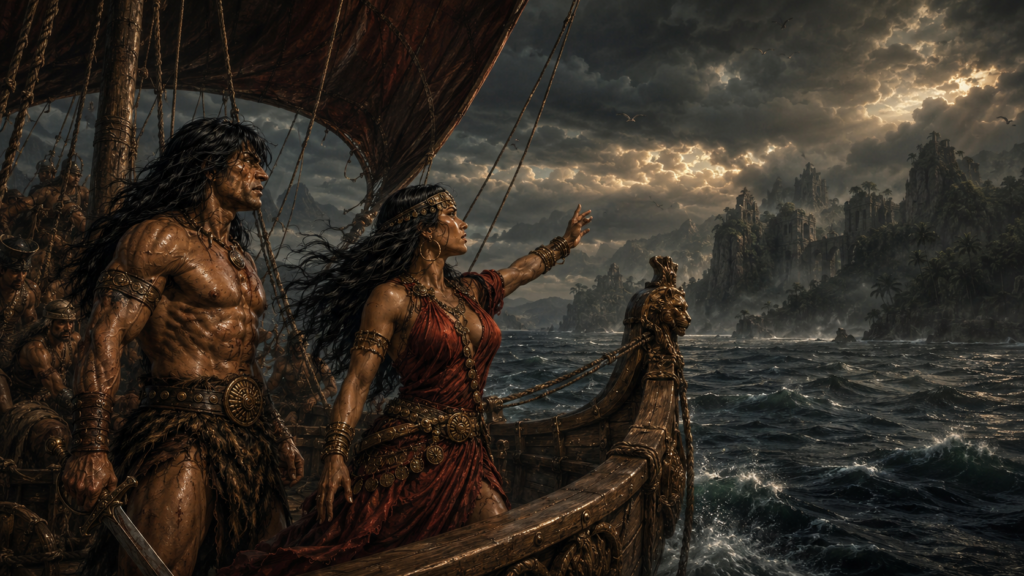
Few Conan stories demonstrate this transformation more powerfully than Queen of the Black Coast. (Spoiler Alert!)
It begins with escape. Conan comes aboard the Argus with the law behind him and compels the vessel towards open water. Almost immediately, the ordered world of merchants and authorities gives way to something wilder. Bêlit and the crew of the Tigress descend upon the ship, and Conan passes in a single violent stroke from fugitive to pirate.
The premise contains the intoxicating promise of swashbuckling romance. Conan and Bêlit are magnificent outlaws: beautiful, terrible and unconquered. They raid the coasts, seize treasure and become names spoken in fear. Neither asks society for a place. Together they create a world upon the deck of the Tigress, held together by passion, strength and the loyalty of those who sail beneath them.
Bêlit is essential to that vision. She is not merely the pirate captain’s lover because she is herself the captain, sovereign of the Black Coast before Conan ever enters her life. She commands, desires and chooses with the same intensity he does. Their union is not a civilizing romance in which one partner tames the other. It is the recognition of two beings equally unwilling to be tamed.
For a time, they appear to have achieved the swashbuckler’s ultimate dream: freedom beyond the law, love without restraint, wealth taken by courage and a horizon that never closes. Howard does not allow the dream to survive.
The story leaves the open coast and follows a river into the silent interior. The movement is more than geographical. Human enemies, however numerous, remain comprehensible. They want gold, revenge, power or survival. The farther the Tigress travels from the sea, the farther the story travels from the familiar dangers of pirate adventure.
The ruins waiting upriver belong to another order of existence. Their wealth appears abandoned, but abandonment in Sword & Sorcery is rarely emptiness. The jungle presses close. The past has not vanished; it has become monstrous.
This is where Howard darkens the swashbuckling inheritance. Skill, reputation and fearless confidence have carried Conan and Bêlit beyond civilization, but those same virtues cannot compel the universe to recognize their sovereignty. They have defeated men, ships and kingdoms. None of that matters to the ancient horror waiting among the ruins.
The story’s progression is merciless: escape becomes freedom; freedom becomes glory; glory becomes forbidden discovery; discovery becomes horror; and horror becomes loss.
Bêlit’s death shatters the fantasy that sufficient courage can make an adventurer invulnerable. Her strength is real. Her command is real. Her love for Conan is real. None grants immunity from mortality. Even her final return from beyond death does not restore what has been taken. It gives Conan the moment he needs to survive, but survival is not victory in the romantic sense.
At the end, the Tigress burns upon the water with Bêlit aboard it. The floating kingdom they created together becomes a funeral pyre. Conan escapes once more, but this escape is nothing like the beginning. He entered the story fleeing authority and hungry for whatever waited beyond the horizon. He leaves with the knowledge that freedom, love and strength can all be lost.
The classical swashbuckler defeats danger without surrendering his buoyancy. Queen of the Black Coast asks what remains when danger cannot be laughed away.
It begins with the intoxicating promise of pirate freedom and ends by revealing its price.
The Bright Sea and the Black Coast
Modern popular culture frequently blends swashbuckling, pirate fantasy and Sword & Sorcery because the traditions share so much visible material. They offer rogues, sword fights, ancient treasure, personal loyalties, corrupt authorities and heroes who survive by audacity. Add supernatural evil to the voyage and the boundary may appear to vanish entirely.
This is why Pirates of the Caribbean is sometimes described as Sword & Sorcery. The resemblance is understandable. The films contain cursed gold, undead crews, sea monsters, sinister magic, desperate swordplay and characters living by their own codes beyond respectable society. Jack Sparrow is a rogue whose cunning repeatedly overturns the plans of more powerful men. On the surface, much of the necessary material appears to be present.
Yet Pirates of the Caribbean is not Sword & Sorcery.
It is supernatural pirate adventure shaped by the swashbuckling tradition. Its governing spirit is comic, romantic and theatrical. Its action delights in elaborate reversals, ingenious escapes and heroes improvising their way through spectacular danger. The supernatural is macabre, but it participates in the fun of the adventure: curses have rules, magical problems can be solved and even death may become another complication in an extravagant escapade.
Sword & Sorcery is not defined by the presence of swords, monsters or morally dubious protagonists. If it were, almost every fantasy adventure could be forced beneath the label. What distinguishes it is the relationship between hero, world and danger: intensely personal stakes; a protagonist relying upon individual capability; civilization viewed with suspicion; magic that feels perilous, alien or corrupting; and violence possessing physical and moral weight.
Pirates of the Caribbean crosses into that territory repeatedly, sometimes quite deeply. It borrows the imagery of supernatural horror and the individualism of the outlaw hero. Certain sequences could be lifted almost intact into darker fantasy. But the series consistently returns to the rhythms of the swashbuckler: spectacle, wit, romantic entanglement, reversals of allegiance and triumphant escape. Its darkness is part of a grand entertainment. In Sword & Sorcery, darkness is more often the condition of the world.
The presence of firearms is not what excludes it. Nor would removing the jokes or spilling more blood automatically transform it. Genre lies deeper than equipment or surface tone. Pirates of the Caribbean belongs beside Sword & Sorcery, overlaps with it and draws upon some of the same ancestral adventure traditions. It does not become Sword & Sorcery merely because those borders touch.
Pirate fantasy can travel freely between the bright sea and the Black Coast. It can embrace the exhilaration of swashbuckling, the dread of supernatural horror or the brutal immediacy of Sword & Sorcery. That flexibility helps explain its enduring appeal. Pirate stories offer freedom without security, fellowship without institutions and a world perpetually opening beyond the horizon.
But the traditions lead their heroes towards different reckonings.
The swashbuckler expects an opportunity to outwit danger. The pirate expects an opportunity to profit from it. The Sword & Sorcery hero knows that danger may devour him regardless.
The Adventurer Beyond the Horizon
The elegant swordsman beneath the palace window and the scarred warrior upon the darkened deck are not the same hero. One moves through a romantic world in which courage, honour and skill may restore justice. The other inhabits a more ancient and indifferent world, where victory may mean nothing more than remaining alive.
Yet they recognize something in one another.
The swashbuckler gave adventure fiction its defiant individual, its flashing blade and its contempt for cowardly authority. Pirate fiction carried that individual beyond the law, where freedom could be seized rather than granted. Sword & Sorcery carried him farther still: beyond the charts of civilization, beyond the protection of moral order and into places where human courage confronts powers that neither admire nor understand it.
Conan carried the freedom and audacity of swashbuckling into a world where the villains were not always men, where darkness could not always be laughed away and where even the greatest adventurer might pay for freedom in blood.
The sea remains the perfect border between those traditions. In sunlight, it promises sails, plunder, romance and escape. Beneath a black sky, it becomes an immeasurable wilderness bearing the hero towards forgotten shores.
Swashbuckling supplied the audacity.
Piracy supplied the freedom.
Sword & Sorcery carried both into the dark.