A warrior approaches a ruin with a blade at his side and very little idea of what waits inside.
There may be treasure. There will almost certainly be trouble. Somewhere beyond the entrance, something ancient has survived longer than it should. It is a familiar invitation to readers of sword and sorcery. It also happens to be an excellent reason to pick up a controller—or sit down at a keyboard and play sword and sorcery video games!
The latest Conan Exiles update offers a timely reminder of that connection. Released on 6 October 2026 for Conan Exiles Enhanced, The Legacy of the Giant-Kings: Part Two introduces rifts leading into otherworldly arenas, four new sorcery spells, and returning Mi-Go enemies. Ancient mysteries and dangerous rewards are once again drawing adventurers beyond the relative safety of the familiar world.
But the relationship between sword and sorcery and video games stretches well beyond Conan himself. From Golden Axe to Kromlech, games have found different ways to capture the genre’s appetite for danger, discovery and hard-won survival. Sometimes that influence shapes an entire game. Elsewhere, it emerges in a single adventure buried within a much larger world.
What Makes a Game Feel Like Sword & Sorcery?
Swords and magic alone tell us very little. Those ingredients appear across fantasy, from stories of wandering mercenaries to vast struggles over the fate of creation. For this exploration, the more useful questions concern the adventure itself. What drives the hero forward? How does the supernatural intrude? What does victory actually mean?
Sword and sorcery often brings those questions close to the individual. A character wants money, freedom, revenge, or simply to survive an unfortunate encounter. A seemingly straightforward undertaking opens onto something far stranger. A theft becomes a confrontation with an ancient power. Shelter turns into a trap. A promising ruin conceals evidence that its builders had excellent reasons to abandon it.
These are tendencies rather than rigid rules. The genre has room for loyalty, love, heroism and consequences reaching far beyond the protagonist. Its particular force often comes from making those things immediate: someone must act, danger is close, and there may be no wise authority coming to put matters right. Games are well suited to that uncertainty. The player has to decide whether to open the door.
Age of Conan: An Earlier Road into Hyboria
Before Conan Exiles, Funcom had already opened another road into Howard’s world. Released in 2008 as Age of Conan: Hyborian Adventures, and later relaunched as Age of Conan: Unchained, this online roleplaying game invited players to create their own adventurers within the Hyborian Age.
Its opening story drew them into a world of intrigue, betrayal and violence, offering the chance to seek a fortune beneath the shadow of Conan’s legend. The attraction is easy to understand. Howard’s stories suggest countless adventures beyond those experienced by the Cimmerian himself: other blades for hire, other forbidden temples, other fortunes waiting to be won and lost.
An online world gives that possibility room to unfold, allowing players to carve out adventures of their own within a familiar setting. Conan Exiles would later approach that invitation through the harsher demands of survival.
Conan Exiles: Beyond the Walls of Safety
Conan provides the most direct connection in this company. For readers drawn to Howard’s Hyborian Age, a game bearing his name immediately raises an enticing possibility: entering that world and facing its dangers for yourself.
The October update builds its invitation around a particularly effective device. Rifts appear within enemy camps across the Exiled Lands and the Isle of Siptah, opening routes into hostile arenas beyond ordinary reality. Materials earned there unlock new sorcery, while the returning Mi-Go bring another otherworldly threat into the landscape.
The appeal, to my mind, lies in the decision at the threshold. There is danger ahead, but there is also something worth taking. Safety competes with curiosity and ambition. That tension suits sword and sorcery beautifully. The adventurer rarely possesses a complete explanation of the powers he encounters. He has to judge what he can overcome, what he can exploit, and when he should leave.
A game adaptation inevitably develops its own systems and mythology. What interests me here is the enduring pull of the premise: somewhere beyond the settled world lies a place that promises wealth and threatens to make the seeker regret wanting it.
Golden Axe: The Barbarian Adventure in Bold Colours
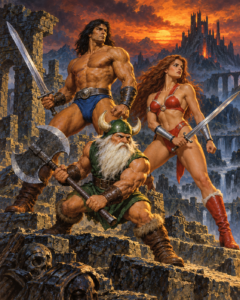 Golden Axe offers a more immediate expression of the appeal. SEGA’s account of its adventure gives us three warriors challenging Death Adder: Ax Battler the barbarian, Tyris Flare the Amazon, and Gilius Thunderhead the dwarf. Their enemy has devastated the land, seized the Golden Axe, and taken the king and princess captive. Each warrior also carries a personal grievance, having lost loved ones to his violence.
There is a kingdom to save, certainly, but revenge gives the journey a human motive. These warriors have reasons of their own to reach Death Adder. For me, the barbarian and Amazon imagery makes Golden Axe a natural touchstone for this discussion. Its appeal is direct and physical. The threat has a face; the road leads towards a confrontation; the heroes possess the strength and determination to attempt it.
Sword and sorcery can be eerie, melancholy and morally complicated. It can also deliver the straightforward pleasure of watching a formidable warrior meet an equally formidable obstacle. Golden Axe belongs in this conversation because that pleasure matters, too.
Kromlech: Celtic Iron and Dangerous Ambition
Kromlech brings the discussion to a contemporary game explicitly drawing on the tradition. Developed by Perun Creative and released into PC Early Access on 5 March 2026, it combines action-adventure roleplaying with rogue-lite elements. Its developers name both European Iron Age cultures — predominantly the Celts — and sword-and-sorcery fiction among its inspirations.
The player takes the role of Cronach, an adventurer pursuing glory and gold who becomes caught in a calamity threatening the world. Character development includes warpaint, mystical brews, equipment inscriptions and sacrifices to the gods, while deeds earn renown and powerful epithets.
That combination makes it especially interesting here. The broader catastrophe gives the story considerable scale, while the adventurer’s ambitions keep a personal stake in view. Even faced with the end of everything, there remains the rather practical matter of living long enough to enjoy the rewards.
Its Celtic inspiration also offers a welcome reminder that the genre can draw strength from many cultural landscapes. Iron Age imagery provides fertile ground for adventures in which physical courage meets powers that demand caution.
As an Early Access title, Kromlech remains a developing work. Its stated influences and premise nevertheless make it a clear example of contemporary developers deliberately returning to sword and sorcery.
Skyrim: Finding the Adventure Within the Epic
Skyrim is a more interesting boundary case. Bethesda presents it as an open-world fantasy epic, with the player taking the role of the Dragonborn and confronting ancient dragons.
That larger identity helps explain why some readers might hesitate to place the whole game beside Conan. Yet its freedom also leaves room for a different kind of experience: choosing a character, following an uncertain lead, and allowing a smaller adventure to occupy the foreground.
A discussion on the Sword and Sorcery subreddit captures the distinction neatly. Among recommendations for Skyrim, one contributor points specifically to its side quests, describing an adventure involving necromancers trying to resurrect a dead sorceress.
Consider that premise on its own. A dangerous cult, forbidden magic, a supernatural threat and an adventurer drawn into the affair: it is easy to understand why a sword-and-sorcery reader would recognize the appeal.
I would therefore approach Skyrim as a world capable of hosting such adventures, while acknowledging its broader epic-fantasy framework. A game can give players hundreds of hours of possibility. The particular story they follow through it may have a much narrower, more personal shape.
The Door Still Opens for Sword and Sorcery Video Games
These games approach the tradition from different directions.
Conan Exiles offers a direct route into a world associated with Howard. Golden Axe supplies a vivid barbarian adventure. Kromlech openly draws on the genre while developing its own Celtic-inspired setting. Skyrim illustrates how its pleasures can emerge within a wider fantasy world. What connects them is the opportunity to take part in the uncertainty.
Reading a story, we follow the adventurer into danger. Playing a Sword & Sorcery video game, we have to carry some responsibility for taking the next step. Curiosity becomes a decision. Greed becomes a risk. Courage is tested by something we could, perhaps, have chosen to avoid.
The ruin is still waiting. Somewhere inside, something has heard us coming.
And now we have to decide whether to go in.