Sword & Sorcery and Epic Fantasy share the same bloodline. Both rise from myth, both wield magic and steel, and both transport us beyond the boundaries of the real.
But despite their shared roots, they walk very different roads.
So what is the real difference between Sword & Sorcery and Epic Fantasy?
At a glance, the distinction seems simple. Sword & Sorcery is smaller, grittier, more personal. Epic Fantasy is vast, layered, and world-spanning. That’s the common explanation — and it’s not wrong.
But it’s also not quite right — because the true difference between these two modes of fantasy isn’t scale.
It’s perspective.
The Illusion of Scale
One of the most common ways people try to separate Sword & Sorcery from Epic Fantasy is by stakes.
Sword & Sorcery, they say, is about small, personal conflicts.
Epic Fantasy is about saving the world.
And often, that’s true.
A lone warrior breaking into a forgotten temple to slay a serpent priest and steal a relic feels very different from a fellowship marching across continents to destroy an ancient evil.
But this idea breaks down quickly.
There are Sword & Sorcery tales that involve wars, kingdoms, and armies. There are Epic Fantasy stories that feel deeply personal and intimate.
Characters like Elric of Melniboné, Conan the Barbarian, Kull of Valusia, and Kane don’t always fit neatly into one box — and neither do their stories.
So if scale isn’t the defining line, what is?
The True Divide: Focus (Sword and Sorcery vs Epic Fantasy)
At its core, the difference between Sword & Sorcery and Epic Fantasy comes down to one simple question: What is the story really about?
Sword & Sorcery asks:
Can this individual survive the world?
Epic Fantasy asks:
Can the world itself be saved?
That shift in focus changes everything.
It shapes the hero, the stakes, and even the way the world itself is experienced.
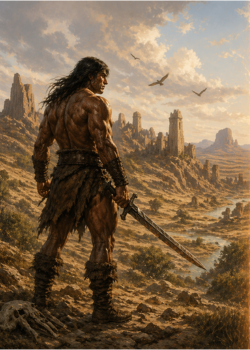 The Sword & Sorcery Lens
Sword & Sorcery is grounded in the immediate and the physical.
It follows individuals — often outsiders — moving through dangerous, indifferent worlds. These are not chosen heroes guided by prophecy. They are wanderers, mercenaries, thieves, exiles.
They are shaped by the world, but not protected by it.
The stakes are direct:
- survival
- freedom
- revenge
- power
- escape
Victory is never guaranteed. Loss is often brutal. And the consequences are paid in blood, not in abstraction. Think Conan the Barbarian — a lone figure moving through a hostile world, where survival is never guaranteed.
Magic, when it appears, is rarely a tool to be mastered. It is something older, darker, and dangerous — something that corrupts, tempts, or destroys. Steel is trusted. Sorcery is feared.
The structure reflects this as well. Sword & Sorcery thrives in tight, episodic bursts — each story a trial, a test, a confrontation with something hostile and unknown.
It is not about restoring balance to the world.
It is about enduring it.
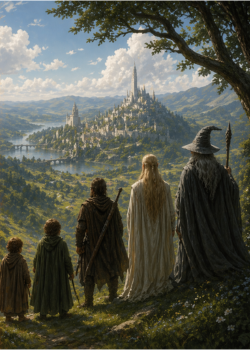 The Epic Fantasy Lens
Epic Fantasy pulls the camera back.
Here, the individual is part of something larger — often something destined. The story unfolds across kingdoms, cultures, and histories.
The world is not just a backdrop; it is a system, a structure, something that can be threatened, broken, and ultimately restored.
The stakes expand:
- the fate of nations
- the survival of entire peoples
- the balance of good and evil
- the fulfillment of prophecy
Characters are frequently tied to systems of power — kings, heirs, chosen ones, councils, fellowships. Even when reluctant, they are drawn into roles that shape the destiny of the world itself.
Think The Lord of the Rings — where the fate of the entire world hangs in the balance.
Magic, in this space, often behaves differently. It may still be dangerous, but it is also studied, structured, even systematized. It becomes part of the world’s fabric — something that can be learned, wielded, and understood.
The structure mirrors this scale. Long arcs. Expanding plots. Multiple threads converging toward a singular, world-defining outcome.
Epic Fantasy builds worlds you want to save.
Where the Confusion Comes From
The reason these genres are so often confused is because they share so many surface elements:
- swords and combat
- magic and monsters
- ancient ruins and lost civilizations
But these are aesthetics — not foundations.
A story can have all the visual hallmarks of Sword & Sorcery and still be Epic Fantasy at its core. Likewise, a story can involve massive events and still feel rooted in Sword & Sorcery if its focus remains tightly bound to the individual experience.
That’s why rigid definitions always fall apart.
Sword & Sorcery isn’t defined by a checklist.
It’s defined by how the story feels.
The Role of the Hero
One of the clearest ways to see the divide is through the role of the protagonist.
In Sword & Sorcery:
- the hero stands outside systems of power
- they are not chosen — they choose
- they act because they must, not because they are destined
In Epic Fantasy:
- the hero is often tied to a greater role
- chosen, prophesied, or elevated
- their actions ripple outward to shape the fate of the world
This is the difference between carving your path… and fulfilling it.
Tone, Texture, and Reality
Sword & Sorcery is tactile.
You feel the weight of the blade. The heat of the fire. The dust, the blood, the exhaustion. The world presses in on the character at all times.
Epic Fantasy, by contrast, is expansive.
It invites you to step back and take in the whole — maps, histories, cultures, languages. It builds immersion through scope rather than immediacy.
Neither approach is better.
But they are fundamentally different experiences.
Two Paths, One Origin
Sword & Sorcery and Epic Fantasy both emerge from the same mythic tradition. They draw from the same well of ancient storytelling — heroes, monsters, gods, and fate.
But they diverge in how they tell those stories.
One narrows the lens.
The other widens it.
The Flame at the Center
If you’ve ever wondered about the difference between Sword & Sorcery and Epic Fantasy, it begins — and ends — here.
Sword & Sorcery burns hotter and closer.
It strips away the distance between the reader and the moment. It places you beside the fire, blade in hand, facing something immediate and dangerous.
There is no prophecy to guide you. No grand design to fall back on.
Only the choice in front of you—
and the will to see it through.
That is where they split.
And that is why both endure.