Long before stories were written in books, they were carried in memory.
They travelled beside campfires and hearths, passed from parent to child, from shepherd to merchant, from one winter gathering to the next. They belonged not to kings or scholars, but to ordinary people whose lives were shaped by forests, rivers, lonely roads, changing seasons, and the unseen mysteries of the world around them.
Some stories warned people to avoid certain hills after sunset. Others spoke of strange lights drifting across marshes, old women who knew the language of herbs, wells whose waters healed more than wounds, or ancient stones where the boundary between worlds seemed thinner than elsewhere.
Whether anyone truly believed every tale matters less than the fact that they were told.
They became part of the landscape itself.
And even now, centuries later, folklore in fantasy continues to return to those same quiet places.
Not because folklore belongs to the past.
But because it has never truly left us.
The Stories of Ordinary People
When people speak about fantasy’s roots, mythology often receives most of the attention. It is easy to understand why. Myths give us gods who shape the heavens, heroes who challenge monsters, sacred relics, and the great struggles that define entire civilizations.
Folklore begins somewhere altogether different.
Rather than asking how the world was created, folklore asks why the old oak should never be cut down. Why strange lights appear over the bog. Why nobody whistles after dark. Why the abandoned cottage at the edge of the village remains empty generation after generation.
These are not the stories of immortal beings ruling the cosmos. They are the stories of ordinary people trying to understand the places they inhabit.
Every community develops them.
Across Europe, Asia, Africa, the Americas, and beyond, local traditions emerged wherever people settled long enough for memory to gather around a landscape. Rivers acquired personalities. Hills became sacred. Forests concealed unseen inhabitants. Ancient ruins inspired explanations long after their builders were forgotten.
These stories often existed outside formal religion and beyond written history. They belonged to villages rather than kingdoms, to families rather than empires.
Folklore is deeply local. One valley may tell a different tale from the next. One village’s protective spirit becomes another village’s warning.
That intimacy gives folklore something uniquely powerful: a profound sense of place.
Every Landscape Holds a Story
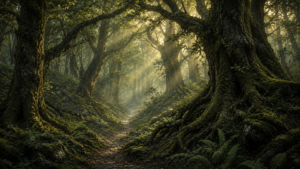 One of folklore’s greatest gifts to fantasy is the idea that no landscape is ever truly empty.
A forest is not merely a collection of trees. It becomes somewhere people avoid after dusk. A lonely standing stone is no longer simply weathered rock, but the last remnant of forgotten ceremonies. A still lake may conceal something ancient beneath its still surface.
Even an ordinary crossroads becomes charged with possibility once enough stories gather around it. This way of seeing the world transforms geography into narrative.
Across Celtic traditions, hills often conceal entrances to the Otherworld, where time flows differently and the familiar laws of life no longer apply. Norse folklore fills forests and mountains with hidden beings who occupy the same landscape as humanity while remaining frustratingly beyond ordinary sight.
Across Slavic traditions, dense woodlands become places where ancient spirits and uncanny encounters wait beyond familiar paths. Anglo-Saxon traditions preserve stories of haunted barrows, restless dead, and places where memory itself seems to linger.
Elsewhere, every culture develops its own relationship with the unseen.
The details differ. The instinct remains remarkably similar.
Fantasy inherits this instinct. Its greatest worlds rarely feel invented from nothing. Instead, they feel as though they have accumulated stories over many generations, leaving traces that one might still discover.
The Quiet Inhabitants of the World
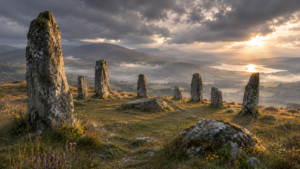 Modern fantasy often celebrates dragons, demons, and towering monsters, yet folklore is usually more interested in quieter mysteries.
The beings of folklore live beside humanity rather than above it. They occupy lonely hills, ancient forests, hidden streams, forgotten crossroads, and windswept moors.
They are woven into the land itself, reminding us that the world has never belonged entirely to humankind.
Among the most enduring are the Fair Folk of Celtic tradition. Known by many names across Ireland, Scotland, and Wales, they were never simply tiny winged creatures of children’s stories. They were the mysterious inhabitants of the Otherworld — beautiful, dangerous, unpredictable, and bound by customs older than human memory.
Certain hills were avoided after dusk. Ancient mounds were treated with quiet respect. Offerings might be left, warnings carefully observed, and careless words avoided, for no one wished to offend neighbours who existed just beyond ordinary sight. The Otherworld itself remains one of folklore’s most enduring gifts to fantasy. It is not another planet or distant realm, but a place that exists alongside our own, separated only by boundaries that are sometimes crossed by accident, curiosity, or fate.
A traveller may wander only a short distance from home before entering a land where time moves differently, familiar laws no longer apply, and returning home proves far more complicated than leaving.
This idea echoes throughout fantasy literature because it suggests that extraordinary places may exist just beyond ordinary perception, waiting patiently beyond the next hill or beneath the oldest trees.
Elsewhere, forests become home to elusive beings who resist easy classification. Trolls, bog spirits, woodland guardians, river dwellers, household spirits, and creatures tied to particular landscapes appear throughout northern and eastern European traditions in countless local forms. They are not always evil. Nor are they always friendly.
They simply belong.
Their presence reminds us that humanity does not entirely possess the natural world.
This idea remains central to much of fantasy. The wilderness is never merely scenery. It has its own inhabitants, its own memories, and sometimes its own intentions.
Wisdom at the Edge of the Village
Folklore also preserves another enduring figure: the keeper of forgotten knowledge.
She may be remembered as a wise woman, a healer, a cunning woman, a herbalist, or — depending upon the fears of later generations — a witch.
The distinction often depends less upon her actions than upon who tells the story.
Many traditional communities relied upon people who understood medicinal plants, seasonal rhythms, local customs, births, deaths, blessings, and protective charms. Their knowledge occupied a space between practical experience and spiritual tradition.
Fantasy continues to draw upon these figures because they embody something increasingly rare in modern life.
Knowledge rooted in place.
Their wisdom comes not from distant academies but from observing the same hills, forests, rivers, and changing seasons over an entire lifetime.
They understand that certain flowers bloom before storms, that particular birds arrive before winter, and that ancient customs survive because generations discovered their value, even if the original reasons have long since faded from memory. Such characters often possess the understated authority that gives fantasy much of its emotional depth.
Ghosts, Ruins, and the Weight of Memory
Few aspects of folklore endure more powerfully than ghost stories.
Nearly every culture possesses tales of haunted roads, abandoned houses, forgotten battlefields, lonely bridges, or places where something refuses to remain entirely in the past.
These stories rarely exist simply to frighten. More often, they remind communities that memory lingers.
Some places carry grief.
Others preserve injustice.
Some simply refuse to be forgotten.
Fantasy draws heavily upon this emotional landscape. An abandoned keep feels compelling not because it is old, but because readers instinctively believe something happened there.
Ruined temples suggest forgotten ceremonies.
Collapsed watchtowers hint at vanished kingdoms.
Ancient roads imply countless travellers whose names have disappeared.
The landscape becomes layered with invisible history. Folklore teaches us that ruins are never silent.
The ruins remember.
The Rhythm of the Seasons
Not every folkloric tradition concerns supernatural beings. Many revolve around the gentle rhythms of ordinary life. Harvest festivals. Midwinter fires. Spring rituals welcoming new growth.
Protective charms hung above doorways. Blessings spoken before journeys. Small superstitions repeated so often that their origins become impossible to trace.
Some customs survive because people believed they offered protection.
Others simply became part of communal identity.
Together they formed an invisible thread connecting generations across centuries.
Fantasy frequently borrows these traditions because they make fictional cultures feel lived-in.
A village that celebrates seasonal festivals feels older than one that merely exists to serve the plot. A traveller who pauses to leave a simple offering at an ancient well suggests a culture with inherited memory rather than invented decoration.
These details rarely demand attention.
Instead, they gently persuade readers that the world existed long before the story began.
Stories That Refuse to Die: Folklore in Fantasy
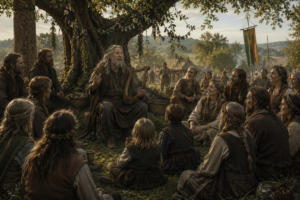 Perhaps folklore’s greatest strength lies in how it survives.
Unlike mythology, which often becomes fixed through written texts, folklore changes every time it is told.
One storyteller forgets a detail. Another adds a warning. A grandmother softens the ending for frightened children. A tale crosses to another village, where it gradually becomes something new.
Oral tradition is wonderfully untidy. Its very imperfections keep it alive.
Fantasy inherits this same flexibility, which is why many of its most memorable worlds feel less like carefully engineered settings than living traditions, where songs, rumours, legends, and half-forgotten tales coexist without perfect agreement.
Readers encounter fragments rather than complete explanations.
The unknown remains unknown. That lingering uncertainty is often where wonder truly lives.
From Folklore to Fantasy
The influence of folklore upon fantasy literature reaches far beyond borrowed creatures or familiar legends.
Writers such as Robert E. Howard instinctively understood that landscapes should possess atmosphere long before monsters appear. His wilderness often feels ancient because it carries the weight of forgotten peoples and lingering superstition.
J.R.R. Tolkien drew deeply from Northern European folklore — particularly its elves, ancient landscapes, and lingering sense of the Otherworld — while creating something entirely his own. Middle-earth succeeds not because it reproduces folklore directly, but because it feels like a world where countless local traditions have accumulated over immense stretches of time.
Writers such as Lord Dunsany, Alan Garner, Susan Cooper, Patricia McKillip, and Ursula K. Le Guin likewise demonstrate that folklore is less about collecting mythical creatures than understanding how stories shape our relationship with place, memory, and community.
The strongest fantasy rarely copies folklore directly. Instead, it captures its atmosphere, its mysteries, and the quiet belief that the world is older — and stranger — than it first appears.
It understands that mystery is often more powerful than explanation; that old places should retain their secrets, that communities carry extraordinary traditions, and that every forest deserves at least one story nobody can quite agree upon.
Much of my own fiction follows this same path.
Rather than adapting existing Celtic tales directly, I find inspiration in their atmosphere: the quiet melancholy of forgotten stones, the sense that forests remember older ages, the rhythm of seasonal landscapes, and the lingering possibility that unseen things still share the world beside us.
Those influences shape mood more than plot. They remind me that fantasy becomes richer when its mysteries feel inherited rather than invented.
For those interested in exploring traditional folklore in greater depth, The Folklore Society offers a wealth of resources on folk beliefs, customs, oral traditions, and the living traditions that continue to inspire fantasy.
The Fire Never Truly Goes Out
 Folklore has endured because it belongs to everyone. It asks no permission to exist.
It survives wherever people gather to explain strange places, pass down old customs, remember forgotten names, or wonder what might be watching from beyond the edge of the trees.
Its creatures may change.
Its stories may evolve.
Its landscapes may shift with every generation.
Yet its purpose remains remarkably constant. To help people understand the world they inhabit.
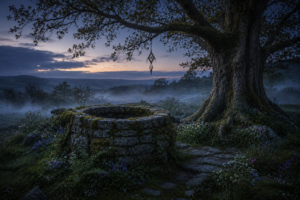
Modern fantasy still draws deeply from folklore because it reminds us that the greatest mysteries are rarely found in distant kingdoms or cosmic battles. They wait in quiet woods, abandoned wells, weathered standing stones, lonely crossroads, and forgotten paths where countless footsteps have gone before our own.
Long before fantasy became a literary genre, people were already filling ordinary landscapes with extraordinary possibility.
Perhaps they still are.
The next time you walk through an ancient forest, pass a lonely ruin, or pause beside an old stone worn smooth by centuries of weather, consider how many stories that place has gathered.
Some have undoubtedly been forgotten. Others survive only in fragments. And perhaps a few still wait patiently for someone willing to listen.
Because folklore endures for the same reason fantasy endures.
It keeps alive humanity’s oldest habit: telling stories about the places we call home, the mysteries we cannot explain, and the unseen world that may still exist just beyond the edge of the firelight.