There are old roads whose first travellers no map remembers.
A weathered stone standing alone upon a hill. The broken walls of a forgotten fortress. A rusted sword unearthed from beneath dark soil. We rarely know the full story behind such places or relics, yet they possess a power all the same.
They invite us to wonder who stood there before us, what hopes they carried, what battles they fought, and what became of them when their own age finally passed into silence.
That quiet sense of mystery is one of the reasons fantasy continues to captivate us. The greatest fantasy worlds do not feel newly invented. They feel remembered, as though countless lives have already been lived and countless stories have already been told before the reader ever arrives.
Every legend begins as an ordinary life.
Before there was a tale sung around a fire, there was simply a person. Before the hero became larger than life, they were flesh and blood. Before kingdoms became the settings of romance and adventure, they were places where people lived, loved, struggled, and dreamed.
Time changes all things. Stone crumbles, empires fall, and names gradually fade from memory. Yet stories have a remarkable way of surviving long after the people who first lived them are gone. As they pass from one generation to the next, memory softens into legend, and legend becomes something richer than history alone.
Over the past few weeks, we have explored many of the foundations upon which fantasy stands: history, language, mythology, and folklore. Each offers something essential to the genre, yet none exists entirely apart from the others.
Given enough time, they begin to converge, until history becomes legend, legend inspires mythology and folklore, and together they create the deep sense of age that makes the greatest fantasy worlds feel timeless.
That transformation may be the oldest story fantasy has ever told.
The Long Memory of Stories
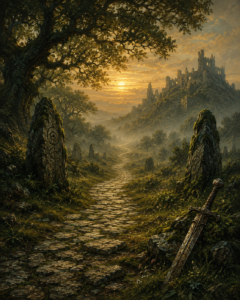 Human beings have never remembered the past as though preserving pages in an archive. We remember through stories.
Long before libraries, printing presses, or digital records, history survived because someone chose to tell it. Around hearth fires, in great halls, and beside campfires beneath unfamiliar stars, memories passed from one generation to the next.
Every retelling carried something forward while quietly leaving something else behind. Details faded. Names were forgotten. Certain moments grew clearer while others slipped into obscurity. What remained was rarely a perfect account of events, but something perhaps even more enduring: the spirit of what had taken place.
Stories preserved what mattered. They carried a people’s triumphs and tragedies, their values and fears, their understanding of courage, loyalty, sacrifice, justice, and hope. As decades became centuries, remarkable deeds grew into extraordinary ones, and extraordinary deeds gradually acquired the qualities of legend until no one could say with certainty where history ended and memory gave way to myth.
This was not an act of deception but a natural consequence of human memory. Every generation inherits the past through the stories it is told, finding new meaning in familiar tales while gently reshaping them for those who follow.
The greatest fantasy follows this same ancient pattern. Its worlds feel believable not because every event is carefully documented, but because they seem to possess the same accumulated memory as our own.
Their histories are not presented as lifeless records but as remembered stories, polished by generations of storytellers until they carry the timeless weight of legend.
When Ordinary Lives Become Extraordinary
Few figures illustrate this transformation more clearly than King Arthur.
Whether Arthur existed exactly as later tradition describes is almost beside the point. Over the centuries, he became far more than a man. He became the image of the ideal king. Camelot came to represent justice and order. Excalibur became more than a sword, while the Round Table grew into a symbol of honour, fellowship, and a kingdom worth striving for. With every retelling, the Arthurian legend accumulated new meaning until it came to embody hopes far greater than any single moment in history could contain.
The same subtle transformation can be found throughout the world. Robin Hood steps from the forests of medieval England as both outlaw and champion of justice. Ragnar Lothbrok stands somewhere between Viking history and heroic saga. El Cid emerges from the conflicts of medieval Spain as both soldier and national hero. William Tell draws his bow across the centuries as a symbol of liberty, while Cú Chulainn remains one of Ireland’s enduring embodiments of youthful courage and impossible resolve.
Even Beowulf, one of the oldest surviving works of English literature, occupies this fascinating space where remembered history, heroic tradition, and imagination converge. Its kingdoms echo a recognizable past, yet the story itself has long since become something greater than a historical record. It survives because it speaks to something timeless within us.
None of these figures endures because every detail of their stories can be proven. They endure because generation after generation discovered something worth remembering within them. Historical fact gave them a beginning, but it was storytelling that gave them immortality.
Maybe this is why the greatest fantasy rarely introduces us to entirely new legends. Instead, it creates worlds where legends already exist. The wandering heroes of Sword & Sorcery so often walk among ruined kingdoms, forgotten tombs, ancient battlefields, and weathered monuments because those places carry the same promise as Arthur’s Camelot or the halls of Beowulf: they suggest that extraordinary lives were lived long before the present story began.
Time Is the Greatest Storyteller
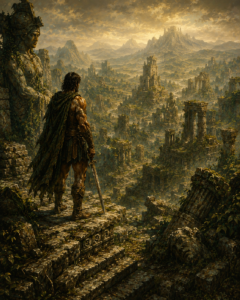 Legends are rarely created in a single moment.
They accumulate, almost imperceptibly, across generations.
Every generation inherits a story already shaped by those who came before. Some details are forgotten, while others become polished through repetition. New audiences ask different questions of familiar tales, and heroes gradually come to represent ideals their original storytellers may never have imagined.
In this way, time itself becomes an invisible storyteller. We often imagine legends being deliberately invented, yet they are more often the result of countless small acts of remembrance. One storyteller shortens a journey. Another enlarges a victory. Someone remembers the kindness of a ruler while gradually forgetting his failures, while another cannot bear to let a hero die unnoticed. No single retelling changes the story beyond recognition, but over centuries each leaves behind a subtle mark.
Little by little, history begins to acquire the shape of legend without anyone consciously deciding to create one. Human memory has never preserved every fact with equal care. Instead, it preserves what resonates most deeply, allowing meaning to endure long after certainty has faded.
The process that the greatest fantasy has always understood best, it does not simply borrow from history; it mirrors the way history itself is transformed through memory and storytelling. Rather than presenting the past as a fixed chronicle, it offers worlds where stories have already passed through countless voices, gathering depth, mystery, and significance with every telling.
That is why the oldest kingdoms in fantasy rarely feel fully explained. Their histories are incomplete, their greatest heroes are half remembered, and their oldest tales are wrapped in uncertainty. Like the legends of our own world, they invite us to imagine everything that has been forgotten as much as everything that has been preserved.
Why Facts Alone Are Never Enough
History tells us what happened, while legend asks why it mattered.
These are not opposing questions but complementary ones, each revealing something the other cannot.
A chronicle may record the date of a battle, the names of its commanders, and the number who fell. A legend remembers the lone warrior who refused to abandon a wounded companion, or the queen who remained upon the walls after everyone else had fled. One preserves the event; the other preserves the meaning people found within it.
Maybe this is why every civilization has created heroic traditions that reach beyond simple historical records. We long not merely to know what happened, but to understand ourselves through those events. The past becomes truly meaningful when it speaks to the present, and legends possess a remarkable ability to carry emotional truth even as literal details change with time.
Weapons evolve. Kingdoms disappear. Borders shift beyond recognition. Yet courage remains recognizable, as do sacrifice, loyalty, love, grief, ambition, and hope. The human heart changes far more slowly than history itself, which is why stories separated by centuries can still feel intimately familiar.
Fantasy has always drawn its greatest strength from this timeless quality. It is rarely concerned with recreating history exactly as it happened.
Instead, it asks the same questions that legends have always asked: What does courage look like? What is worth sacrificing for? How should power be wielded? What kind of legacy does a single life leave behind?
These are not questions confined to any one age or civilization. They are the questions that transform historical events into enduring legends, and they are the same questions that continue to give the greatest fantasy its lasting power.
Imagined Histories That Feel Remembered
Few writers understood this more deeply than Robert E. Howard and J.R.R. Tolkien.
Although their worlds differ greatly in tone, both recognized that a believable fantasy world cannot begin where the current story starts — it must possess a past.
Howard’s Hyborian Age feels convincing not simply because Conan journeys through ancient kingdoms, but because every kingdom already bears the weight of forgotten ages. Civilizations rise upon the ruins of older civilizations. Once-great empires inherit fragments of cultures they scarcely understand, while abandoned cities, weathered idols, and crumbling towers hint at peoples whose names have long since vanished from memory.
Yet Howard’s world is more than an imagined history. It is a world where history has already begun to harden into legend. The heroes of one age become little more than whispered names in the next, and every journey takes place beneath the shadow of forgotten kingdoms whose greatest stories have already passed into myth. Conan is rarely the first hero to walk those roads. He is simply the latest.
Tolkien approached the same idea from a different direction. Middle-earth is filled with songs whose origins lie beyond living memory. Characters speak naturally of battles fought thousands of years before they were born. Ancient swords bear names because countless hands carried them before the present age, while forests, mountains, and rivers seem to remember events no living character fully understands.
Readers encounter only a small part of an immense imagined tradition, and that incompleteness is precisely what makes the world feel complete. Neither Howard nor Tolkien overwhelms the reader with endless historical explanation. Instead, each reveals the past in fragments — through old songs, ruined cities, half-forgotten names, weathered monuments, and stories whose details have become uncertain with time.
That is how memory works in our own world, and it is one of the reasons their worlds feel so authentic. They do not simply possess histories; they possess legends born from those histories. Every ruin hints at forgotten triumphs. Every ancient blade suggests hands that once carried it. Every old road seems to have been travelled long before the reader ever arrives.
The secret behind the greatest fantasy, we believe in these worlds not because every detail is explained, but because they feel as though they have already been lived in, remembered, and retold for countless generations.
Worlds That Already Have Their Own Legends
This may be one of fantasy’s quietest ambitions.
Not simply to invent a world, but to create one that feels remembered.
The places that linger longest in our imagination rarely seem newly created. Instead, they feel as though generations have already lived there before we arrived. Every ruined fortress hints at forgotten kings. Every ancient road suggests travellers whose names have vanished. Every weathered monument implies victories, betrayals, pilgrimages, or sacrifices whose full stories have been lost to time.
Readers instinctively sense this depth, even when only fragments are revealed. A single old song can imply centuries of forgotten history, while a broken statue or a family heirloom quietly suggests dynasties whose stories have almost entirely disappeared. The smallest details often create the strongest impression because they remind us that every world possesses a past beyond the edges of the page.
That has always been one of my own guiding philosophies when creating fictional worlds. I have never wanted them to feel as though they begin on the first page. Instead, I want them to feel like places where stories have already been told and retold for generations before the reader ever arrives.
Some tales have become contradictory. Others are remembered differently depending upon who tells them. Certain heroes have grown larger than life, while others have faded almost entirely into obscurity.
To me, that feels closer to the way history itself becomes legend. Every generation inherits only fragments of the past, piecing together old stories from memory, tradition, and imagination. Complete certainty is rare, but perhaps that is precisely what gives legends their enduring power.
The spaces between those fragments invite us to imagine what has been forgotten.
That is where fantasy truly begins.
Fantasy as Humanity’s Oldest Conversation
Seen in this light, fantasy is not separate from history at all. It continues one of humanity’s oldest conversations with the past. Every civilization has looked backwards while simultaneously imagining beyond what was known.
We inherit ruins and wonder who built them. We discover forgotten names and ask what kind of people they once belonged to. We remember victories and defeats whose emotional echoes survive long after the original witnesses have passed away. In every age, we have searched not only for facts, but for meaning.
Fantasy gives shape to that search, not by replacing history but by standing beside it.
History reminds us where we came from, while legend helps us understand why those journeys continue to matter. Together, they preserve something greater than dates, names, or kingdoms alone. They preserve the values, fears, aspirations, and imagination of the people who came before us.
Perhaps that is why the greatest works of fantasy never feel disconnected from the real world. However strange their creatures or distant their kingdoms, they recognize something profoundly human within us.
They ask the same timeless questions that legends have always asked: What does it mean to live honourably? What is worth sacrificing for? How should power be used? What kind of legacy does a single life leave behind?
As readers, we become part of that tradition. Every time we lose ourselves in a tale of forgotten kingdoms, wandering heroes, or ancient evils, we participate in the same act of remembrance that has shaped stories for thousands of years. We are not simply consuming fiction; we are continuing a conversation that began long before the first fantasy novel was ever written.
Perhaps that is why the genre continues to endure. It does not ask us to escape history, but to see it through the lens of imagination, finding in ancient stories the same hopes, fears, and questions that still shape our own lives today.
We are not inventing something entirely new.
We are continuing something very old.
The Fire That Endures
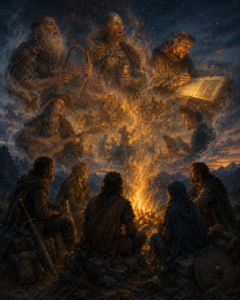 This series began by asking why fantasy continues to matter in an age of endless entertainment. The answer may have been before us all along.
Fantasy has never existed in isolation. It draws its strength from history, finds its voice through language, reaches towards mythology, and draws life from folklore. Given enough time, all of these currents converge in legend, where memory and imagination become impossible to separate.
That is why the greatest fantasy never feels detached from the real world. Instead, it feels like the continuation of something humanity has been doing for thousands of years.
The greatest legends endure not because every detail is historically certain, but because they preserve something far more lasting than certainty alone.
They preserve courage when kingdoms fall.
They preserve sacrifice when names are forgotten.
They preserve hope when history grows dark.
Long after monuments have weathered and chronicles have faded, people will still gather to tell stories. Some will speak of Arthur. Others will remember Beowulf, Cú Chulainn, Robin Hood, Ragnar Lothbrok, El Cid, or William Tell. New heroes will emerge, old stories will be retold, and every generation will leave its own mark upon the legends it inherits.
Centuries from now, those stories too may blur at their edges. Heroes will become larger than life. Forgotten roads will acquire impossible journeys. Great battles will become more glorious, more desperate, and more impossible with every telling, while names outlive the people who first carried them.
History will become memory. Memory will become legend. And legend, in time, will inspire new stories of its own.
Perhaps that has always been fantasy’s underlying purpose. Not to escape the past, but to carry it forward.
Somewhere, beside another fire in another age, someone will listen with the same wonder that has accompanied humanity since the first stories were ever told. They may never know where every tale began, or how much of it was history and how much was imagination. In the end, it will hardly matter.
Because fantasy is not an escape from history.
It is one of humanity’s oldest ways of carrying the past into the future.