Long before kingdoms were mapped, before histories were written, before libraries gathered the wisdom of nations, stories were carried in memory and firelight.
They spoke of gods who shaped the heavens, heroes who defied impossible odds, monsters that embodied humanity’s darkest fears, and journeys from which no traveller returned unchanged. We still tell those stories. Only now, we call them fantasy.
Fantasy often feels like an invention of the modern age. Shelves are lined with novels, films fill our cinemas, and sprawling fictional worlds have become cultural landmarks in their own right.
Yet the roots of the genre reach far deeper than publishing categories or literary traditions. They stretch back to humanity’s oldest stories, to the myths that every civilization has told in one form or another.
Fantasy has inherited that tradition. It does not replace mythology. Rather, mythology in fantasy remains one of the deepest foundations of the genre.
Mythology in Fantasy: The First Stories
Long before fantasy became a recognized genre, mythology shaped the stories from which it would eventually grow.
It offered worlds inhabited by divine powers, impossible creatures, sacred relics, and heroes whose courage was measured not by certainty of victory, but by their willingness to confront the unknown.
These stories were never merely entertainment. They sought to explain existence, preserve cultural memory, and wrestle with questions that remain just as compelling today.
Throughout history, people have looked beyond the ordinary world and imagined something greater.
The ancient Greeks envisioned Olympus, where immortal gods argued, loved, deceived, and intervened in the affairs of mortals. The Norse imagined Yggdrasil, the great World Tree binding together realms of gods, giants, men, and the dead. Across Celtic tradition, the boundary between this world and the Otherworld remained perilously thin, where heroes might step into lands beyond time itself. Egyptian myths explored divine kingship, death, and eternal renewal. Mesopotamian stories wrestled with flood, empire, mortality, and the limits of human ambition.
The Arthurian legends, though later than many ancient mythologies, transformed Britain into a landscape where sacred kingship, enchanted swords, prophetic figures, and impossible quests became inseparable from cultural identity.
Each tradition developed its own language of symbols and beliefs, yet beneath their differences familiar patterns emerge. Gods stand above humanity, embodying both creation and destruction. Heroes leave the safety of home to face impossible trials. Monsters guard forgotten places or represent forces that cannot simply be reasoned with. Sacred weapons become extensions of destiny itself. Prophecy hangs over lives not as certainty, but as possibility, while journeys into unknown lands become journeys into the self.
These recurring themes appear so consistently across civilizations that they begin to feel less like coincidence than reflections of something deeply human. We have always needed stories that reach beyond ordinary experience.
Perhaps this explains why mythology continues to resonate thousands of years after many of the civilizations that created it have vanished. The details may differ, but the emotional truths remain remarkably familiar. Every generation must confront fear, every life contains uncertainty, and every culture searches for meaning.
Myths gave shape to these experiences, and fantasy continues to do the same.
Why Every Civilization Created Myths
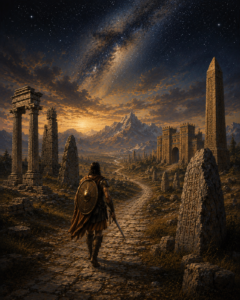 Mythology was never simply an attempt to explain the world before science. It was humanity’s first great language of meaning.
Through myth, people explored questions that have never truly disappeared. Why do we suffer? What makes a good ruler? Where do courage and sacrifice come from? What happens after death? How should we face forces greater than ourselves?
These were not abstract philosophical exercises, they were questions woven into everyday existence, transformed into stories that could be remembered, retold, and passed from one generation to the next. Myth gave shape to ideas too vast to capture through facts alone, allowing people to understand themselves through narrative rather than explanation.
That is why mythology endures. Its settings may belong to distant ages, but its concerns remain timeless. Whether the story unfolds beneath the shadow of Mount Olympus, among the halls of Asgard, along the banks of the Nile, or within the forests of ancient Britain, the emotional landscape remains recognizably human.
Fantasy inherits that same purpose. At its best, mythology in fantasy continues to ask the oldest questions we know, beneath imagined kingdoms, impossible creatures, and worlds of its own making.
Heroes, Monsters, and Sacred Things
One of mythology’s greatest gifts to fantasy is its understanding of heroism.
Modern culture often reduces heroes to invincible champions, yet mythological heroes were rarely flawless. Heracles possessed unimaginable strength but struggled against rage and guilt. Odysseus survived through cunning as much as courage. Sigurd won glory but could not escape tragedy. Cú Chulainn stood against impossible odds while knowing his fate was already written.
Their victories mattered precisely because they came at tremendous cost. Heroism was never defined by perfection, but by perseverance in the face of suffering, sacrifice, and impossible choices. This understanding echoes throughout fantasy literature.
Robert E. Howard’s Conan is not descended from Olympus, yet he shares something essential with the heroes of myth. He survives not because destiny guarantees success, but because courage, strength, instinct, and sheer determination carry him through encounters with things far older and darker than civilization itself.
Howard understood that heroism becomes meaningful when measured against genuine danger.
J.R.R. Tolkien drew even more directly from mythological traditions. Norse legend, Anglo-Saxon literature, Finnish epic, and Christian symbolism all helped shape Middle-earth, yet The Lord of the Rings never feels like a collection of borrowed myths.
Instead, Tolkien created what he called a “mythology for England,” allowing ancient patterns to emerge within an original world whose history possessed the depth and weight of genuine legend.
The greatest fantasy writers rarely retell myths outright. Instead, they absorb mythology’s rhythms, structures, and emotional truths before creating worlds that feel ancient in their own right. The result is not imitation, but continuation.
Monsters offer another powerful example. Across mythology, they are never simply obstacles waiting to be defeated. They often embody fears that societies struggled to understand. Dragons guarded impossible wealth, serpents represented chaos, giants reflected untamed nature, and the Minotaur stood at the center of a labyrinth that became both prison and psychological trial. Creatures lurking beyond the edge of the known world reminded listeners that civilization occupied only a fragile island amid vast uncertainty.
Fantasy inherited this understanding. The greatest monsters are memorable not because they are physically dangerous, but because they represent something larger than themselves. A dragon becomes greed. An ancient horror becomes forgotten history. A cursed king becomes the corruption of power. A nameless thing beneath ruined stones becomes humanity’s fear of what has been buried but never truly destroyed.
Sword & Sorcery has always excelled at this form of storytelling. Howard’s ancient gods, Clark Ashton Smith’s forgotten entities, Karl Edward Wagner’s eldritch horrors, and countless others derive much of their power from mythic thinking.
They are not merely adversaries to overcome. They remind both hero and reader that the world remains older, stranger, and more mysterious than human ambition can ever fully comprehend.
The same is true of sacred weapons and legendary relics. Throughout mythology, extraordinary objects rarely exist because they are powerful alone. Their significance lies in what they represent.
Excalibur is more than a sword; it is legitimacy, kingship, and responsibility. Mjölnir is not simply a hammer but an expression of divine authority and protection. The spear of Odin, the aegis of Athena, and the treasures sought by Gilgamesh all carry symbolic weight beyond their practical use.
Fantasy continues this tradition naturally. Readers understand that certain blades become legendary because of the hands that wield them, the sacrifices made to obtain them, or the ideals they come to represent. Relics become repositories of memory, weapons become symbols of identity, and the physical and the spiritual become inseparable.
The Journey Beyond the Known World
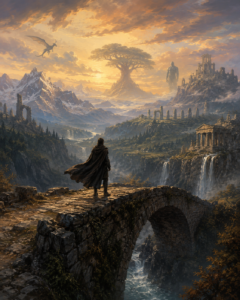 Perhaps no mythic inheritance has shaped fantasy more profoundly than the idea of the journey itself.
Again and again, mythology sends its heroes beyond familiar horizons. Sometimes the destination is a distant kingdom. Sometimes it is the realm of the dead. Sometimes it is a mountain where gods reside or an island that exists outside ordinary time.
Yet the geographical destination is only part of the story.
The true journey always changes the traveller. Every hardship strips away certainty, every trial reveals character, and every sacrifice leaves its mark. Fantasy remains devoted to this pattern because it mirrors human experience so closely.
The roads may now wind through imagined kingdoms instead of ancient Greece or Scandinavia, but readers recognize the emotional truth immediately.
Growth rarely comes through comfort, and wisdom seldom arrives without loss.
Even prophecy and destiny, so central to mythology, continue to fascinate modern fantasy for similar reasons. Ancient myths rarely present fate as a simple script that characters obediently follow. Instead, prophecy creates tension between freedom and inevitability. Characters make choices, yet those choices often become the very means through which destiny unfolds.
Fantasy repeatedly returns to this question because we still ask it ourselves. How much of life lies within our control? How much is shaped by circumstances beyond us? Can courage alter destiny, or does courage simply determine how we meet it?
These questions have never lost their relevance. They simply wear new names.
Fantasy as the Heir of Myth
The remarkable diversity of world mythology reminds us that no single civilization possesses a monopoly on wonder.
Greek myths gave us Heracles and Perseus. Norse tradition offered Odin, Thor, and Ragnarök. Celtic legends filled forests and rivers with mystery while preserving memories of heroic kings and impossible voyages.
Egypt imagined a cosmos sustained through divine order against the constant threat of chaos. Mesopotamia gave us Gilgamesh, whose search for immortality remains one of humanity’s earliest surviving literary explorations of grief and mortality.
Arthurian legend transformed history into enduring myth, where Merlin, the Grail, and the Round Table became symbols whose power far exceeds any single historical moment.
Together, these traditions reveal something extraordinary. Across continents and centuries, humanity has always imagined beyond the visible world. Separated by oceans, languages, and cultures, civilizations repeatedly arrived at stories that echoed one another in surprising ways. Different names, different landscapes, different gods — but recognizably similar hopes, fears, virtues, and questions.
Fantasy inherits not one mythology, but the entire human tradition of mythmaking. This is one reason mythology in fantasy continues to resonate across cultures and generations. Readers do not need to recognize every mythological reference consciously. They respond instinctively because these narrative patterns feel strangely familiar.
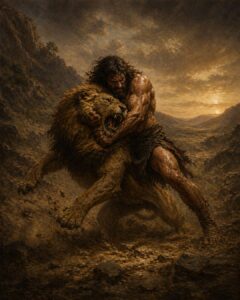 At Inferno Books, this enduring connection to mythology remains deeply inspiring. Our own Heracles of Blood & Bronze trilogy returns to one of Western literature’s oldest heroic traditions, not to reproduce the ancient myths exactly, but to explore the heroic spirit through a more grounded Bronze Age lens.
The interest has never been in recreating marble statues or idealized legends. It has been in asking why the figure of Heracles continues to endure after thousands of years, and what his struggles still reveal about strength, endurance, sacrifice, and humanity itself.
In that sense, even returning to ancient myth becomes an act of continuing the conversation rather than merely repeating it. Fantasy does not preserve myths like museum pieces behind glass.
It keeps them alive — through every new world inspired by ancient archetypes, every hero who walks into darkness, every impossible relic waiting to be found, every forgotten god sleeping beneath ruined temples, and every reader who recognizes something ancient within a story they have never read before.
These are not departures from mythology. They are evidence that mythology never truly ended.
It simply found new voices.
The Flame Never Went Out
The forms have changed. The names have changed. The worlds have changed.
But the stories continue because we continue to need them.
We still search for courage when facing uncertainty. We still wrestle with fate and free will. We still imagine monsters to give shape to our fears. We still dream of distant kingdoms where impossible choices reveal who we truly are.
Perhaps that is why fantasy remains so enduring. Not because it offers escape from reality, but because it carries forward one of humanity’s oldest traditions: using story to explore the deepest truths of being human.
The fires around which myths were once spoken have long since burned to ash.
Yet the stories endure.
And every time we open a fantasy novel, we add another spark to the flame.