There is a persistent misunderstanding surrounding Sword & Sorcery fantasy — especially among those who encounter the genre only through parody, imitation, or internet stereotypes.
To many outsiders, it appears to be little more than brute violence, hypersexual imagery, and a crude masculine power fantasy wrapped in fur, steel, and firelight.
Yet when you return to the foundations of the genre — to the stories of Robert E. Howard, the paintings of Frank Frazetta, or the mythic atmosphere of Conan the Barbarian — a far richer vision begins to emerge.
Beneath the swords and ruins, at the heart of the Sword & Sorcery tradition, is a worldview rooted in archetype, consequence, vitality, and deeply human truths — something modern fantasy often struggles to portray with sincerity: the sacred masculine and the sacred feminine.
Why True Heroic Fantasy Was Never About Exploitation
Sword & Sorcery, at its best, strips away the comforts and abstractions of civilization and asks fundamental questions about human nature.
What remains when survival is uncertain?
What kind of man emerges when power can no longer hide behind institutions?
What becomes of beauty, love, honor, temptation, and sacrifice when existence itself feels elemental?
These stories endure because they are not truly about conquest. They are about character revealed under pressure.
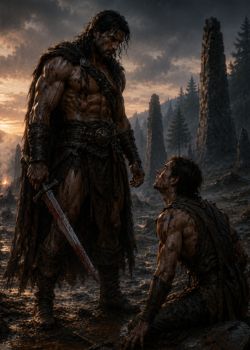 The Warrior Archetype Was Never About Cruelty
Modern discussions about masculinity often swing wildly between extremes. Strength is either glorified without restraint or treated as something inherently dangerous and suspect.
Genuine masculine virtues — courage, discipline, protectiveness, endurance — are frequently flattened into caricature.
Classic Sword & Sorcery presents a more ancient understanding of masculine power.
The true warrior archetype is not a sadist, tyrant, or predator. He is dangerous because he must be. The world he inhabits is harsh, violent, and uncertain. Yet what defines him is not violence alone, but his relationship to it.
Conan, for example, is feared because he is capable of killing. But Howard rarely portrays him as bloodthirsty for its own sake. Conan despises cowardice, treachery, corruption, and decadence far more than he enjoys violence itself. He fights because survival demands it, because freedom requires it, or because someone vulnerable stands in the shadow of something monstrous.
That distinction is essential.
The greatest Sword & Sorcery heroes are not driven primarily by domination or cruelty. They are defined by resilience, willpower, loyalty, instinct, and the refusal to submit to corruption even when surrounded by collapsing civilizations.
Violence in these stories carries moral and physical weight. Every duel risks death. Every scar means something. Combat reveals character rather than merely showcasing spectacle.
This is why grounded heroic fantasy still resonates so deeply with readers today. Beneath the action lies a longing for meaningful strength — strength tied to responsibility rather than ego.
The sacred masculine is not endless aggression. It is disciplined force guided by purpose.
It protects rather than merely consumes.
It endures hardship without collapsing into self-pity.
It carries burden willingly.
It understands restraint.
A warrior who cannot control himself is not powerful. He is unstable.
The old myths understood this instinctively. Strength divorced from wisdom eventually becomes corruption. Power without discipline becomes tyranny. Even the mightiest heroes in myth are constantly tested by pride, temptation, rage, and excess.
Sword & Sorcery works when it remembers that the true battle is never only external. The deepest conflicts are spiritual and psychological. The hero must master himself before he can confront the darkness around him.
The Feminine in Myth Was Never Hollow
Sword & Sorcery has long been criticized for its sensual imagery, and certainly the genre has never been shy about physical beauty, attraction, or erotic tension. Yet many modern critiques misunderstand the difference between sensuality and exploitation.
Howard did not write Conan as a wandering voyeur obsessed with women. In fact, Conan is surprisingly restrained compared to many modern fantasy protagonists. Most of the time he is concerned with survival, battle, kingship, escape, vengeance, or confronting ancient horrors. Attraction exists naturally within the world, but it rarely becomes the sole focus of the narrative.
The women in classic Sword & Sorcery are often queens, priestesses, pirates, rulers, assassins, mystics, witches, survivors, or temptresses. They may be seductive, but they are rarely empty.
There is gravity to them.
The feminine in myth has always represented something profound and multifaceted. Creation and destruction. Mystery and intuition. Healing and temptation. Compassion and chaos. Ancient mythologies across the world understood that feminine power was not merely decorative — it was elemental.
This is part of why the paintings of Frazetta still feel strangely alive decades later. His work radiates vitality rather than sterile commercialism. The men are powerful, but so are the women. Everything feels primal: muscle, fire, wilderness, danger, beauty, death, motion, survival.
The imagery is sensual because life itself is sensual.
Modern entertainment often struggles to portray this balance. Characters are frequently reduced to either cynical sexual spectacle or flattened into ironic, emotionally detached archetypes with no mythic depth whatsoever. In trying to avoid old excesses, many stories lose contact with the deeper symbolic truths that mythic fantasy once carried naturally.
Classic Sword & Sorcery, despite its rough edges, often possessed a strange reverence for masculine and feminine polarity. There was tension between the two energies rather than resentment between them.
That tension gave the stories vitality.
 Sensuality Is Not the Same as Commodification
One of the greatest differences between classic heroic fantasy and much modern entertainment lies in how desire is portrayed.
Sword & Sorcery traditionally treated attraction as part of human existence rather than the entire purpose of a character. Desire existed alongside danger, mortality, loyalty, ambition, and mystery. Sexuality was woven into the atmosphere of life itself rather than isolated as a commercial product.
Modern media often strips intimacy of symbolic meaning. Everything becomes immediate, explicit, disposable, and transactional.
Characters are designed to be consumed.
Human connection becomes flattened into spectacle.
Yet mythic storytelling reminds us that eros without reverence eventually becomes emptiness.
The sacred masculine loses itself when it becomes pure appetite.
The sacred feminine loses itself when it becomes performance without depth.
Neither can remain powerful when stripped of mystery, dignity, or symbolic meaning.
This is one reason older fantasy art and storytelling continue to resonate despite changing cultural tastes. Beneath the pulp surfaces lies an instinctive understanding that beauty matters precisely because it is connected to mortality, danger, longing, and the sacredness of life itself.
The old stories understood that desire becomes meaningful when intertwined with consequence.
Why Readers Are Returning to Mythic Fantasy
There is a reason so many readers are gravitating back toward grounded heroic fantasy today.
People are exhausted by irony, cynicism, and emotionally weightless storytelling. They are searching for stories that feel human again — stories where actions matter, sacrifice costs something, and strength is tied to moral responsibility rather than empty domination.
Readers want heroes who earn their destiny rather than inheriting it through prophecy. They want worlds where courage still matters. They want stories that acknowledge darkness without becoming consumed by nihilism.
Much of the enduring power of heroic fantasy stems from its connection to timeless archetypes — the same mythic patterns explored by Joseph Campbell in The Power of Myth decades ago.
Most importantly, they want archetypes that still feel alive.
The enduring power of Sword & Sorcery comes from its ability to speak to ancient truths beneath the surface of adventure. The genre explores civilization and savagery, temptation and discipline, freedom and corruption, desire and restraint. Beneath every ruined temple and bloodstained battlefield lies a meditation on what it means to remain human in a brutal world.
That is why these stories endure generation after generation.
Not because they are shallow fantasies of domination, but because they remind us of something modern storytelling often forgets:
Strength without honor becomes destruction,
beauty without meaning becomes consumption,
and power without soul eventually devours itself.